
Venture Building as a Regional Strategy for DeepTech Impact
In emerging regions, a significant portion of scientific and technological knowledge remains disconnected from the mechanisms required to become scalable companies. This gap is particularly visible in Latin America, where universities, research centers, and technical communities generate valuable capabilities, yet often lack clear pathways to translate them into market-ready solutions.
In this context, venture building can be understood as an infrastructure layer connecting science, industry, and capital with emerging and known market unmet needs.. Its role is not limited to accelerating existing startups, but rather identifying unsolved problems with commercial value, and finding technologies with potential, assessing their maturity, structuring validation pathways, assembling the right teams, and progressively reducing the technical, commercial, regulatory, and institutional risks that prevent scaling.
Unlike models focused on launching companies quickly and uniformly, venture building applied to deeptech requires a far more selective and specialized approach. Science-based technologies often face long development cycles, capital-intensive requirements, technical uncertainty, complex intellectual property processes, infrastructure dependencies, and slow industrial adoption. As a result, not every technology should immediately become a company. Some require additional research, others need real-world validation, and others depend on finding the right industrial partner or operating team before moving forward.
The value of venture building lies precisely in structuring this process. An effective model must combine scientific scouting, technical evaluation, market understanding, intellectual property strategy, team design, infrastructure access, industrial validation, policy navigation, and financing preparation. This combination allows organizations to distinguish between promising projects, technologies that remain too early-stage, and opportunities capable of becoming impactful companies.
Talent represents one of the most critical conditions. In deeptech, it is not enough to have highly skilled inventors or researchers; it also requires individuals capable of operating under uncertainty, translating scientific capabilities into value propositions, negotiating with institutions, engaging with industry, and building viable commercial pathways. The creation of hybrid teams — where technical depth, commercial vision, and operational capability coexist — remains one of the central challenges of the model.

Infrastructure also plays a decisive role. Laboratories, pilot plants, testing capabilities, industrial facilities, and real-world validation environments are necessary to reduce uncertainty and demonstrate feasibility. In regions where this infrastructure is limited, fragmented, or expensive, venture building must also function as an access orchestrator: connecting projects with testing environments, technical partners, and industrial platforms.
The capital required for deeptech cannot be understood through a single financing logic. These companies require staged financing: resources for technical maturation, early validation, intellectual property protection, industrial pilots, team formation, and scaling. Venture building therefore must coordinate patient capital, non-dilutive funding, strategic investment, public financing, and industrial participation. Financial logic should accompany progressive risk reduction rather than demand premature outcomes under traditional venture metrics.
Industrial partnerships are another essential component. In deeptech, validation rarely occurs solely through presentations or desktop analysis. It requires real operating environments, technical interlocutors, performance testing, integration with existing systems, and collaborative learning. Relationships with corporations and public infrastructure should go beyond sponsorships or procurement agreements and instead become spaces for co-development, validation, and early adoption.
Recent science-driven venture building initiatives in climate technologies also suggest that Latin America already possesses a meaningful scientific pipeline capable of generating scalable DeepTech opportunities. Programs connecting researchers, entrepreneurs, and industrial stakeholders have demonstrated that many promising climate and industrial technologies originate directly from public research institutions and national laboratories rather than from traditional startup ecosystems.
In one recent cohort focused on climate and industrial technologies, researchers from institutions such as the National Autonomous University of Mexico (UNAM), the National Polytechnic Institute (IPN), the Center for Research and Advanced Studies in Materials (CIMAV), the Scientific Research Center of Yucatán (CICY), and the Center for Research and Assistance in Technology and Design of the State of Jalisco (CIATEJ) participated with projects spanning advanced materials, industrial decarbonization, biotechnology, distributed energy systems, and climate resilience technologies. The cohort reflected a broader regional reality: much of Latin America’s deeptech potential remains concentrated within scientific institutions that historically have had limited access to commercialization pathways, industrial validation environments, and venture financing structures.
The experience also highlighted that a significant portion of these projects could evolve into opportunities relevant for specialized investors, particularly in sectors such as energy systems, advanced manufacturing, climate infrastructure, and agricultural biotechnology. More importantly, it demonstrated that the challenge in the region is not necessarily the absence of scientific capability, but the absence of coordinated systems capable of translating scientific assets into scalable industrial ventures.
From a regional perspective, the value of venture building extends far beyond the creation of individual companies. Its broader contribution is the development of repeatable capabilities: stronger technology identification mechanisms, improved transfer processes, closer science-industry collaboration, entrepreneurial talent formation, clearer financing pathways, and portfolios of opportunities with long-term strategic relevance. In that sense, venture building does not simply produce startups; it strengthens the ecosystem conditions that make DeepTech entrepreneurship possible.
At the same time, implementation requires realism. Deeptech venture building is expensive, slow, and operationally complex. It requires institutional coordination, disciplined selection criteria, specialized leadership, the ability to reject projects, tolerance for uncertainty, and a long-term perspective. Applied incorrectly as a conventional startup accelerator, it risks forcing immature technologies into premature commercialization, creating companies without execution capacity, or generating expectations misaligned with actual development timelines.
Its greatest relevance emerges in sectors where challenges are structural and opportunities for impact are significant: energy transition, resilient infrastructure, biotechnology, advanced manufacturing, materials, water, food systems, health, and climate industry. In these areas, Latin America has the potential to build meaningful competitive advantages if it succeeds in connecting scientific capabilities with industrial demand and appropriate scaling mechanisms.
Understood in this way, venture building is a long-term strategy and methodology transforming scientific knowledge into impact. Its success depends less on replicating external models and more on building local conditions: hybrid talent, shared infrastructure, risk-aligned capital, flexible intellectual property frameworks, industrial partnerships, and disciplined maturation processes. For Latin America, its potential lies in converting fragmented scientific capabilities into scalable industrial platforms capable of solving complex problems while generating sustainable regional advantages.
At Activae, we believe that building strong deeptech ecosystems requires more than capital or isolated innovation initiatives. It requires structured

mechanisms capable of connecting scientific talent, industrial challenges, strategic partners, and long-term financing into coherent pathways for technology maturation and deployment. We recognize the importance of venture building as a strategic infrastructure for transforming the region. Through our work, we support organizations, institutions, and partners interested in designing and developing venture building programs tailored to deeptech realities — helping structure pipelines, connect stakeholders, identify high-potential opportunities, and create the conditions necessary for science-based ventures to emerge and scale sustainably.
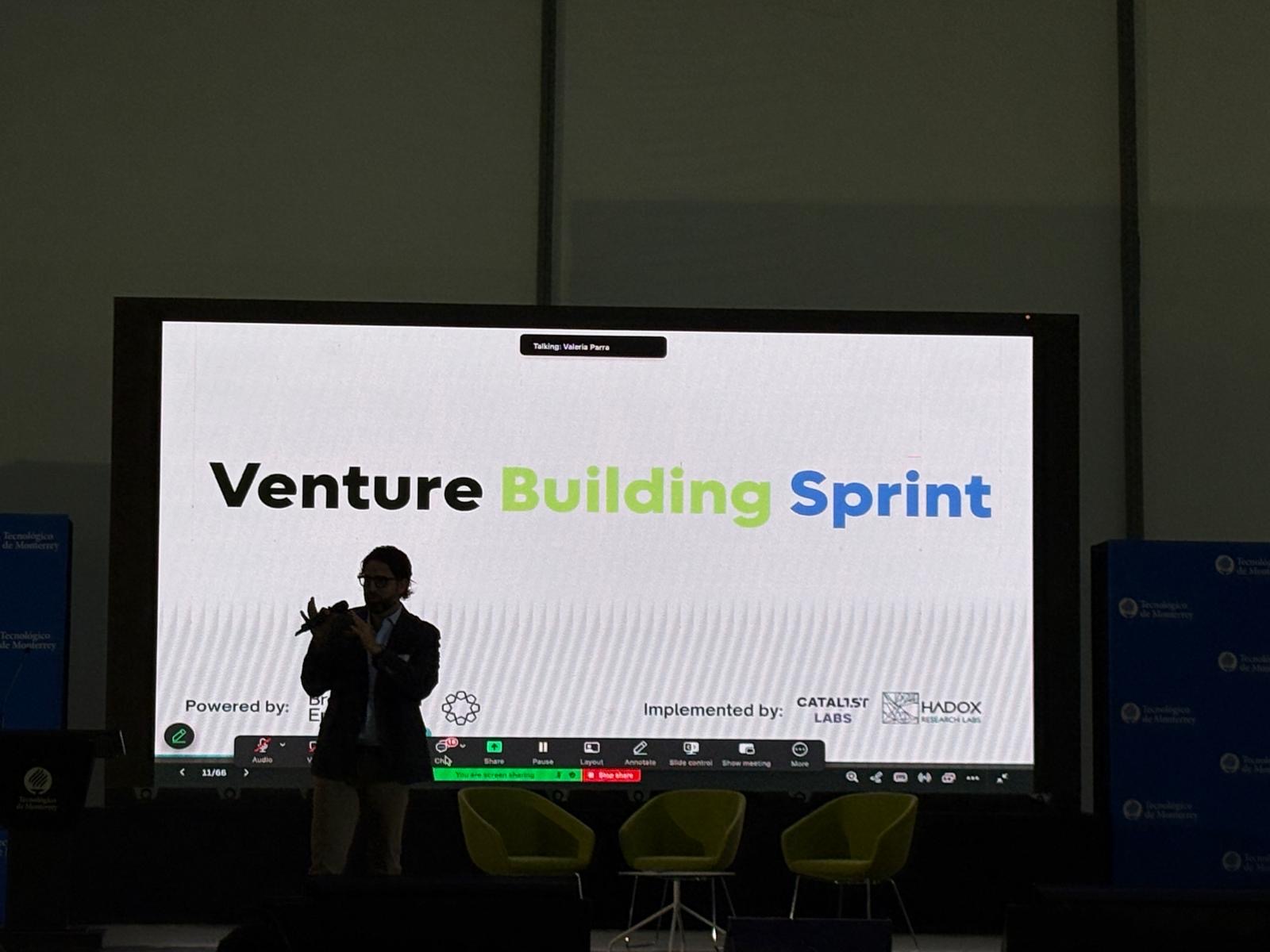
And more importantly, Venture Building is a collective effort where a whole ecosystem is needed, the work done with Breakthrough Energy in the Venture Building Sprint in February could not have happened without the collaborative work of several organizations. Mapping the scientific capabilities and understanding the barriers scientists face in Mexico was an instrumental piece of the work we did with Nodo Guanajuato and Hadox. Our collaboration will continue to transform the region, and if you want to be engaged, please contact by email, we are interested in growing the ecosystem.
Special acknowledgment to Eva and Edgar for their collaboration and thoughtful review of this article, as well as for contributing valuable insights and expertise that helped shape its development.
Contact Info:
Edgar Antonio Valdés Porras | Eva Guadalupe Hernández Avilez
Authors

Maria Lozoya
Associate emerging technologies

Diego Santamaria Razo
Managing Director
Related Posts

ClimateTech: Understanding a Growing Ecosystem of Industrial Innovation
ClimateTech has emerged as one of the most dynamic areas…

Building flexible mobility system is a must. Let’s start today.
Climate-resilient transport infrastructure depends on how effectively existing systems can…

The Future of Mobility Depends on Climate Resilience
Modern transport infrastructure for decades was designed under an assumption…