
Deep Diving into Industrial Processes and Manufacturing
How clean heat, electrification, hydrogen, alternative chemistries, and carbon management are reshaping industrial production.
Within the ClimaTech landscape, Industrial Processes and Manufacturing examines the systems that transform energy and raw materials into the products, components and infrastructure used throughout the economy. These are environments where scientific principles, engineering constraints and commercial requirements must operate simultaneously, often under demanding conditions of temperature, pressure, throughput, safety and material performance, which means that transforming industrial production requires much more than replacing one technology with another.
Within the ClimaTech landscape, Industrial Processes and Manufacturing examines the systems that transform energy and raw materials into the products, components and infrastructure used throughout the economy. These are environments where scientific principles, engineering constraints and commercial requirements must operate simultaneously, often under demanding conditions of temperature, pressure, throughput, safety and material performance, which means that transforming industrial production requires much more than replacing one technology with another.
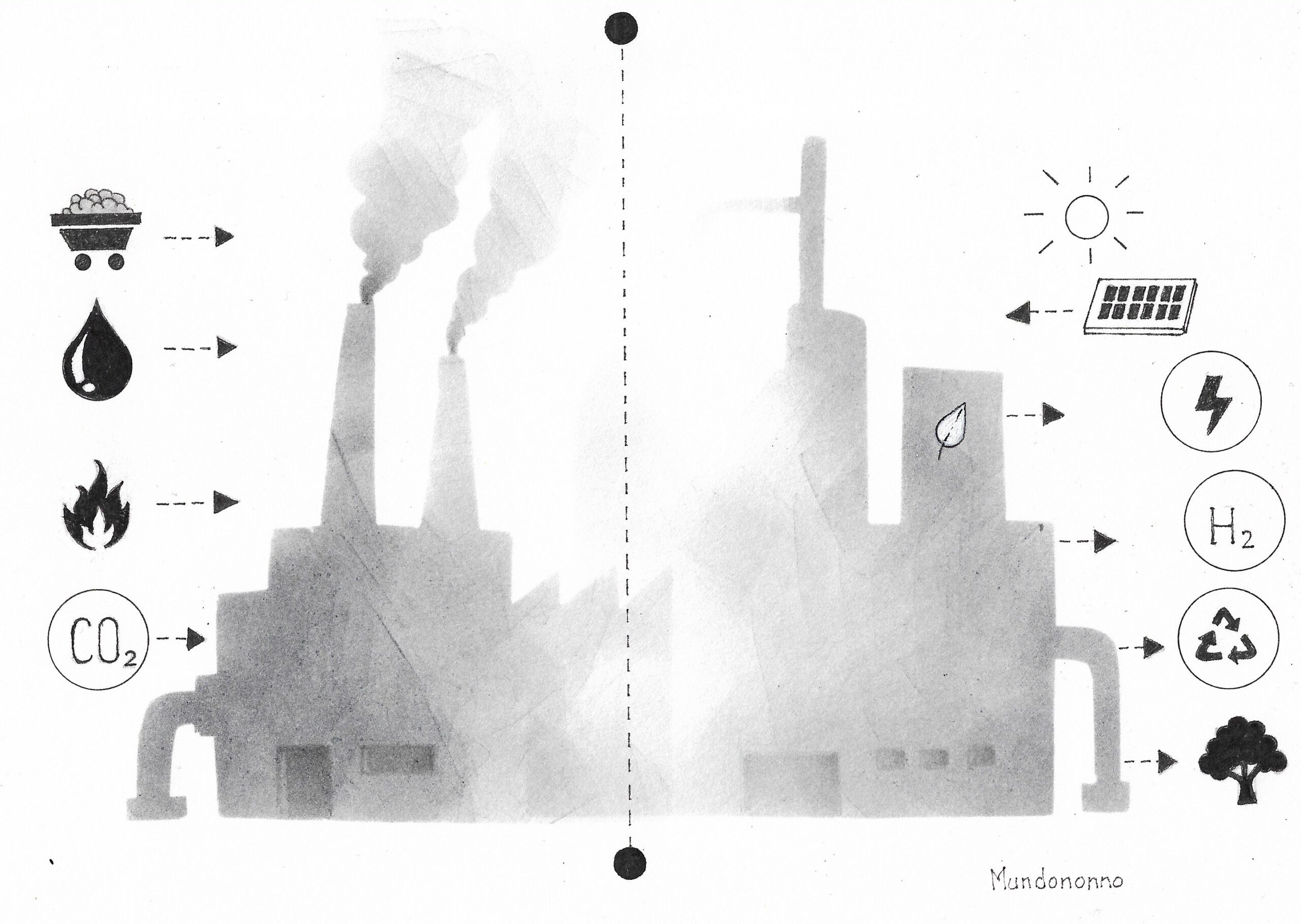
From Resource Consumption to Sustainable Production
Industry must rethink how it consumes energy and materials to keep producing, innovating and growing sustainably.
Industrial activity shapes emissions through the energy required to generate heat and operate equipment, the greenhouse gases released by certain chemical reactions, the use of fossil resources as production inputs and the material losses that increase demand for primary production. For this reason, the IPCC (Intergovernmental Panel on Climate Change) approaches industrial transformation as an interconnected challenge involving energy, production processes, material demand, resource efficiency and circularity, all of which influence the capacity of industry to reduce its environmental impact while continuing to meet society’s material needs.[1]
Its relevance extends beyond the emissions generated inside factories because progress across the wider ClimaTech landscape depends on the ability to manufacture emerging technologies at sufficient scale, quality and cost. Renewable-energy systems, energy storage, low-carbon mobility, resilient infrastructure and environmental technologies are all shaped by the materials they use, the energy embedded in their production, the resilience of their supply chains and the capacity of manufacturers to expand without reproducing the same resource and emissions pressures they are intended to address.
Industrial transformation has consequently become a question of competitiveness as well as climate action, particularly as energy costs, access to strategic materials, supply-chain concentration, carbon requirements and customer expectations reshape the conditions under which companies produce and compete. Manufacturing systems that can use resources more efficiently, adapt to new inputs and integrate emerging technologies may strengthen operational resilience while opening access to developing markets, which is why the IEA (International Energy Agency)increasingly positions manufacturing at the intersection of climate, energy and economic policy. [2]
This intersection creates opportunities for scientific development, venture creation and investment wherever production systems consume excessive energy, lose valuable materials, depend on vulnerable inputs, struggle to meet new performance requirements or lack the infrastructure needed to adopt a better process. Understanding those possibilities requires looking beyond individual technologies and examining how complete industrial systems create value, manage constraints and connect with the rest of the ClimaTech landscape, beginning with a clearer definition of what this family covers.
What Industrial Processes and Manufacturing Covers
Its scope extends across the complete production environment, from the reactions and equipment operating inside a facility to the material flows, digital systems and external infrastructure that allow production to continue safely, consistently and at commercial scale. This makes it a particularly interconnected ClimaTech family, since opportunities may emerge through changes to the process itself, the resources it consumes, the way operations are controlled or the relationships between facilities and their surrounding industrial ecosystems.
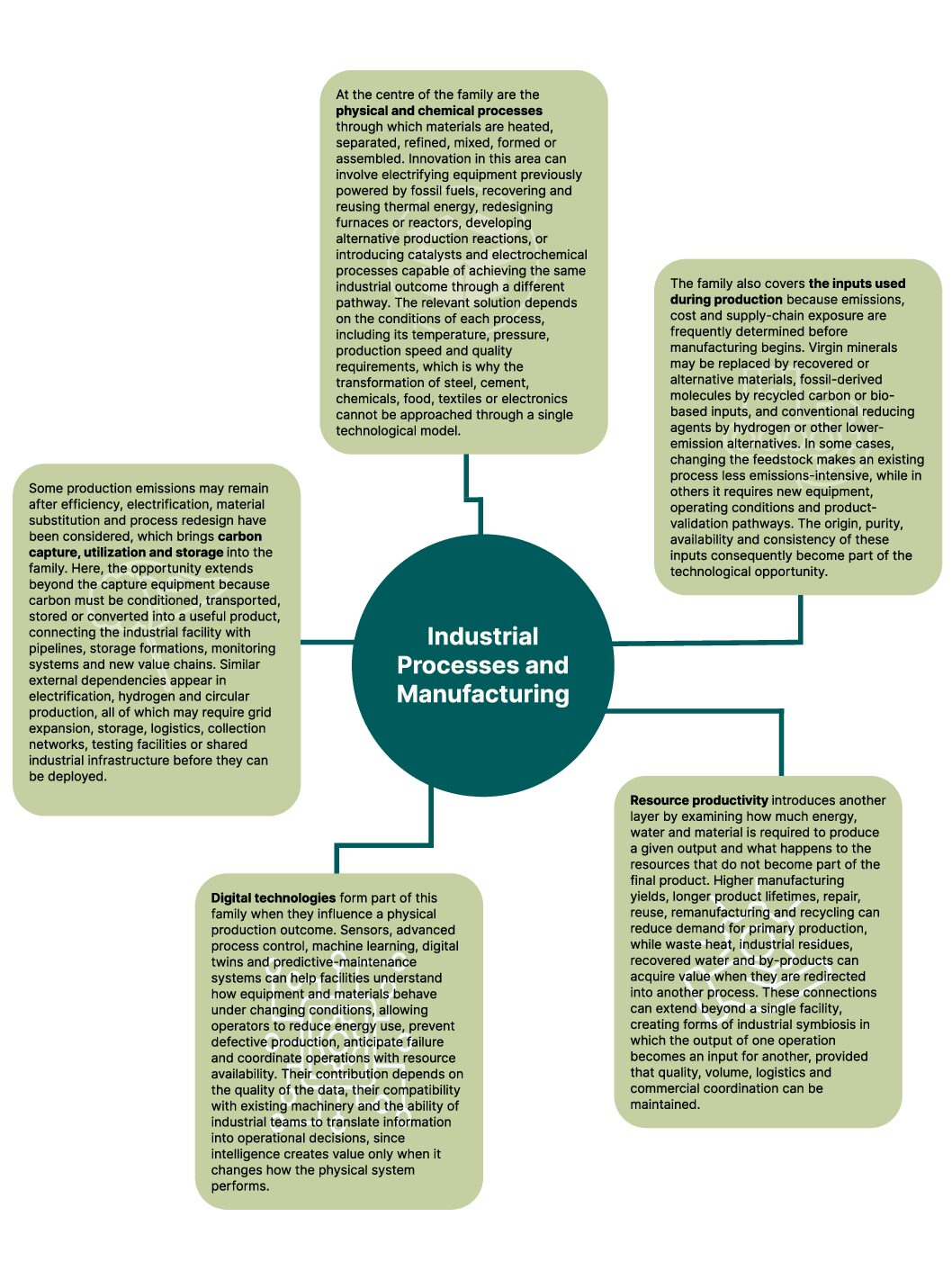
These areas are commonly grouped in different ways depending on the institution and analytical purpose. The U.S. Department of Energy emphasizes energy efficiency, industrial electrification, low-carbon fuels and feedstocks, and carbon capture, utilization and storage, while the IPCC expands the view to include material demand, material efficiency, circularity and the interactions among strategies. Together, these perspectives show that industrial transformation involves the decarbonization of production and the reconfiguration of the material and resource systems surrounding it.[3]
The boundaries of this family therefore intersect with energy, advanced materials, carbon management, water, the built environment, mobility and circular systems. What distinguishes the industrial perspective is the point at which the analysis begins: the production system and the conditions required to transform inputs into reliable outputs. Understanding that scope makes it possible to examine the scale of the family’s economic and environmental influence, which extends across industrial emissions, resource demand and the capacity to manufacture the technologies supporting the wider climate transition.
The Scale of Its Impact
The importance of this family begins with the scale of the industrial system itself. When emissions from purchased electricity and heat are included, industry was responsible for approximately 20 GtCO₂-eq in 2019, equivalent to 34% of global greenhouse gas emissions, while industrial emissions have grown faster since 2000 than those of any other sector. These figures reflect an economy that depends on continuously producing steel, cement, chemicals, plastics and other essential materials, making industrial transformation one of the largest opportunities for meaningful emissions reduction.[1]
Demand for these materials will continue as cities expand, infrastructure is renewed and clean-energy systems are deployed. Global steel demand alone is projected to increase by more than one-third by 2050, which means that reducing production cannot serve as the principal strategy; new scientific and technological approaches must allow industry to meet growing material needs with lower energy, resource and carbon intensity.[4]
The distance between technical possibility and deployment also reveals the size of the opportunity. Announced primary near-zero-emission steel projects expected by 2030 represent around 10 million tonnes of capacity, compared with the more than 100 million tonnes required to remain aligned with a net-zero pathway. Closing gaps of this magnitude will require advances in technology alongside manufacturing capacity, infrastructure, financing, industrial partnerships and market demand, positioning this family as a critical area for ventures, investors and organizations seeking to shape the next generation of industrial systems.[5]
Scientific and Technological Approaches
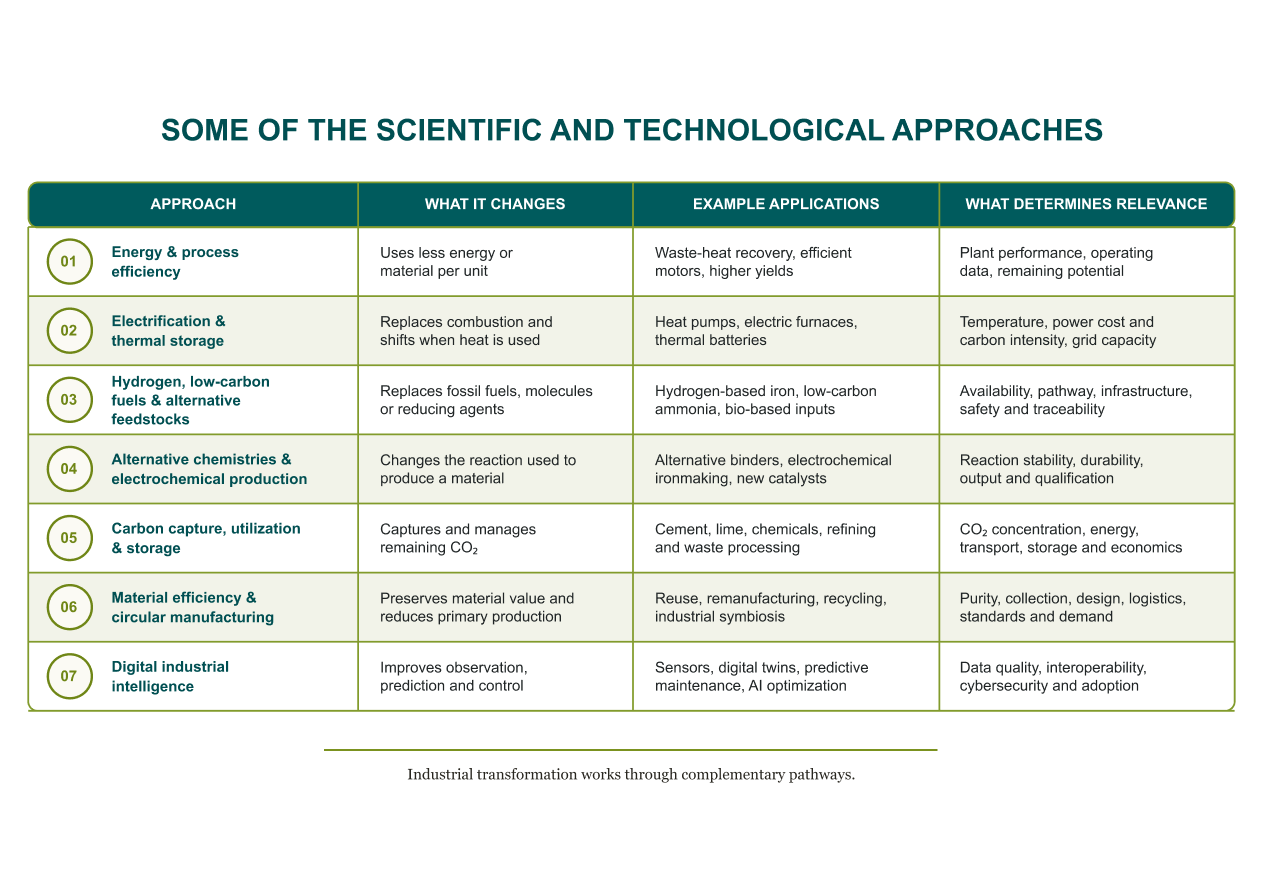
Industrial transformation cannot follow a single technological pathway because emissions originate from different parts of the production system and each process operates under its own chemical, thermal and material constraints. The most relevant approach may reduce the resources required, replace the source of energy, alter the production reaction, recover materials that would otherwise be lost or manage emissions that remain unavoidable. The U.S. Department of Energy organizes industrial decarbonization around efficiency, electrification, low-carbon fuels and feedstocks, and carbon management, while the IPCC also emphasizes material efficiency, circularity and changes in demand, demonstrating that these approaches work across different yet interconnected layers of the industrial system. [3]
Startups Translating These Approaches into Industrial Solutions
These approaches are already being advanced by startups and scale-ups across different industrial regions. The following examples are illustrative rather than exhaustive, and several companies operate across more than one technological category.
Energy and process efficiency
HEATEN
(Norway)
Develops high-temperature heat pumps that recover industrial waste heat and return it as process steam or hot water.
Wankel Energy Systems
(India)
Converts energy normally lost when industrial steam pressure is reduced into usable electricity.
Exergyn
(Ireland)
Develops solid-state heating and cooling technology based on shape-memory alloys, avoiding conventional refrigerants.
Electrification and thermal storage
Rondo Energy
(United States)
Stores intermittent renewable electricity as high-temperature heat for continuous industrial operations.
Wankel Energy Systems
(India)
Converts energy normally lost when industrial steam pressure is reduced into usable electricity.
MGA Thermal
(Australia)
Uses miscibility-gap alloy blocks to store renewable energy and deliver industrial heat, steam or electricity when required.
Hydrogen, low-carbon fuels and alternative feedstocks
Hysata
(Australia)
Develops capillary-fed electrolysers designed to reduce the electricity required to produce green hydrogen.
H2Pro
(Israel) Uses decoupled, membraneless water electrolysis to produce hydrogen under variable renewable-power conditions.
HiiROC
(United Kingdom)
Applies thermal plasma electrolysis to produce hydrogen from hydrocarbons while generating solid carbon rather than gaseous CO₂.
Alternative chemistries and electrochemical production
Sublime Systems
(United States)
Uses an electrochemical process to produce cement without conventional fossil-fuelled kilns.
Boston Metal
(United States and Brazil)
Uses molten oxide electrolysis to convert metal oxides into liquid metal using electricity instead of carbon.
Cemvision
(Sweden)
Produces low-carbon cement using industrial by-products, alternative formulations and electrified production.
Carbon capture, utilization and storage
Carbon Clean
(United Kingdom and India)
Develops modular point-source carbon-capture systems for cement, steel, refining and other hard-to-abate industries.
Svante
(Canada)
Manufactures solid-sorbent filters designed to capture CO₂ from industrial flue-gas streams.
Mantel
(United States)
Uses molten borate salts to capture CO₂ at the high temperatures found inside boilers, kilns and furnaces.
Material efficiency and circular manufacturing
Samsara Eco
(Australia)
Uses AI-designed enzymes to break plastics and synthetic textiles into monomers that can return to production.
Kubik
(Ethiopia)
Converts difficult-to-recycle plastic waste into low-carbon building materials.
Polybion
(Mexico)
Uses agro-industrial fruit waste as feedstock for bacterial fermentation, producing cultivated cellulose for material applications.
Digital industrial intelligence
TRACTIAN
(Brazil)
Combines industrial sensors, AI and asset-management software to detect equipment failures and reduce unplanned downtime.
Ethon
(Switzerland)
Applies industrial AI to identify process variation, quality losses and opportunities to optimize production.
Nanoprecise
(Canada)
Uses multidimensional sensing and AI-based predictive maintenance to improve equipment reliability and energy performance.
Together, these examples demonstrate that industrial climate innovation is emerging through different combinations of materials science, thermodynamics, electrochemistry, biotechnology, equipment engineering and digital intelligence. They also show that the same technological approach can respond to very different industrial conditions depending on regional infrastructure, available feedstocks, manufacturing capabilities and market demand.
How These Approaches Should Influence Technology Analysis
Identifying the technological approach is only the starting point of an analysis because solutions within the same category can differ significantly in performance, infrastructure requirements and commercial viability. An industrial technology must therefore be evaluated in relation to the specific process it intends to transform, the incumbent alternative it must outperform and the conditions under which a customer would adopt it.
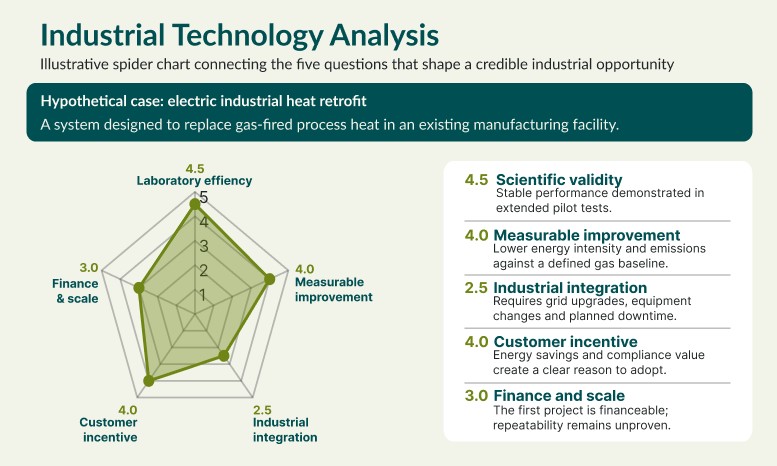
Illustrative output from the Activae Technology Assessment process.
The first question is if the scientific principle can generate a meaningful advantage under industrial conditions. Laboratory efficiency or emissions reductions may change once the technology must operate continuously, process variable inputs, maintain product quality and comply with safety requirements. Its impact must also be measured against a clearly defined baseline, considering the energy source, feedstock origin, material losses and any emissions transferred to another stage of the value chain.
Analysis must then move beyond the technology itself to examine integration. A solution may require modifications to existing equipment, new grid connections, hydrogen or CO₂ infrastructure, specialized suppliers, customer qualification or planned production shutdowns. These dependencies influence where deployment can begin, how quickly it can scale and whether the technology is suitable for retrofitting existing facilities or depends on newly built industrial capacity.
Commercial potential is similarly shaped by the value created for the customer. Emissions reduction may be important, but adoption can also depend on energy savings, productivity, reliability, access to regulated markets, supply-chain resilience or improved product performance. Capital requirements, operating costs, financing timelines and the availability of strategic partners must be assessed alongside those benefits to determine whether the proposed advantage is sufficient to support implementation.
A credible analysis should ultimately connect five questions: Does the science work? Does it create a measurable improvement over the current process? Can it operate and integrate under industrial conditions? Is there a customer with enough incentive to adopt it? Can the solution be financed and repeated at scale? Examining these questions together makes it possible to distinguish a promising scientific development from an industrial opportunity with a plausible pathway toward adoption.
How These Approaches Should Influence Technology Analysis
Identifying the technological approach is only the starting point of an analysis because solutions within the same category can differ significantly in performance, infrastructure requirements and commercial viability. An industrial technology must therefore be evaluated in relation to the specific process it intends to transform, the incumbent alternative it must outperform and the conditions under which a customer would adopt it.
Activae contributes to this process through a structured assessment that connects scientific and technological potential with unmet industrial needs, market conditions, adoption requirements, regulatory frameworks and investment logic. By examining scientific relevance, measurable improvement, technical implementability, scalability, financial viability and market acceptance, we determine whether a technology can answer these questions together as a credible industrial opportunity. Through technology and market intelligence, readiness assessment, commercialization strategy and investment analysis, we help founders and other stakeholders identify what is already credible, what still requires validation and which technical, commercial or systemic dependencies must be addressed to build a viable pathway from scientific possibility to industrial implementation.
References
[1] Intergovernmental Panel on Climate Change (IPCC), 2022. “Industry,” in Climate Change 2022: Mitigation of Climate Change. Cambridge University Press.
[2] International Energy Agency (IEA), 2024. Advancing Clean Technology Manufacturing. Paris: IEA.
[3] U.S. Department of Energy (DOE), 2022. Industrial Decarbonization Roadmap: Fact Sheet. Washington, D.C.: DOE.
[4] International Energy Agency (IEA), 2020. Iron and Steel Technology Roadmap: Towards More Sustainable Steelmaking. Paris: IEA.
[5] International Energy Agency (IEA), 2024. “Steel,” in Breakthrough Agenda Report 2024. Paris: IEA.
Authors

Maria Lozoya
Associate emerging technologies

Diego Santamaria Razo
Managing Director
Related Posts

The interaction between microorganisms, soil, and crops
How microbial technologies support crop nutrition and what determines their…

Water stress in agriculture
Water constraints affect agricultural decisions well before a crop shows…
The resources behind a resilient city
Consider a city preparing for hotter, drier summers. Its water…