
The interaction between microorganisms, soil, and crops
How microbial technologies support crop nutrition and what determines their performance in the field.

The opportunity beneath the surface
A field can contain phosphorus reserves that remain difficult for a crop to access. Fertilizer can supply additional nutrients while physical restrictions limit the roots’ ability to reach them. These situations illustrate an important distinction in agricultural productivity: the nutrients present in a field and those acquired by the crop are connected through chemical, physical, and biological processes. Understanding those processes creates opportunities to improve the return on agricultural inputs.
Microorganisms participate in this connection. Certain bacteria convert atmospheric nitrogen into forms that plants can use; others help mobilize phosphorus from less available sources. Mycorrhizal fungi establish associations with roots, extending the volume of soil from which plants can acquire nutrients. These functions provide several routes for supporting crop nutrition, each with different requirements and potential applications.
The crop also influences these interactions. Roots release compounds into the surrounding soil, helping shape the microbial communities that develop nearby. Research in rice, for example, has shown how changes in root-released organic acids can encourage the recruitment of particular bacteria and improve phosphorus uptake under experimental conditions. This illustrates a relationship in which plant characteristics, microbial activity, and nutrient availability influence one another. It also provides a scientific basis for developing solutions matched to specific crops and growing conditions.
Soil condition helps determine how these relationships function. Compaction can restrict root growth and nutrient acquisition, while nutrient depletion changes the resources available to support production. Soil degradation therefore matters both as a constraint on agricultural performance and as context for selecting an intervention. A useful diagnosis identifies the particular limitation affecting the crop and the processes through which it could be addressed.
Microbial technologies offer ways to intervene in these processes through selected organisms delivered as agricultural products. Their potential rests on connecting a biological function with a defined agronomic need. A global meta-analysis drawing on 171 publications found improvements in crop yield and nitrogen and phosphorus use efficiency following biofertilizer application, with responses varying according to climate, soil phosphorus availability, and other soil characteristics. The findings support an approach that treats the microorganism, the soil, and the crop as interacting determinants of performance.
For technology developers, this creates opportunities across strain selection, formulation, manufacturing, and application. For growers, the relevant outcomes include nutrient uptake, crop performance, input requirements, and the cost of incorporating a product into existing practices. Evaluating the opportunity requires connecting those outcomes: identifying which microbial function addresses a measurable constraint, establishing the conditions in which it delivers results, and determining whether the benefits justify adoption.
How microbial technologies support crop nutrition
To understand microbial technologies, it is useful to examine the biological functions they target and the experiments used to demonstrate them. The following examples distinguish the mechanism investigated, the organism and crop involved, and the conditions under which the reported result was obtained.
Biological nitrogen fixation: connecting microbial activity with crop uptake
Nitrogen-fixing bacteria use the enzyme complex nitrogenase to convert atmospheric nitrogen into ammonia. Bacterial regulatory pathways control both this activity and the assimilation of the resulting ammonia into microbial biomass. These pathways are described in the introduction to Haskett et al.’s study of Azorhizobium caulinodans. [1]
In their experiments, the researchers engineered coordinated control of nitrogen fixation and ammonia release in this bacterium using the signalling molecule rhizopine under laboratory conditions. The result demonstrates a route for regulating two processes relevant to nitrogen delivery: producing fixed nitrogen and releasing it from the bacterial cell. [1]
Crop acquisition requires a further connection between bacterial activity and plant nutrition. Martinez-Feria et al. investigated this connection using specific gene-edited strains of Klebsiella variicola and Kosakonia sacchari in maize. Their isotope-tracer field experiments estimated an average contribution of 21 kg N/ha to plants by the VT–R1 growth stages under the tested conditions. [2]
For technology assessment, these experiments address different questions. The first examines control of microbial nitrogen production and release. The second measures a contribution to crop nitrogen acquisition. This distinction helps define the evidence required as a technology moves from biological function to agricultural application.
Phosphorus mobilization: releasing nutrients from specific sources
Microorganisms can affect phosphorus availability through different processes. One is solubilization, in which poorly soluble inorganic phosphorus becomes more accessible.
Alzate Zuluaga et al. investigated this process using Enterobacter sp. strain 15S and tricalcium phosphate. In laboratory culture, the bacterium released several organic acids alongside phosphate solubilization. [3]
The researchers subsequently tested bacterial inoculation and individual organic acids in a controlled cucumber cultivation system. Their nutrient analysis reported improved phosphorus nutrition in selected treatments relative to the phosphorus-starved control. Figure 4 presents the allocation of nutrients in roots and shoots. This finding applies to the bacterium, phosphorus source, crop, and experimental conditions examined. [3]
A second process is mineralization, through which enzymes release phosphate from organic compounds. Kaur and Reddy discuss this pathway in relation to phosphatase and phytase activity. Their biochemical characterization identified these activities in selected bacterial isolates. [4]
In a subsequent organic maize field experiment, inoculation with the selected isolates increased phosphorus uptake and crop yield relative to the study’s uninoculated treatments. The isolates expressed several traits, including phosphate solubilization, enzyme activity, and production of indole acetic acid and siderophores. The field result therefore represents the performance of these multifunctional strains. [4]
Mycorrhizal associations: establishing a functional exchange
Arbuscular mycorrhizal associations involve nutrient exchange between a fungus and its host plant. Javot et al. investigated the plant side of phosphorus acquisition in Medicago truncatula. They demonstrated that loss of function of the phosphate transporter MtPT4 impaired acquisition of fungus-delivered phosphate and caused premature degeneration of the fungal arbuscules inside roots. [5]
The carbon supplied by the plant has also been investigated experimentally. Luginbuehl et al. demonstrated the transfer of plant-produced lipids to arbuscular mycorrhizal fungi and identified components of the plant pathway required for that transfer. Their findings establish a specific contribution of the host to the association. [6]
Fungal exploration of the surrounding soil provides another component of the interaction. Liu et al. used a compartmentalized maize cultivation experiment in which fungal hyphae could cross a mesh barrier into soil inaccessible to roots. The authors reported that this access supported plant phosphorus acquisition. This was a controlled experimental system. [7]
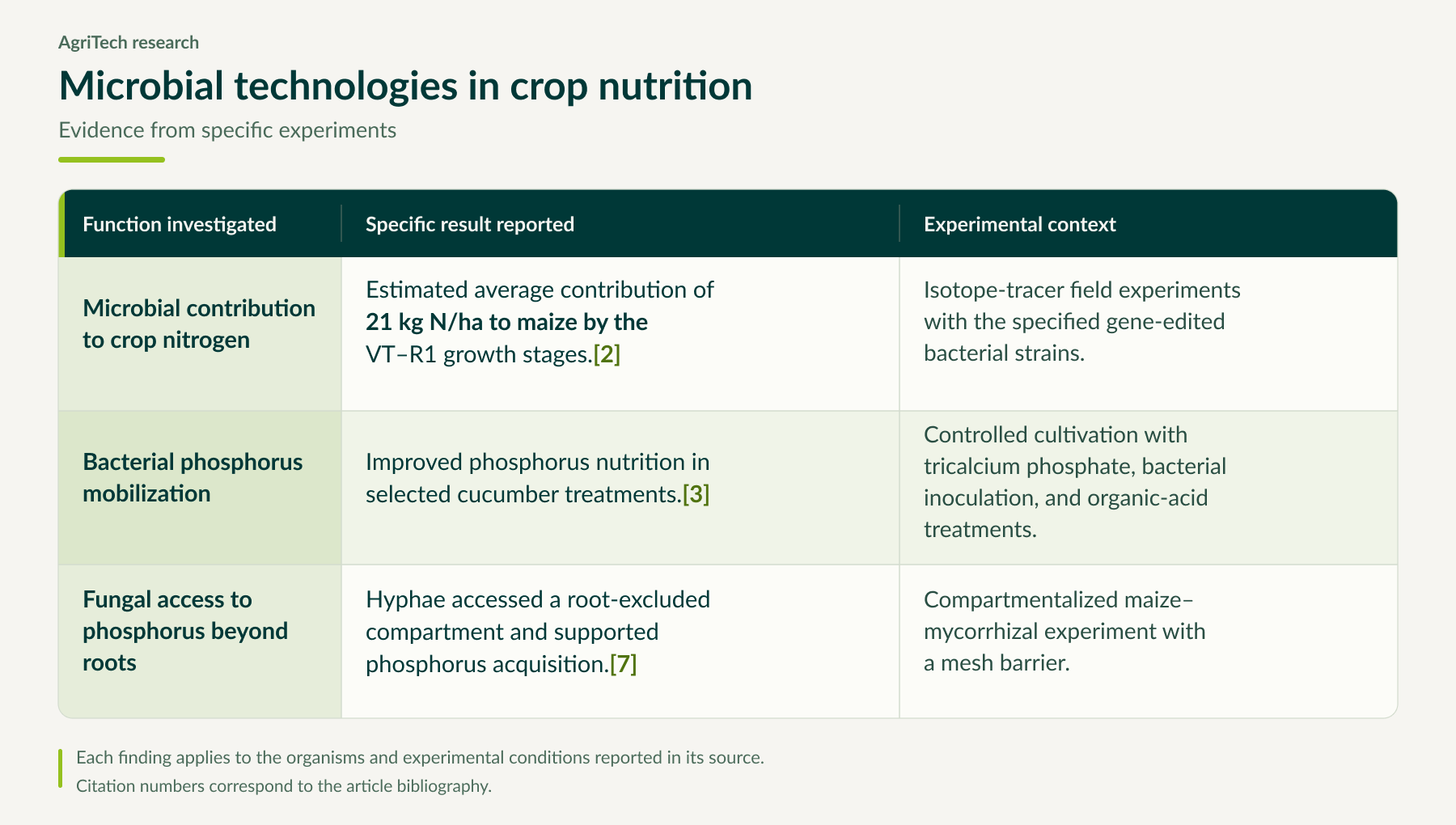
Each row summarizes the specified study and its experimental scope.
For evaluating agricultural applications, these studies suggest three practical questions: which biological process is being targeted, what evidence connects it to crop nutrition, and how closely the experimental conditions match the intended use. These questions provide the analytical framework used in this article.
Matching biology to field conditions
Evaluating a microbial technology requires connecting its biological function with a defined agricultural use: a particular crop, field condition, and application protocol. The studies below illustrate three aspects of this assessment: selecting suitable fields, preserving the organism during storage, and integrating application into existing farming practices.
Identifying where an intervention can deliver value
Lutz et al. tested the arbuscular mycorrhizal fungus Rhizoglomus irregulare SAF22 in 54 maize fields in Switzerland. Responses in maize growth ranged from −12% to +40%, with statistically significant positive responses in 14 fields. These results were measured within the study’s field experiments, demonstrating different outcomes from the same fungal inoculation across locations. [8]
The researchers also examined whether information collected before inoculation could help explain those differences. In their predictive models, the selected soil fungal indicators contributed more explanatory information than the selected physical, chemical, and biological soil parameters, as reported in Figure 5. This was a proof-of-concept developed for the crop and geographical setting examined. [8]
For technology development, this finding supports investigating diagnostic tools that help identify suitable applications before a product is deployed. The commercial opportunity includes connecting an inoculant with information about the conditions in which it is likely to provide value.
Nutrient availability provides another basis for matching. In a meta-analysis of 171 publications, Schütz et al. found that arbuscular mycorrhizal fungi and phosphorus-solubilizing microorganisms showed their highest yield responses in different categories of initial soil phosphorus availability. Figure 5 presents these responses separately for the microbial groups. [9]
Our interpretation is that product selection should begin with a defined nutritional constraint. A phosphorus-mobilizing product, for example, needs an application strategy informed by the phosphorus resources present and the crop’s access to them.
Preserving the organism through storage and delivery
Formulation can determine how many viable microorganisms remain available for application. Arbaugh et al. investigated this aspect using Klebsiella variicola encapsulated in a spray-dried, cross-linked alginate matrix. Under the tested conditions, encapsulation maintained bacterial viability on bare maize seeds for more than three months during storage. [10]
This result addresses a product-development requirement: maintaining the organism between seed coating and use. For commercial assessment, storage stability and agronomic performance should be measured separately. The former establishes whether a formulation preserves the microorganism; the latter determines what the delivered organism contributes to the crop.
Designing application protocols around farm operations
Sandini et al. investigated pre-inoculation of soybean seeds with Bradyrhizobium elkanii, including combinations with fungicide and insecticide treatments. Their HiCoat treatment combined peat inoculant, liquid inoculant, and a polymer. In the bacterial-survival experiment, this treatment maintained more than 2 × 10⁶ colony-forming units per seed at 60 days, including the tested chemical-treatment combination. Figure 1 reports the survival results. [11]
The development implication is specific: compatibility should be evaluated for the complete application protocol, including formulation, accompanying treatments, and the interval before sowing. A protocol validated for one combination provides a starting point for testing other intended uses.
For developers and agricultural partners, this matching process creates a practical agenda: define the target use, characterize the relevant field conditions, preserve the biological function through delivery, and measure the resulting crop response. This provides a clearer basis for designing products that fit agricultural operations and for identifying where further development can improve their value.
Engineering more reliable microbial products
The conditions discussed above create specific opportunities for technology development. Microbial selection, trait optimization, protective formulations, and delivery methods provide different ways to connect a biological function with an agricultural application. Each approach addresses a distinct development task and requires evidence appropriate to that task.
Selecting organisms that function together
One development route is to select combinations of microorganisms through experiments that examine their compatibility, persistence, and effects on the plant.
Wang et al. started with 23 previously characterized rice-associated bacterial strains and used laboratory and plant experiments to identify combinations capable of coexisting and colonizing rice. Their selection process incorporated microbial traits, compatibility tests, and genomic information. [12]
In controlled rice experiments, two selected five-strain consortia increased shoot dry biomass after 40 days compared with the uninoculated control. Figure 5B reports this result for consortia A and G. [12]
The development opportunity is to build defined combinations around experimentally demonstrated interactions. For commercial assessment, the composition of the consortium and the conditions supporting its activity become part of the product specification.
Optimizing the traits responsible for nutrient delivery
Genetic tools provide another route: modifying the regulation of a microbial function relevant to crop nutrition.
In the maize-associated bacteria examined by Martinez-Feria et al., the researchers edited the nifLA regulatory region and the glnD and glnE genes to influence nitrogenase activity and ammonium release. The modifications are described in Figure 1 and the laboratory methods. [2]
In laboratory assays containing added ammonium, the edited strains retained nitrogenase activity, while the corresponding wild-type strains showed activity only in nitrogen-free conditions. Figure 2A presents that comparison. [2]
This approach targets a defined physiological constraint. Its development value depends on connecting the modified trait with microbial establishment, nutrient transfer, and crop performance under the intended conditions of use.
Designing formulations around biological stability
Formulation development offers a complementary opportunity to improve the product’s physical handling and preservation.
In the encapsulation system investigated by Arbaugh et al., adding trehalose together with maltodextrin improved the ambient-storage stability of Klebsiella variicola in cross-linked alginate powder. Maltodextrin alone had a limited effect in the tested formulations. [10]
For product development, this comparison makes the choice of formulation ingredients an experimentally testable design decision. Relevant targets can include maintaining viable cells during processing, preserving them through storage, and delivering the intended dose at application. These targets can be evaluated alongside the manufacturing cost and handling requirements of the resulting formulation.

Developing new routes into the crop
Delivery technology can also change when and where a microorganism is introduced.
Mitter et al. investigated applying Paraburkholderia phytofirmans PsJN during flowering to introduce the bacterium into developing seeds. In their wheat field experiment, 21 of 24 harvested seeds tested positive for the introduced strain using strain-specific quantitative PCR. The result is reported in the “Field Application” subsection. [13]
This finding establishes an experimental route for introducing a selected microorganism during seed production. A nutritional application built around that route would require additional evidence connecting the delivered organism with nutrient acquisition and crop outcomes.
For developers and agricultural partners, these approaches create several points of intervention: choosing compatible organisms, optimizing a functional trait, protecting biological activity, or improving delivery. The appropriate development priority follows from the constraint identified in the target application and the measurable improvement the technology is intended to provide.
Nine ventures bringing microbial technologies to agriculture
The following companies illustrate different routes for translating microbial functions into agricultural products. Their approaches cover nitrogen delivery, mycorrhizal associations, nutrient mobilization, and microbial biostimulation.
Pivot Bio
United States, develops gene-edited microbial inoculants for nitrogen delivery to maize roots.
BioConsortia
United States, develops nitrogen-fixing microbial seed treatments designed for root colonization and storage stability.
Groundwork BioAg
Israel, produces Rootella mycorrhizal inoculants designed to improve phosphorus acquisition through associations between fungi and plant roots.
Ficosterra
Spain, combines seaweed extracts and microorganisms in biostimulants targeting nutrient mobilization and crop nutrition.
Aphea.Bio
Belgium, develops ACTIV, a microbial seed treatment for wheat and barley targeting root development and nutrient uptake.
NewLeaf Symbiotics
United States, develops Terrasym 401, a soybean inoculant using methylotrophic bacteria to support nutrient uptake.
Syntropia
Mexico, transforms organic waste into agricultural inputs and offers planting kits with mycorrhizal substrates.
Biolevel
United Kingdom, develops PhosN and MaizeNP, multistrain microbial formulations targeting nitrogen fixation and phosphorus mobilization.
Puna Bio
Argentina, develops Kunza, a seed treatment using extremophile bacteria to support nutrient availability and stress tolerance in soybean.
From microbial potential to agricultural value
The interaction between microorganisms, soil, and crops offers several routes to improving crop nutrition. Turning these biological functions into useful agricultural products requires a clear connection between the mechanism being developed, the conditions in which it operates, and the outcome a grower needs. A practical starting point is a defined application: a particular crop, nutrient constraint, soil context, and management programme against which performance can be assessed.
Evidence of microbial establishment is one part of that assessment. In the Swiss study involving 54 maize fields discussed earlier, neither the establishment of the introduced mycorrhizal fungus nor total root colonization showed a relationship with the crop’s growth response [8]. For product evaluation, this finding supports measuring microbial establishment and agronomic benefit separately. Detecting an organism in the root environment answers a different question from determining whether its presence improves crop performance.
A useful field evaluation should therefore connect biological measurements with the grower’s decisions. Where a product is intended to complement fertilizer, trials should compare specified combinations of inoculation and fertilizer rates against the existing fertilization programme. Relevant outcomes include harvested yield, crop quality, nutrient uptake, application costs, and net return per hectare. Reporting the distribution of results across sites and seasons would also help identify where the product delivers value and where further development is needed. Environmental claims require corresponding measurements: improved yield alone cannot establish reduced nutrient losses or lasting recovery of soil function.
For ventures developing these technologies, the same approach can guide commercialization. Field evidence should inform the target market, while formulation and manufacturing decisions should address the required shelf life, application method, and compatibility with other agricultural inputs. These requirements provide concrete milestones for development and investment, allowing technical progress to be assessed alongside the conditions needed for adoption.
Which readiness dimension needs attention before your next scaling decision? If you are developing, evaluating, or applying microbial technologies, share the challenge you are working through and the evidence you need to move forward with greater confidence.
References
[1] Haskett, T. L., Karunakaran, R., Bueno Batista, M., Dixon, R., & Poole, P. S. (2022). Control of nitrogen fixation and ammonia excretion in Azorhizobium caulinodans. PLOS Genetics, 18(6), e1010276. https://doi.org/10.1371/journal.pgen.1010276
[2] Martinez-Feria, R., Simmonds, M. B., Ozaydin, B., et al. (2024). Genetic remodeling of soil diazotrophs enables partial replacement of synthetic nitrogen fertilizer with biological nitrogen fixation in maize. Scientific Reports, 14, 27754. https://doi.org/10.1038/s41598-024-78243-3
[3] Alzate Zuluaga, M. Y., de Oliveira, A. L. M., Valentinuzzi, F., Jayme, N. S., Monterisi, S., Fattorini, R., Cesco, S., & Pii, Y. (2023). An insight into the role of the organic acids produced by Enterobacter sp. strain 15S in solubilizing tricalcium phosphate: in situ study on cucumber. BMC Microbiology, 23, 184. https://doi.org/10.1186/s12866-023-02918-6
[4] Kaur, G., & Reddy, M. S. (2013). Phosphate solubilizing rhizobacteria from an organic farm and their influence on the growth and yield of maize (Zea mays L.). The Journal of General and Applied Microbiology, 59(4), 295–303. https://doi.org/10.2323/jgam.59.295
[5] Javot, H., Penmetsa, R. V., Terzaghi, N., Cook, D. R., & Harrison, M. J. (2007). A Medicago truncatula phosphate transporter indispensable for the arbuscular mycorrhizal symbiosis. Proceedings of the National Academy of Sciences, 104(5), 1720–1725. https://doi.org/10.1073/pnas.0608136104
[6] Luginbuehl, L. H., Menard, G. N., Kurup, S., Van Erp, H., Radhakrishnan, G. V., Breakspear, A., Oldroyd, G. E. D., & Eastmond, P. J. (2017). Fatty acids in arbuscular mycorrhizal fungi are synthesized by the host plant. Science, 356(6343), 1175–1178. https://doi.org/10.1126/science.aan0081
[7] Liu, Y.-W., Guan, D.-X., Qiu, L.-X., Luo, Y., Liu, F., Teng, H. H., Kuzyakov, Y., & Ma, L. Q. (2025). Spatial dynamics of phosphorus mobilization by mycorrhiza. Soil Biology and Biochemistry, 206, 109797. https://doi.org/10.1016/j.soilbio.2025.109797
[8] Lutz, S., Bodenhausen, N., Hess, J., Valzano-Held, A., Waelchli, J., Deslandes-Hérold, G., Schlaeppi, K., & van der Heijden, M. G. A. (2023). Soil microbiome indicators can predict crop growth response to large-scale inoculation with arbuscular mycorrhizal fungi. Nature Microbiology, 8, 2277–2289. https://doi.org/10.1038/s41564-023-01520-w
[9] Schütz, L., Gattinger, A., Meier, M., Müller, A., Boller, T., Mäder, P., & Mathimaran, N. (2018). Improving crop yield and nutrient use efficiency via biofertilization—A global meta-analysis. Frontiers in Plant Science, 8, 2204. https://doi.org/10.3389/fpls.2017.02204
[10] Arbaugh, B. M., Rezaei, F., Mohiti-Asli, M., Pena, S., Scher, H. B., & Jeoh, T. (2022). A strategy for stable, on-seed application of a nitrogen-fixing microbial inoculant by microencapsulation in spray-dried cross-linked alginates. ACS Agricultural Science & Technology, 2(5), 950–959. https://doi.org/10.1021/acsagscitech.2c00107
[11] Wang, Y., Dall’Agnol, R. F., Bertani, I., Bez, C., & Venturi, V. (2024). Identification of synthetic consortia from a set of plant-beneficial bacteria. Microbial Biotechnology, 17(2), e14330. https://doi.org/10.1111/1751-7915.14330
[12] Mitter, B., Pfaffenbichler, N., Flavell, R., Compant, S., Antonielli, L., Petric, A., Berninger, T., Naveed, M., Sheibani-Tezerji, R., von Maltzahn, G., & Sessitsch, A. (2017). A new approach to modify plant microbiomes and traits by introducing beneficial bacteria at flowering into progeny seeds. Frontiers in Microbiology, 8, 11. https://doi.org/10.3389/fmicb.2017.00011
Authors

Maria Lozoya
Associate emerging technologies
Related Posts

Water stress in agriculture
Water constraints affect agricultural decisions well before a crop shows…

The resources behind a resilient city
Consider a city preparing for hotter, drier summers. Its water…

The invisible gap in Future Moblity
How devices, payments, data, identity systems, and algorithms are reshaping…