Deep Diving Into Circular resource systems recovery
From residual streams to resource systems
Circular resource systems recovery focuses on technologies that enable materials and resources to remain productive beyond their initial use. Across industrial, agricultural, urban, and infrastructure systems, many material streams still contain metals, minerals, nutrients, chemicals, water, energy, and other components that can be recovered and returned to productive use.

The technological opportunity lies in making that recovery increasingly precise, efficient, and economically viable. Instead of treating complex residual streams as a single output, emerging technologies can identify, separate, extract, transform, and purify specific components according to their properties and potential applications.
This expands resource recovery beyond conventional recycling because depending on the resource and the process involved, recovery can take place at different stages of a value chain: within manufacturing processes, from industrial side streams, from wastewater, from agricultural and biological residues, or from products and materials after their initial use.
The result is a broader technological system in which resources can move through multiple productive cycles. For DeepTech companies, the opportunity is therefore not only to recover more material, but to recover resources at the quality, consistency, cost, and scale required for them to become viable inputs again.
Circular resource systems recovery is ultimately about increasing the productive value that can be extracted from resources already in circulation.
Why resource recovery is becoming strategically relevant
Resource recovery is gaining strategic importance as growing demand for materials coincides with increasing pressure on the systems that supply them. Technologies supporting electrification, digital infrastructure, advanced manufacturing, and the energy transition depend on minerals, metals, chemicals, and other resources whose production can be geographically concentrated or difficult to expand quickly. As these industries scale, securing reliable access to the resources they require becomes an increasingly important part of their long-term development.
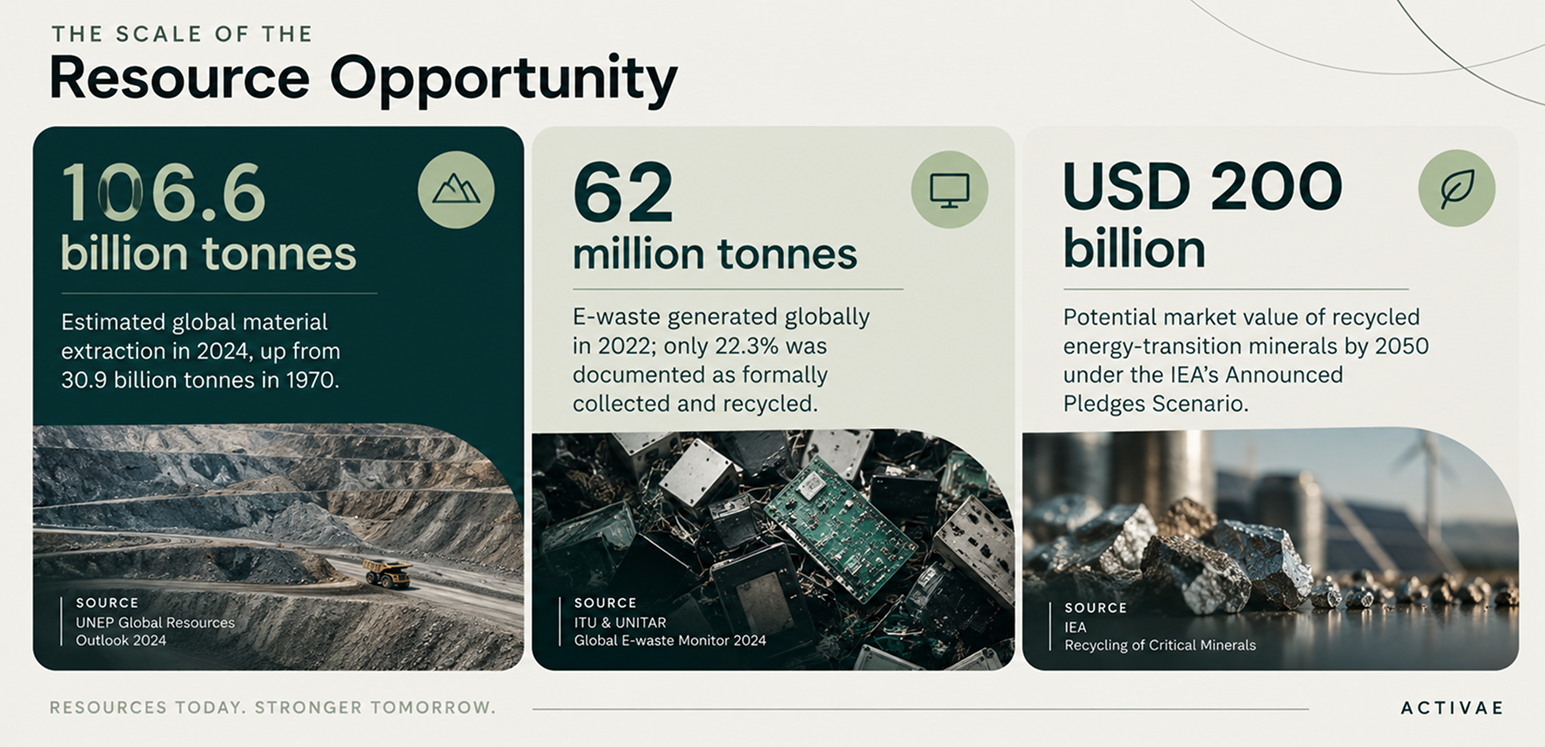
These figures illustrate both the scale of resources moving through the global economy and the potential value of developing additional pathways to recover them. The opportunity is particularly visible in material-intensive sectors, where products and industrial streams can retain economically and strategically valuable components after their initial application.
Within this context, resources already circulating through industrial processes, products, infrastructure, wastewater, and other material streams represent an additional source of supply. Recovering these resources can complement primary production by extending their productive use and creating alternative pathways for obtaining valuable inputs. This becomes particularly relevant when recovered materials can return to manufacturing or industrial processes at a quality that allows them to substitute or supplement newly extracted resources.
Within this context, resources already circulating through industrial processes, products, infrastructure, wastewater, and other material streams represent an additional source of supply. Recovering these resources can complement primary production by extending their productive use and creating alternative pathways for obtaining valuable inputs. This becomes particularly relevant when recovered materials can return to manufacturing or industrial processes at a quality that allows them to substitute or supplement newly extracted resources.
The value of recovery therefore extends beyond the quantity of material that can be captured. By creating additional sources of water, chemicals, energy, minerals, and manufacturing inputs, recovery can help industries diversify how they obtain essential resources and reduce their exposure to fluctuations in availability and cost. Its strategic relevance increases further when these recovered resources can be processed locally or closer to where they will be used, strengthening the connection between resource availability and industrial production.
Circular resource recovery is consequently becoming part of a broader conversation around resource productivity, supply resilience, and industrial competitiveness. The opportunity lies in using technological advances to access value that already exists within material flows and turn it into reliable inputs for new productive cycles. Understanding that opportunity starts with identifying which resources can be recovered and where they exist within these systems.
What Can Be Recovered?
The value contained within residual streams can take many forms, which means resource recovery extends far beyond the recirculation of solid materials. Industrial processes, biological residues, wastewater, manufactured products, and infrastructure can contain materials and compounds that retain physical, chemical, or energetic properties useful for further applications. What can be recovered depends on the composition of each stream and, importantly, on whether its valuable components can be separated and brought back to a usable specification.
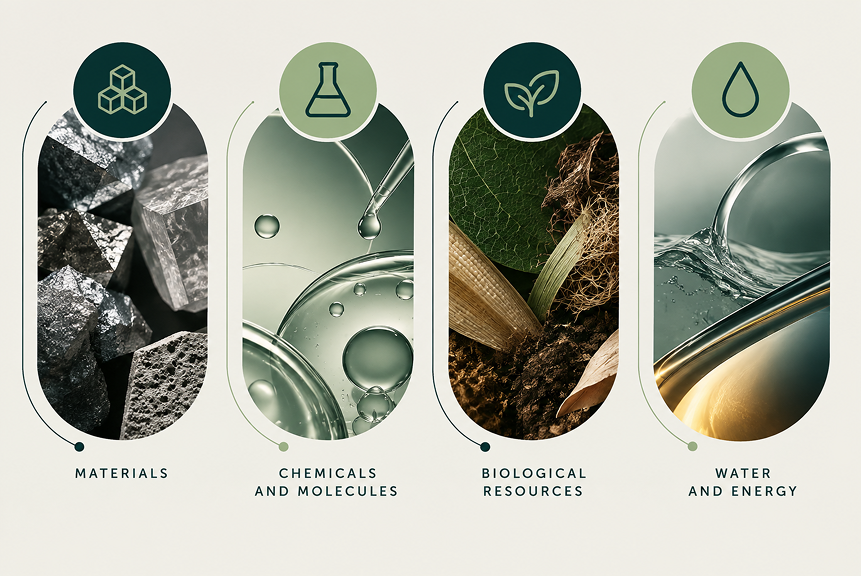
Materials such as metals, minerals, polymers, glass, and fibers can be recovered from manufacturing residues, construction materials, electronic equipment, batteries, and products reaching the end of their initial use. Their potential value is closely linked to the ability to preserve or restore properties such as purity and performance, since these characteristics determine whether recovered materials can return to demanding industrial applications.
Chemicals and molecules create another layer of recovery opportunity. Solvents, acids, salts, catalysts, and other compounds used or generated during industrial processes can remain valuable after their first application. Technologies capable of selectively separating and purifying these components can allow them to be reused within the same process or redirected toward other applications, extending their productive life without requiring them to remain in their original material form.
Biological resources contain a different set of recoverable components, including nutrients, proteins, oils, sugars, fibers, and other organic compounds. Agricultural residues, food-processing streams, and other biological inputs can therefore become feedstocks for new materials, chemicals, fertilizers, fuels, or ingredients when their components can be effectively isolated or transformed. This connects resource recovery with the broader development of bio-based production pathways.
Water and energy can also be recovered alongside physical materials. Water from industrial and municipal streams can be treated to meet the quality requirements of subsequent uses, while thermal energy and energy-rich compounds generated within processes can be captured and redirected. In these cases, recovery reduces the need to continuously introduce new resources into processes where part of the required input may already be present within existing flows.
Together, these resource categories show that the opportunity is not defined by a single type of waste or recovery pathway. It depends on identifying what valuable components remain within a stream, what condition they are in, and whether they can be recovered at a specification that enables another productive use. The next question is where, across different value chains, these recovery opportunities emerge.
Across the Resource Lifecycle
Resource recovery opportunities emerge at multiple points across a resource lifecycle rather than only after a product reaches the end of its initial use. Materials and other valuable components can leave their primary pathway during extraction and processing, manufacturing, industrial operations, distribution, use, or end-of-use. Each of these points produces streams with different compositions, concentrations, and recovery requirements, making the location of recovery an important factor in determining which technologies and business models can be applied.
In manufacturing and industrial processes, side streams can contain materials, chemicals, water, heat, and other inputs that retain productive value. Because these streams originate from controlled processes, their composition may be relatively well understood, creating opportunities to recover resources close to where they were originally used and, in some cases, reintegrate them directly into production.

Other opportunities emerge from agricultural, biological, and wastewater streams, where valuable components are often dispersed within complex mixtures. Nutrients, organic compounds, water, and energy-rich materials can be recovered from these flows, although their concentration and variability influence how they can be processed and what applications the recovered outputs can ultimately serve.
Recovery can also take place at the end of a product or material’s initial use, including batteries, electronics, vehicles, packaging, construction materials, and industrial equipment. At this stage, resources that were previously incorporated into finished products must be identified and separated from increasingly complex combinations of materials before they can return to productive applications.
These different recovery points form an interconnected resource pathway in which value can be captured before, during, or after a resource’s initial application. Where recovery takes place influences the composition of the available stream, the infrastructure required to access it, and the technological pathway needed to transform it into a usable input. This is where different approaches to separation, extraction, conversion, and purification begin to play distinct roles.
Technology Pathways Enabling Resource Recovery
Recovering resources from complex material streams depends on technologies capable of distinguishing valuable components from the surrounding mixture and bringing them back to a condition suitable for productive use. Because these streams vary widely in composition, concentration, and physical or chemical properties, there is no single recovery process. Different technological pathways intervene depending on what needs to be recovered, how it is embedded within the stream, and the specifications required for its next application.
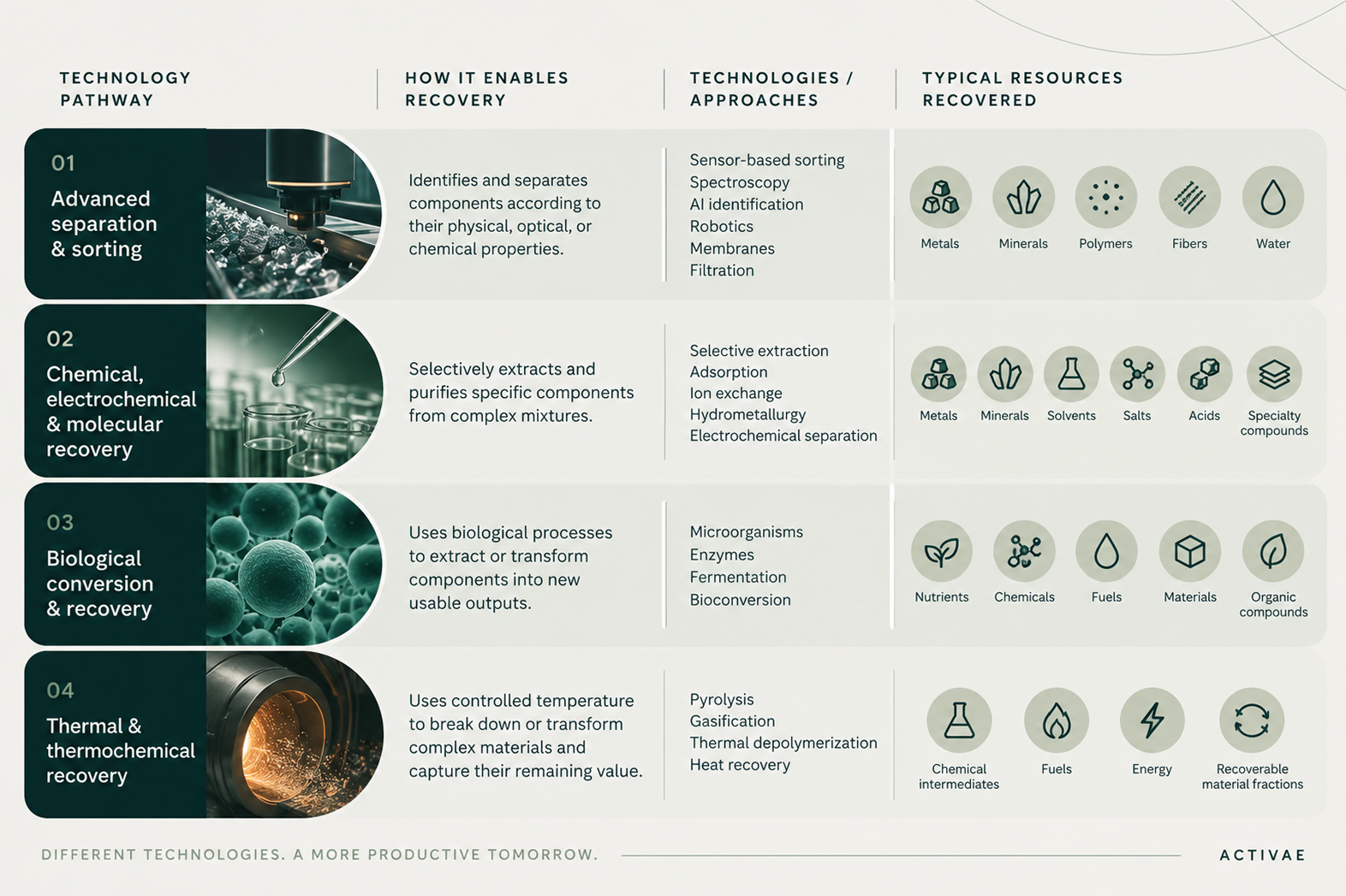
Increasingly, these pathways operate as integrated recovery systems rather than isolated technologies. Digital characterization can identify what enters a process, separation technologies can concentrate valuable fractions, conversion processes can transform them, and purification can bring the resulting outputs to the specifications required by downstream users. The relevant technological question therefore moves beyond whether a resource can technically be recovered to how selectively, efficiently, and consistently it can be recovered in a form that has a viable next use.
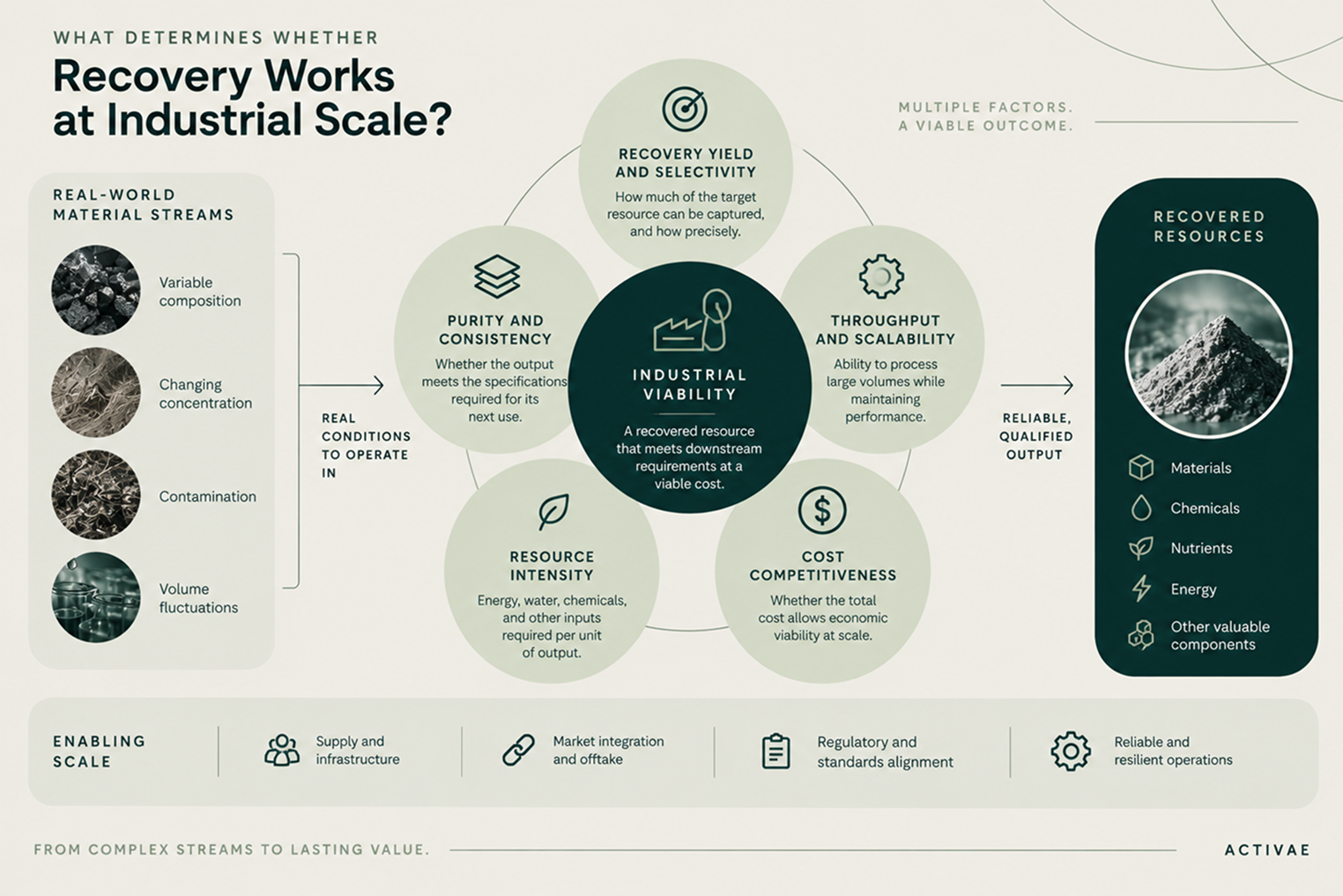
Industrial-scale recovery therefore depends on more than maximizing a single performance metric. A viable technology must balance recovery performance with the quality of its output, the resources required to operate, and its ability to maintain those results as processing volumes increase. Once these conditions are demonstrated, the question shifts from technical performance to deployment: how can the technology operate within the supply chains, infrastructure, and markets required to sustain recovery at scale?
Scaling Is More Than Recovering the Resource
Once a recovery technology can produce a consistent and usable output, scaling depends on whether a reliable system can form around it. Recovery facilities need continuous access to suitable input streams, the infrastructure to collect and prepare them, and downstream users capable of integrating the recovered resources. The commercial pathway therefore connects multiple actors and operations that may sit across different industries and locations.
Feedstock availability and quality are fundamental to this pathway. Recovery operations require sufficient volumes of suitable material to maintain utilization, but residual streams can vary by geography, season, industrial activity, and product composition. Securing access to these streams may involve long-term supplier relationships, aggregation from multiple sources, or preprocessing systems that reduce variability before material reaches the recovery facility.
Collection, preprocessing, and logistics determine how efficiently those resources can reach the technology. Some streams are generated in concentrated industrial locations, while others are distributed across cities, farms, buildings, or individual products. Their density, transportation requirements, storage conditions, and need for sorting or preprocessing influence where recovery facilities can operate and whether centralized or distributed configurations make economic sense.
On the other side of the process, qualification and market integration determine whether recovered outputs can become reliable inputs for another industry. Potential buyers need confidence that these resources meet technical specifications, regulatory requirements, and performance standards consistently over time. Qualification processes, certification, traceability, and long-term offtake agreements can therefore become as important to commercialization as the recovery process itself.
Scaling ultimately requires these elements to function as a connected pathway: feedstock supply → collection and preprocessing → recovery → qualification → offtake → reintegration. The strength of that pathway determines whether a technically viable recovery process can evolve into a repeatable industrial model, connecting resources already in circulation with the industries capable of putting them back into productive use.
Companies Building the Next Generation of Resource Recovery
The diversity of resource streams described throughout this article is reflected in the companies developing technologies to recover them. Rather than approaching circularity as a single technology category, these ventures target specific combinations of feedstock, recovery process, and output, ranging from metals dissolved in industrial wastewater to nutrients contained in biosolids. The examples below illustrate how different technological pathways are beginning to move resource recovery toward industrial applications.
Circular Materials
Area: Critical metals recovery
Location: Italy
Recovers critical and strategic metals from industrial wastewater using Supercritical Water Precipitation technology.
BioMetallica
Area: Biological metals recovery
Location: United Kingdom
Combines biotechnology and hydrometallurgy to recover precious and critical metals from e-waste, mine tailings, catalysts, and other complex streams.
Infinite Elements
Area: Bioleaching & critical minerals
Location: United States
Develops biohydrometallurgical processes to recover critical minerals from electronic waste and manufacturing scrap.
Sedron Technologies
Area: Nutrient & water recovery
Location: United States
Recovers water, nutrients, and other usable outputs from biosolids, manure, and high-volume organic streams.
Together, these companies demonstrate that resource recovery is developing through multiple technological routes rather than converging around a single solution. The relevant technology depends on where value exists, how that value is embedded within the original stream, and what quality the recovered resource must achieve to enter its next application. The emerging landscape therefore ranges from highly selective molecular recovery to integrated systems capable of producing several usable outputs from the same input stream.
Where Resource Recovery Is Heading
The next stage of resource recovery is increasingly focused on recovering greater value from existing streams rather than simply increasing the volume of material processed.
Advances in characterization, separation, and purification are making it possible to target specific materials and compounds with greater precision, opening recovery pathways for resources that may previously have been too dispersed, contaminated, or technically difficult to access.
At the same time, selective recovery of critical and high-value materials is becoming particularly relevant as industries seek more diversified sources of strategically important inputs. Batteries, electronics, industrial wastewater, manufacturing residues, and other complex streams can contain resources whose value justifies more sophisticated recovery processes, creating opportunities for technologies designed around specific materials rather than broad material categories.
The configuration of recovery infrastructure is also evolving. Distributed and modular systems can bring processing closer to where certain resource streams are generated, while centralized facilities can benefit from aggregation and economies of scale. Which model develops will depend on the characteristics of each stream, including its volume, concentration, transportation requirements, and the location of potential users for the recovered outputs.
Finally, greater material intelligence and traceability can strengthen the connection between recovery and reintegration. Better information about what materials are present, where they originate, how they have been processed, and what specifications they meet can help recovery operators identify valuable streams while giving downstream industries greater confidence in recovered inputs.
Together, these developments point toward resource recovery systems that are becoming more selective, information-driven, and integrated with industrial supply chains. The technologies that advance will need to connect recovery performance with reliable access to resources and clear applications for what they produce, turning circularity into a practical component of how industries secure and manage their inputs.
Recovering Value Already in the System
Circular resource systems recovery completes an important part of the ClimaTech landscape explored throughout this series. Energy, agriculture, manufacturing, transport, the built environment, and digital systems all depend on continuous flows of materials, water, chemicals, nutrients, and energy. Resource recovery adds another dimension to these systems by creating pathways through which part of that value can remain productive beyond its initial application.
As recovery technologies become more selective and capable of operating across complex streams, their role can extend beyond managing residual materials. They can contribute additional sources of industrial inputs, strengthen resource productivity, and create new connections between sectors in which the output of one process becomes a valuable input for another.
The opportunity ultimately lies in making those connections technically reliable and commercially viable. Recovering a resource is only the beginning; its value is realized when it can reliably enter another productive cycle.
Authors

Maria Lozoya
Associate emerging technologies

Diego Santamaria Razo
Managing Director
Related Posts

The interaction between microorganisms, soil, and crops
How microbial technologies support crop nutrition and what determines their…

Water stress in agriculture
Water constraints affect agricultural decisions well before a crop shows…
The resources behind a resilient city
Consider a city preparing for hotter, drier summers. Its water…