
Deep Diving into Transport, Logistics, and Cold Chain
A temperature-controlled product is only as protected as the weakest handoff in its journey.
Moving sensitive goods in a warming world
In modern society, most of what we use and eat needs to be transported from where it is harvested or produced to where it is consumed. That requires a considerable effort in maintaining goods fresh and healthy for consumption. But according to the food and Agriculture Organization of the United Nations, approximately 526 million tonnes of food—around 12% of global production—are lost or wasted because of insufficient refrigeration.[1] United Nations Environment Programme (UNEP) and Food and Agriculture Organization of the United Nations (FAO) also estimate that food cold chains are responsible for around 4% of global greenhouse gas emissions when emissions from cooling technologies and food loss caused by inadequate refrigeration are considered together.[2]
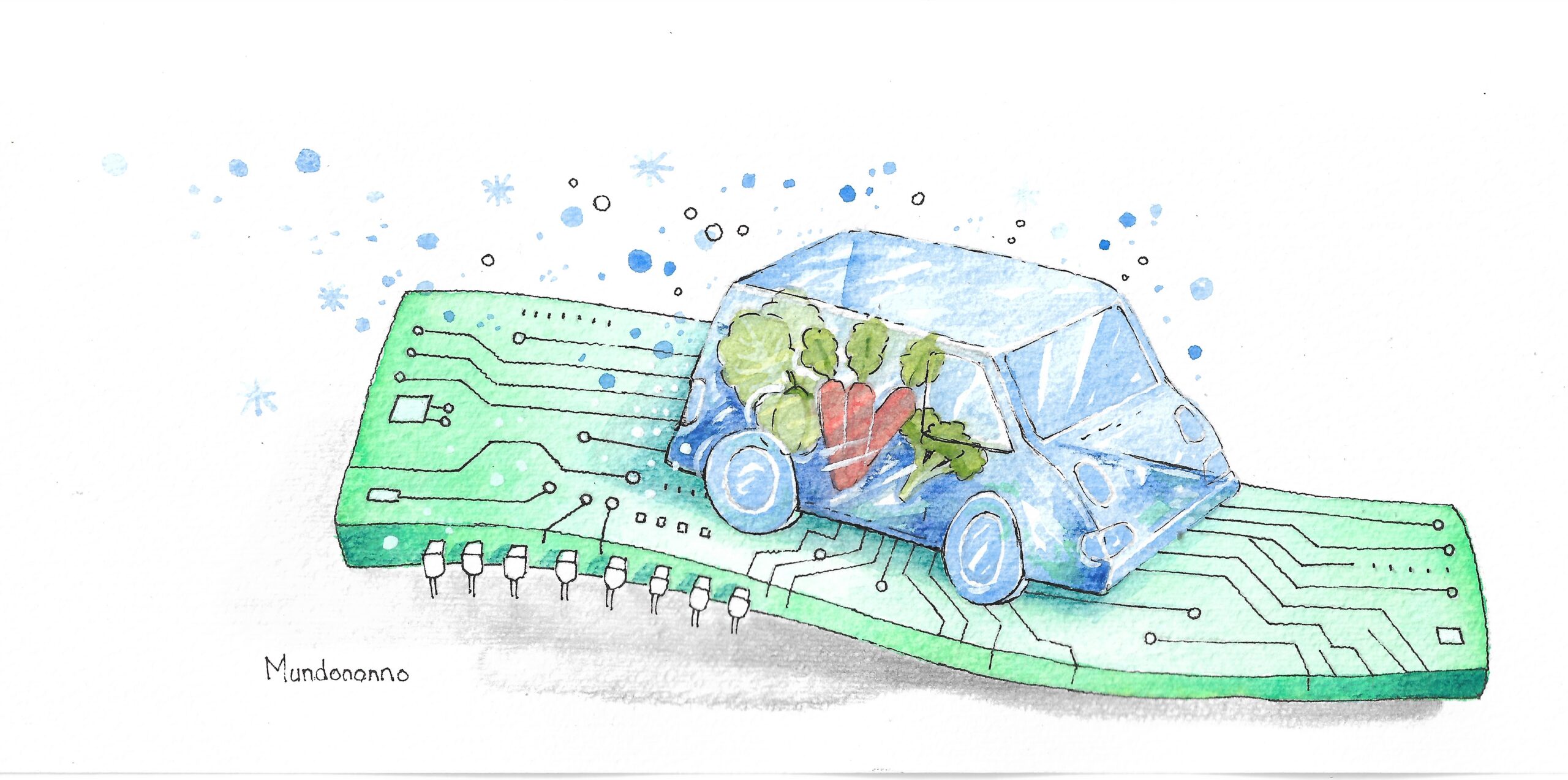
Transport on ice: I envisioned an ice-shaped van carrying vegetables inside. It travels along a giant microchip designed to resemble a road.
These figures reveal a dual challenge. Greater access to refrigeration can reduce food loss, strengthen farmer incomes, support public health, and connect producers with more distant markets. Expanding cold-chain infrastructure through inefficient equipment, carbon-intensive energy, and high-global-warming-potential refrigerants can increase energy demand and emissions.
Climate change and the growing movement of temperature-sensitive produces are making the transportation of goods a challenge that stresses its key metrics: speed, cost, and capacity.
Fresh produce continues to respire after harvest and begins losing quality when field heat is not removed quickly. Frozen food can experience changes in texture and safety when temperatures fluctuate. Vaccines, biologics, and other pharmaceutical products may lose stability after exposure to conditions outside their approved range. Chemicals, flowers, and advanced industrial materials can also be affected by humidity, light, vibration, or excessive heat.
Higher ambient temperatures increase the thermal load placed on warehouses, vehicles, packaging, and last-mile operations. Longer or more intense periods of heat can raise cooling demand, reduce the protection time provided by passive packaging, increase pressure on electricity systems, and make delays more consequential for sensitive cargo. Infrastructure originally designed around more stable environmental conditions must now operate across a wider range of temperatures and disruptions.
ClimateTech has an important role in resolving this tension. The opportunity extends across efficient refrigeration, low-impact refrigerants, electrified transport, renewable energy, thermal storage, advanced insulation, condition monitoring, predictive operations, and distributed cooling infrastructure. Their combined purpose is to preserve product value while reducing the energy, emissions, and resources required across the journey.
The cold chain makes the relationship between climate adaptation and mitigation especially visible. It must protect goods from increasingly demanding environmental conditions while transforming the technologies and energy systems used to provide that protection.
Across storage, refrigeration, packaging, and delivery, emerging technologies are improving temperature control, reducing energy consumption and product loss, and strengthening operational resilience. This article examines where these solutions can create the greatest environmental and commercial value.
The cold chain was a logistics and cost problem based on energy
Transport describes the physical movement of goods, while logistics coordinates the routes, timing, inventory, infrastructure, information, and organizations that make this movement possible. The cold chain operates within this wider system and adds a product-specific requirement: environmental conditions must remain within defined limits throughout the journey. Temperature is often the central variable, although humidity, airflow, light exposure, vibration, and handling time can also influence whether a product retains its quality, safety, and intended function. For this reason, cold-chain performance depends on the complete environment surrounding the product rather than the performance of a refrigerated vehicle or warehouse in isolation.
The word “cold” can also be misleading because the objective is not to maintain the lowest possible temperature. Some products require chilled or frozen environments, while others travel under controlled ambient, ultra-low-temperature, or cryogenic conditions. The appropriate range depends on the biological or chemical characteristics of the product, its intended use, its stability profile, and the regulations that govern it. A reliable system must therefore understand what it is protecting before deciding which equipment, packaging, monitoring, and operating conditions are required.
For food, this system begins near production and continues until consumption. FAO and UNEP describe upstream operations as pre-cooling, processing, packaging, ice production, and short-term storage close to farms or production sites. Downstream operations include refrigerated transportation, distribution centers, wholesale markets, retail infrastructure, and final delivery.[2] Pharmaceutical supply chains follow a comparable physical journey, although many products require additional qualification, monitoring, and documentation. The World Health Organization guidance consequently addresses storage facilities, backup power, customs clearance, transport routes, vehicle and container performance, alarm systems, calibration, traceability, contingency planning, and personnel training as connected parts of pharmaceutical product protection.[3]
Maintaining these conditions requires several forms of infrastructure to operate together. Active cooling systems use electricity or fuel to regulate temperature inside cold rooms, refrigerated vehicles, and air or ocean containers, while passive systems rely on insulation and a finite source of thermal protection, such as gel packs, dry ice, or phase-change materials.[3] Their performance is influenced by the roads, ports, loading facilities, warehouses, energy supply, packaging configurations, maintenance networks, and digital systems available along the route. A change in one part of this environment can alter the performance of the rest. Longer waiting times increase the duration for which packaging must provide protection, unreliable electricity increases dependence on backup systems, and limited connectivity can prevent operators from responding to changing conditions.
This interdependence makes the cold chain a relevant ClimateTech system. Its first climate-related function is protective: food, medicines, and other sensitive goods must remain accessible and usable under rising temperatures and increasingly variable environmental conditions. The consequence of maintaining its primary function is that it has an impact, economically and environmentally talking.
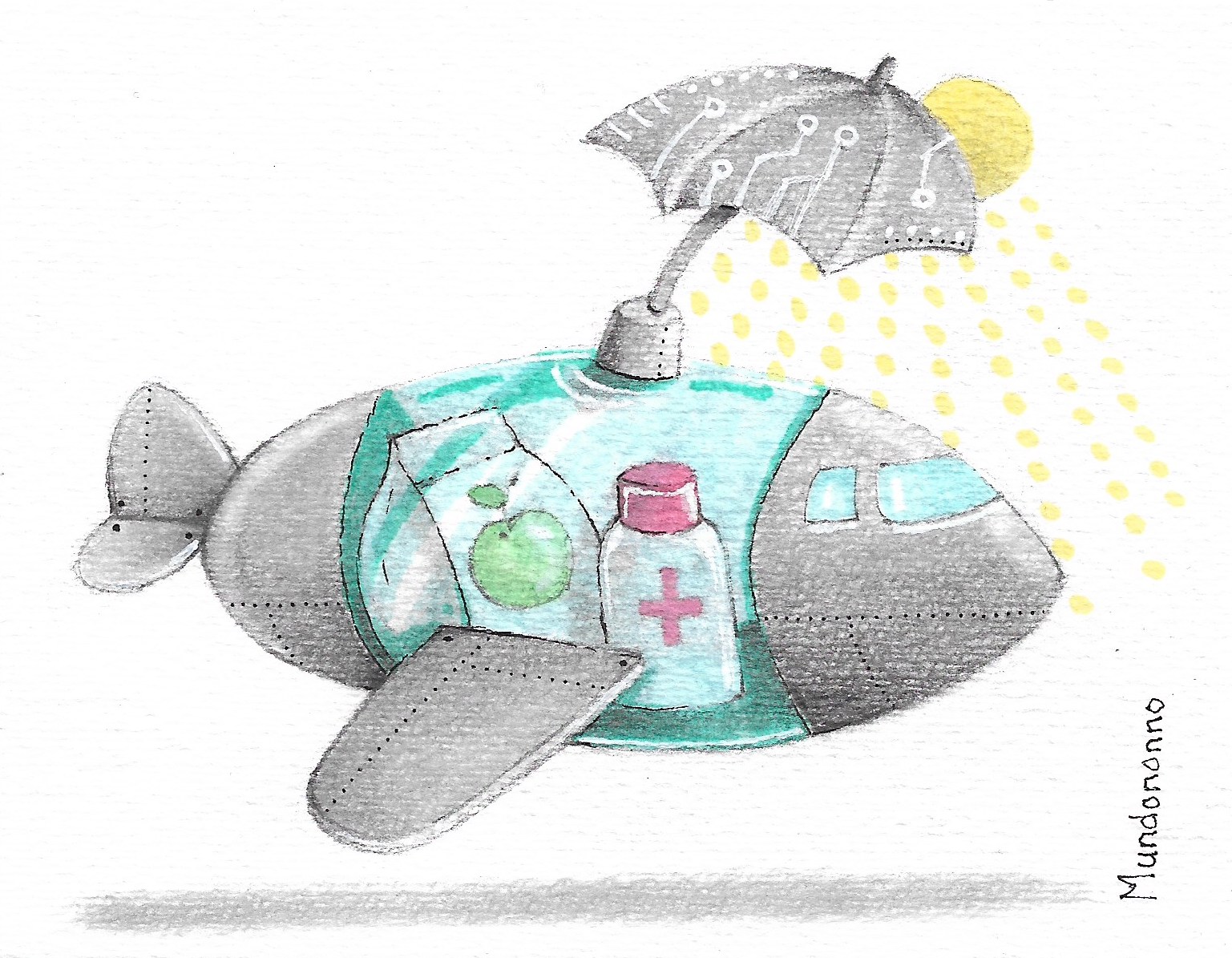
Airplane: I envision a refrigerated aircraft designed for transportation. The umbrella represents a digital system that powers and protects it, allowing food and medicines to be transported safely inside.
Refrigeration consumes energy, transport relies heavily on fuel, refrigerants can generate direct emissions through leakage, and discarded products carry the environmental footprint accumulated during production, processing, storage, and transportation. Strengthening the cold chain therefore involves expanding reliable access to cooling while reducing the energy, emissions, refrigerant impact, and product losses associated with its operation.
Achieving both objectives requires coordination across organizations as well as technologies. Producers, logistics providers, warehouse operators, carriers, customs authorities, energy providers, distributors, retailers, healthcare facilities, and regulators may each control a different part of the journey. Product condition depends on how successfully their decisions, infrastructure, and information remain connected as responsibility moves between them. This distributed structure explains why many failures emerge at the boundaries between operations, especially when a product changes location, transport mode, energy source, monitoring system, or responsible actor.
Where continuity breaks
The main cold-chain problem is the loss of continuity across a system composed of different facilities, transport modes, energy sources, digital platforms, and responsible organizations. Each component may perform correctly within its own boundaries while the complete journey still fails to preserve the product. A cold warehouse, refrigerated vehicle, or monitoring device therefore provides limited protection when the transitions between them remain exposed.
The consequences are already visible at a global scale. Approximately 14% of food produced for human consumption is lost before reaching retail, representing an estimated economic cost of USD 936 billion annually. Insufficient refrigeration contributes to the loss or waste of 526 million tonnes of food, equivalent to around 12% of global production.[2] This means a significant share of agricultural output loses value somewhere between production, storage, transportation, distribution, and consumption.
These losses also carry a climate impact. Every discarded product contains the land, water, energy, materials, processing, cooling, and transportation used before it became unusable. UNEP and FAO estimate that food cold chains generate around 4% of global greenhouse gas emissions when emissions from cooling technologies and food loss caused by inadequate refrigeration are considered together.[2] Expanding cooling access can reduce waste, but the climate value of that expansion depends on the efficiency, refrigerants, energy sources, and transport systems used.
Long and unpredictable logistics processes increase the period during which sensitive goods must remain protected. According to the World Bank’s Logistics Performance Index, an average of 44 days passes between a container entering the port of the exporting country and leaving the destination port. This period accounts for approximately 60% of the total time required to trade goods internationally, with some of the largest delays occurring at seaports, airports, and multimodal facilities.[4] The measure covers container trade broadly, rather than cold-chain cargo specifically. It still reveals the amount of time and uncertainty that temperature-sensitive products may encounter across international routes.
Climate change is increasing the operational pressure surrounding these movements. Higher ambient temperatures raise cooling loads, reduce the protection time available from passive packaging, and make power interruptions or logistics delays more consequential. UNEP projects that total cooling demand could more than triple by 2050 under a business-as-usual scenario. Cooling-related greenhouse gas emissions could reach approximately 7.2 billion tonnes of carbon dioxide equivalent by that year, nearly twice their 2022 level.[5] These projections cover the wider cooling economy, including buildings, industrial processes, and cold chains, and show the energy and emissions context in which cold-chain infrastructure will need to expand.
The problem therefore combines several forms of discontinuity. Thermal continuity breaks when products leave controlled environments or equipment cannot maintain the required conditions. Energy continuity breaks when refrigeration lacks reliable electricity, fuel, batteries, or backup systems. Information continuity breaks when condition data arrives too late or remains separated across platforms. Operational continuity breaks when responsibility changes without a clear process for responding to an excursion.
Climate pressure reduces the margin available for each of these failures. A delay that remains manageable under moderate conditions may exceed the thermal capacity of the same equipment or packaging during intense heat. A power interruption becomes more difficult to absorb when cooling systems are already operating near peak demand. Fragmented information becomes more consequential when the time available to intervene is shorter.
These numbers establish the scale, while the mechanism explains where that scale originates: value is repeatedly lost at the points where products, infrastructure, energy, information, and responsibility stop operating as one continuous system. The next step is to examine how these failures appear in real supply chains and why seemingly small operational gaps can produce significant economic and environmental consequences.
What failure looks like in practice
Cold-chain failures often emerge through small disruptions. Fresh produce can deteriorate while waiting for initial cooling, especially in regions where farms are far from refrigerated infrastructure. FAO identifies rapid postharvest cooling as essential for preserving commercial life.[1]
Handoffs introduce another point of vulnerability. A pharmaceutical shipment may remain stable during transport but experience a temperature excursion while waiting at a port, passing through customs, or entering temporary storage. Missing temperature records can also force recipients to quarantine products whose integrity cannot be verified.[3]
Energy instability creates similar consequences during storage. UNICEF documented cases in South Sudan where generator failures spoiled vaccines overnight, leaving families without access to immunisation.[6] In food chains, irregular power and repeated temperature fluctuations can damage frozen products and reduce their value.[7] These examples show why cold chains require resilient energy, effective thermal protection, continuous monitoring, and coordinated logistics.
Some of the technologies transforming cold chains
The technology landscape supporting resilient, low-carbon cold chains extends across cooling, energy, materials, data, and transportation. The following categories illustrate some of the approaches being developed to reduce product loss, improve continuity, and lower the climate impact of logistics.

These examples represent part of a wider and evolving technology landscape. Their climate value comes from reducing product loss, lowering energy and fuel consumption, and limiting emissions from refrigerants. The strongest cold-chain systems combine several approaches according to the product, infrastructure, climate, and market in which they operate.
Startups applying these technologies
The following startups and scaleups illustrate how some of these technological pathways are becoming deployable cold-chain solutions.
Efficient, low-impact refrigeration
MAGNOTHERM
(Darmstadt, Germany)
Develops magnetic cooling systems that eliminate conventional refrigerant gases and reduce electricity consumption.
Phononic
(Durham, United States)
Uses solid-state cooling in connected totes for chilled and frozen grocery logistics.
Barocal
(Cambridge, United Kingdom)
Commercialises pressure-driven solid refrigerants for efficient cooling without high-GWP gases.
Distributed renewable cold infrastructure
ColdHubs
(Nigeria)
Operates solar-powered walk-in cold rooms through a pay-as-you-store model for farmers and market vendors.
Ecozen
(Pune, India)
Combines solar refrigeration, thermal storage, and remote monitoring in farm-gate cold rooms.
InspiraFarms Cooling
(Africa and other emerging markets)
Builds modular precooling systems, cold rooms, and packhouses for food supply chains.
Thermal storage and advanced packaging
Ember LifeSciences
(California, United States)
Builds reusable, connected pharmaceutical shipping boxes with active and passive temperature control.
Inficold
(Uttar Pradesh, India)
Integrates thermal storage into cold rooms and milk chillers to maintain cooling during grid interruptions.
Tan90 Thermal
(India)
Develops phase-change thermal batteries and reusable containers for cold storage and last-mile delivery.
Condition monitoring and product intelligence
Tive
(United States)
Provides real-time monitoring of location, temperature, humidity, light exposure, and shock across food and pharmaceutical shipments.
Controlant
(Kópavogur, Iceland)
Combines IoT devices, software, and automated workflows to monitor pharmaceutical cold chains.
Wiliot
(Israel and the United States)
Uses battery-free IoT sensors to monitor temperature and handling conditions at case or product level.
Clean transport and logistics orchestration
Volta Air
(British Columbia, Canada)
Builds fully electric refrigeration units for vans and trucks used in urban and last-mile deliveries.
TurtleTree
(South Africa, Europe, and the United States)
Produces battery systems for transport refrigeration, supported by remote monitoring and energy-management software.
Sunswap
(Leatherhead, United Kingdom)
Develops battery- and solar-powered refrigeration units that replace diesel systems in refrigerated trailers.
Condition monitoring and product intelligence
NanoFreeze
(Bogotá, Colombia)
Develops bio-nanotechnology-based cooling materials, including cold sheets, portable coolers, and refrigerator panels that maintain temperature while reducing refrigeration energy demand.
TE-FOOD
(Albstadt, Germany)
Provides end-to-end, blockchain-based food traceability solutions that help companies track products across supply chains, verify claims, improve recalls, and share transparent information with consumers.
Sufresca
(Ness Ziona, Israel)
Produces natural edible coatings that slow softening, moisture loss, and fungal decay in fresh fruits and vegetables.
Together, these companies show that cold-chain is emerging through several complementary routes: cleaner cooling, distributed infrastructure, thermal storage, product-level intelligence, and electrified transport. Their climate impact will ultimately depend on how effectively these technologies can be integrated into local energy, logistics, and food systems.
Different markets require different systems
Cold-chain technologies cannot be transferred unchanged from one market to another. Their performance depends on ambient temperatures, electricity reliability, transport distances, road conditions, maintenance capacity, regulation, and the type of product being moved. A system designed for a dense logistics network may be technically or economically unsuitable for a rural region with fragmented production and limited access to reliable power.
In established cold-chain markets, the climate opportunity lies in improving existing infrastructure through efficient refrigeration, low-impact refrigerants, electrified transport, and better system monitoring. In regions where infrastructure remains limited, the priority may be to create reliable cooling access close to farms and local markets. Modular solar cold rooms, thermal storage, and pay-per-use business models can help reduce dependence on unstable grids and large upfront investments. The FAO identifies decentralised solar energy as an important option for off-grid and remote cold chains.
The technical requirements also change by product. Vaccines and biologics require strict temperature control, traceability, and regulatory compliance, while fresh produce depends heavily on rapid precooling and affordable storage near the point of harvest. Frozen food requires continuous high-energy refrigeration, and each system must remain reliable during extreme heat, flooding, power interruptions, and transport delays.
Scaling these technologies therefore requires local infrastructure, financing models, technical support, and policy to develop alongside the equipment itself. As the UNEP and FAO emphasise, sustainable cold chains need a systems approach. The most relevant ClimateTech solutions will be those that reduce emissions while responding to the operational realities of each market.
What determines whether a cold-chain solution can scale?
A cold-chain technology becomes scalable when it can maintain the required temperature under real operating conditions and deliver clear economic value. Energy efficiency, refrigerant leakage, equipment reliability, maintenance requirements, downtime, and the reduction of product losses all affect its long-term performance. Its climate impact must also consider emissions from electricity consumption, refrigerants, transport, and equipment across the system’s lifetime.
Economics can be as decisive as technical performance. Efficient equipment may remain inaccessible when it requires significant upfront investment or operates below capacity. Models such as cooling-as-a-service, leasing, shared infrastructure, and pay-per-use can distribute costs and make adoption more viable. The World Bank identifies food cold chains and cooling-as-a-service among the areas that could benefit from dedicated sustainable finance.
Integration is another critical factor. New equipment must connect with warehouses, vehicles, packaging, monitoring platforms, and existing operating procedures. Spare parts, trained technicians, data access, and local implementation partners determine whether performance can be maintained after deployment.
Scaling therefore depends on the alignment of technology, infrastructure, business models, financing, and policy. UNEP highlights measurable data, innovative business models, financing mechanisms, training, and capacity building as essential components of sustainable cold-chain development. These factors help determine whether a solution can progress from a successful pilot to reliable, lower-emission infrastructure.
Where the strategic opportunity lies
The strongest opportunities often emerge where several parts of the cold chain are improved together. Efficient refrigeration creates greater value when it is supported by clean energy, thermal storage, condition monitoring, and logistics systems capable of responding to disruptions. This creates space for companies developing individual technologies and for those integrating them into complete services.
For founders, the challenge is to demonstrate reliable performance within the customer’s operating environment, supported by clear unit economics and measurable climate outcomes. Investors and industrial partners must evaluate the importance of the problem, technology readiness, infrastructure dependencies, deployment requirements, and the pathway to recurring revenue.
Solutions with the greatest potential will reduce product loss, energy consumption, operating costs, and emissions while improving reliability. Identifying them requires an understanding of how the technology interacts with the wider energy, logistics, regulatory, and commercial system.
Building the next generation of cold chains
As temperatures rise and supply networks face more frequent disruption, cold chains are becoming critical climate infrastructure. Their transformation will affect food security, healthcare, trade, producer incomes, and the emissions generated across global supply chains.
Many of the necessary technologies are already emerging. The next challenge is selecting the right solutions, validating them under real operating conditions, integrating them with existing infrastructure, and developing viable pathways for deployment and scale.
Developing a technology for transport, logistics, or cold chains? Contact Activae to assess its investment readiness, identify the gaps that could slow deployment, and build a clearer path toward capital and scale.
Developing resilient, accessible, and lower-emission cold chains will require coordinated decisions across the entire system. Those decisions will determine how effectively essential products can move through a warmer and increasingly uncertain world.
References
[1] Food and Agriculture Organization of the United Nations — Cooling the Chain, Cutting the Waste, 2026
[2] UNEP and FAO — Sustainable Food Cold Chains: Opportunities, Challenges and the Way Forward, 2022
[3] World Health Organization — Model Guidance for the Storage and Transport of Time- and Temperature-Sensitive Pharmaceutical Products
[4] World Bank — Logistics Performance Index 2023
[5] UNEP — Global Cooling Watch 2025
[6] UNICEF — Cold-chain management in South Sudan
[7] FAO — Cold storage and food loss in fish value chains
Authors

Maria Lozoya
Associate emerging technologies

Diego Santamaria Razo
Managing Director
Related Posts

Deep Diving into Agriculture and Food System
Feeding the world depends on agricultural systems capable of withstanding…
Deep Diving into Industrial Processes and Manufacturing
How clean heat, electrification, hydrogen, alternative chemistries, and carbon management…

How does Activae prepare you for Investment?
Science-based ventures carry several forms of progress at once: technical…