How does Activae prepare you for Investment?
Science-based ventures carry several forms of progress at once: technical development, customer discovery, industrial planning, regulatory decisions, team building, financial preparation, among many other things. Before defining an investment strategy, founders need a grounded view of how these elements currently come together within their company.
Activae’s Investment Readiness Assessment provides that starting point. Through a structured questionnaire, we examine the evidence, assumptions, and constraints shaping the venture across the areas that influence its capacity to advance. The objective is to establish a clear position: what the company has already validated, where relevant questions remain open, and which conditions will shape its next stage.
The assessment value lies in creating a rigorous basis for decision-making. Once founders understand their current position, they can define priorities with greater precision, connect their capital needs to meaningful milestones, and enter investment conversations with a clearer account of what the company is building and what it needs to unlock next.
A Funding Round Is a Decision About the Next Stage
A funding round is often framed around a number: how much capital the company needs to continue moving forward. For a science-based venture, the more important question is what that capital needs to make possible.
The answer may involve validating performance in a relevant environment, developing a pilot with an industrial partner, completing a certification pathway, establishing an initial production process, or building the capabilities required for commercial execution. Each objective carries different assumptions, risks, timelines, and evidence requirements.
This is why a financing objective needs to be defined before the fundraising narrative takes shape. Investors need to understand the company’s current position, the uncertainty that remains between the venture and its next stage, and the milestones the proposed capital is intended to unlock.
A clear objective gives the round a practical role within the company’s development. It connects the amount being raised to a defined body of work, the resources needed to carry it out, and the evidence that should result from it. It also gives founders a basis for deciding which questions deserve attention now and which can be addressed later.
Fundraising becomes part of the venture’s execution strategy: a decision about how the company will move from its current position toward a specific next stage.
A Technology Needs a Venture Capable of Carrying It Forward
Technical maturity provides essential evidence about performance, feasibility, and development progress. Yet a venture’s ability to reach its next stage also depends on the conditions surrounding the technology: who will adopt it, how it will be produced, which constraints may affect delivery, and whether the company has the capacity to execute.
A promising material, process, or platform may demonstrate compelling results in a controlled environment while important questions remain around repeatability, integration into existing operations, access to critical inputs, regulatory requirements, cost structure, or the capabilities needed to bring it to market. These questions shape the company’s path just as directly as technical development.
For this reason, investment readiness requires a view of the venture as an interconnected system. Activae examines seven areas that contribute to the company’s capacity to progress:
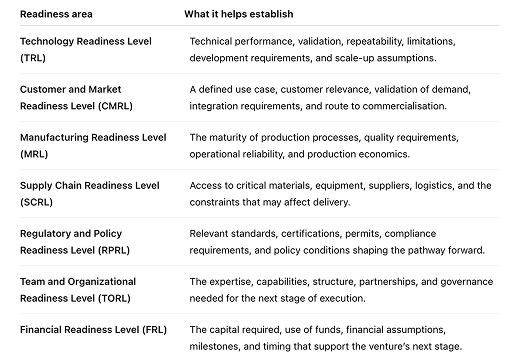
These areas develop alongside one another and continuously shape each other: customer requirements may influence technical development, regulatory conditions may affect product design and timelines and manufacturing decisions may alter capital needs and commercial assumptions.
Understanding these connections gives founders a holistic basis for planning their next move. It also allows them to present a venture whose technical promise is supported by a credible path toward adoption, delivery, and growth.
Readiness Depends on What the Company Is Raising For
A venture does not need to reach the same level of maturity across every area before seeking capital. The relevant question is whether its current position, the evidence available, and the work proposed are appropriate for the objective of the round.
Capital for technical validation, for example, calls for a clear development hypothesis, credible scientific foundations, and a realistic plan for generating the next set of technical evidence. A round intended to finance a pilot requires additional clarity around the conditions in which the technology will operate, the requirements of the potential user, the criteria that will define success, and the resources needed to carry out the validation.
As the venture moves toward a first commercial deployment, the scope of preparation expands. Founders need to understand how the solution will be delivered, what regulatory or certification requirements apply, how production and supply conditions may affect cost and timing, and what needs to happen for a customer to adopt it. At scale-up, manufacturing capacity, supply chain resilience, quality systems, commercial demand, organisational capability, and working capital become increasingly connected.
The purpose of an assessment is therefore to interpret readiness in context. It helps establish which questions matter most for the next financing decision and which areas require further evidence before the company takes on a larger level of execution risk.
This perspective gives founders a more precise basis for fundraising. Rather than presenting capital as a general requirement for growth, they can explain the specific transition the round is designed to support, the uncertainties it will address, and the progress it is expected to create.
Credibility Comes From Understanding What Remains Unresolved
Early-stage ventures operate with uncertainty. Some elements have been validated through experiments, pilots, customer conversations, or operational experience. Others remain hypotheses that require further testing, external input, or time to develop.
The ability to distinguish between them is central to a credible investment conversation. Founders need to communicate what the company knows, the evidence supporting it, and the assumptions that still shape its path forward. This gives investors, partners, and internal teams a more accurate basis for evaluating the opportunity and the work ahead.
A clear view of unresolved questions also helps prevent resources from being allocated around assumptions that have not yet been tested. A venture may need to confirm performance under specific operating conditions, validate a customer’s adoption requirements, assess supply constraints, define its regulatory pathway, or test the financial implications of production at a larger scale.
These questions do not diminish the value of the venture. They define the priorities that will determine whether its next stage can be executed effectively.
Investment readiness therefore depends on the quality of this internal clarity. When founders understand which uncertainties are most relevant, they can explain how the next round of capital will generate the evidence, capabilities, and decisions required to address them.
Preparing for Investment Is Preparing for Execution
Preparing to raise capital gives founders a structured way to look ahead. It brings together the decisions that will shape the next stage of the venture: what needs to be validated, which capabilities need to be built, where external partners are required, and how resources should be allocated over time.
This clarity matters well beyond the fundraising process. A company that can connect its technology, customer needs, manufacturing processes, supply chain, policies, team and financial needs, is better positioned to coordinate its team and make informed decisions as new evidence emerges.
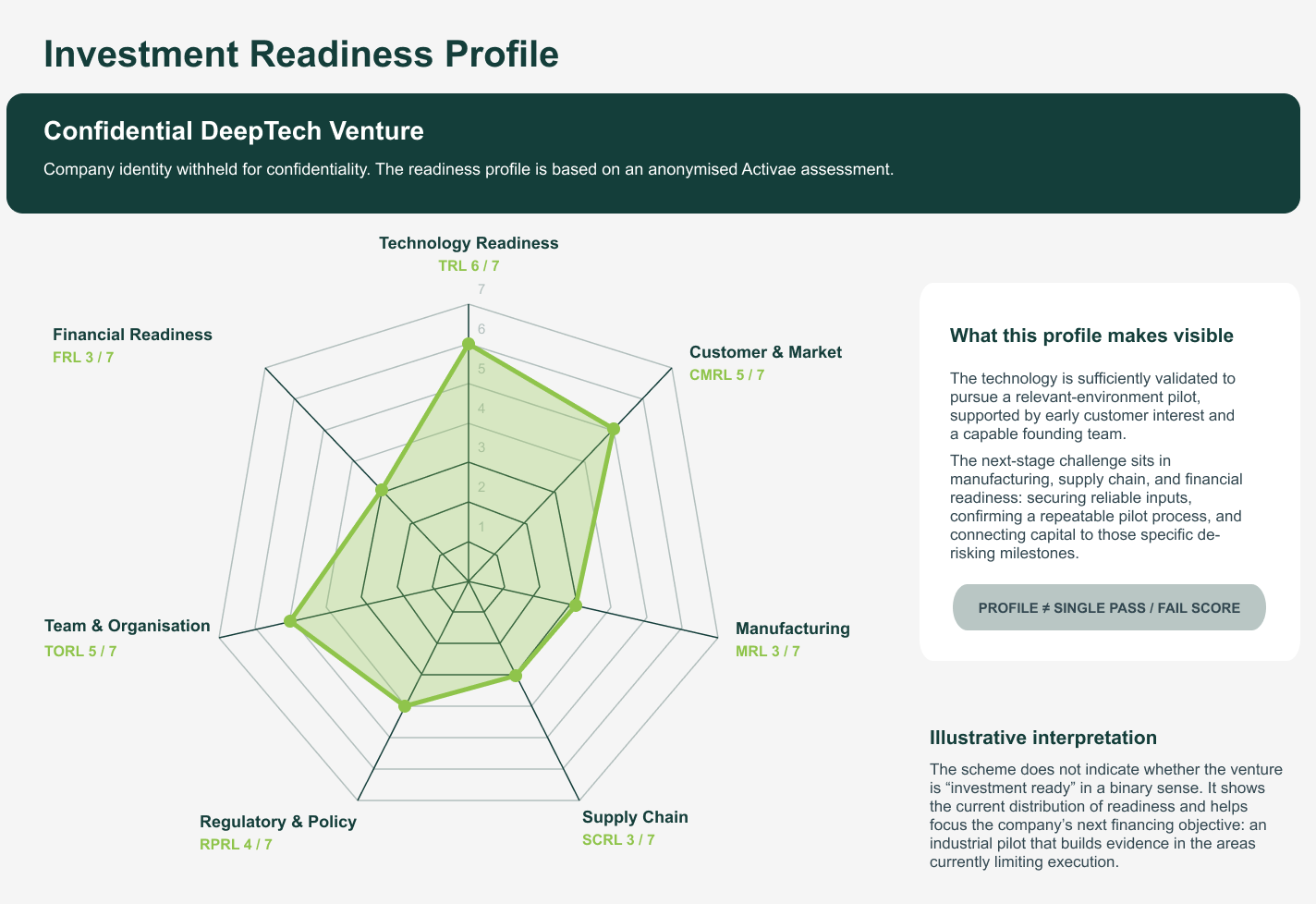
Activae’s Investment Readiness Assessment helps founders establish that shared perspective. By assessing the venture’s current position across the seven readiness areas, it creates a basis for identifying the questions that deserve attention before the company takes on its next stage of development.
The result is a clearer relationship between capital and execution. Founders can articulate what the company has already achieved, what remains to be addressed, and how the proposed funding will support specific progress.
For investors, this preparation enables a more transparent conversation around evidence, risks, timing, and use of funds. For the venture, it creates direction: a way to move forward with a clearer understanding of the work, decisions, and conditions required to reach the next milestone.
Investment readiness gives founders a clearer basis for making that transition: from a promising technology to a venture with a defined path to validate, deliver, and grow and on the Investors’ side, the assessment is used as a due diligence to compare what a venture claims and where they are.
Follow Activae and contact us if you want to assess your venture and want to build up a capital raising strategy with us.
Authors

Maria Lozoya
Associate emerging technologies

Diego Santamaria Razo
Managing Director
Related Posts

The interaction between microorganisms, soil, and crops
How microbial technologies support crop nutrition and what determines their…

Water stress in agriculture
Water constraints affect agricultural decisions well before a crop shows…

The resources behind a resilient city
Consider a city preparing for hotter, drier summers. Its water…