Biological pathways: Fermentation
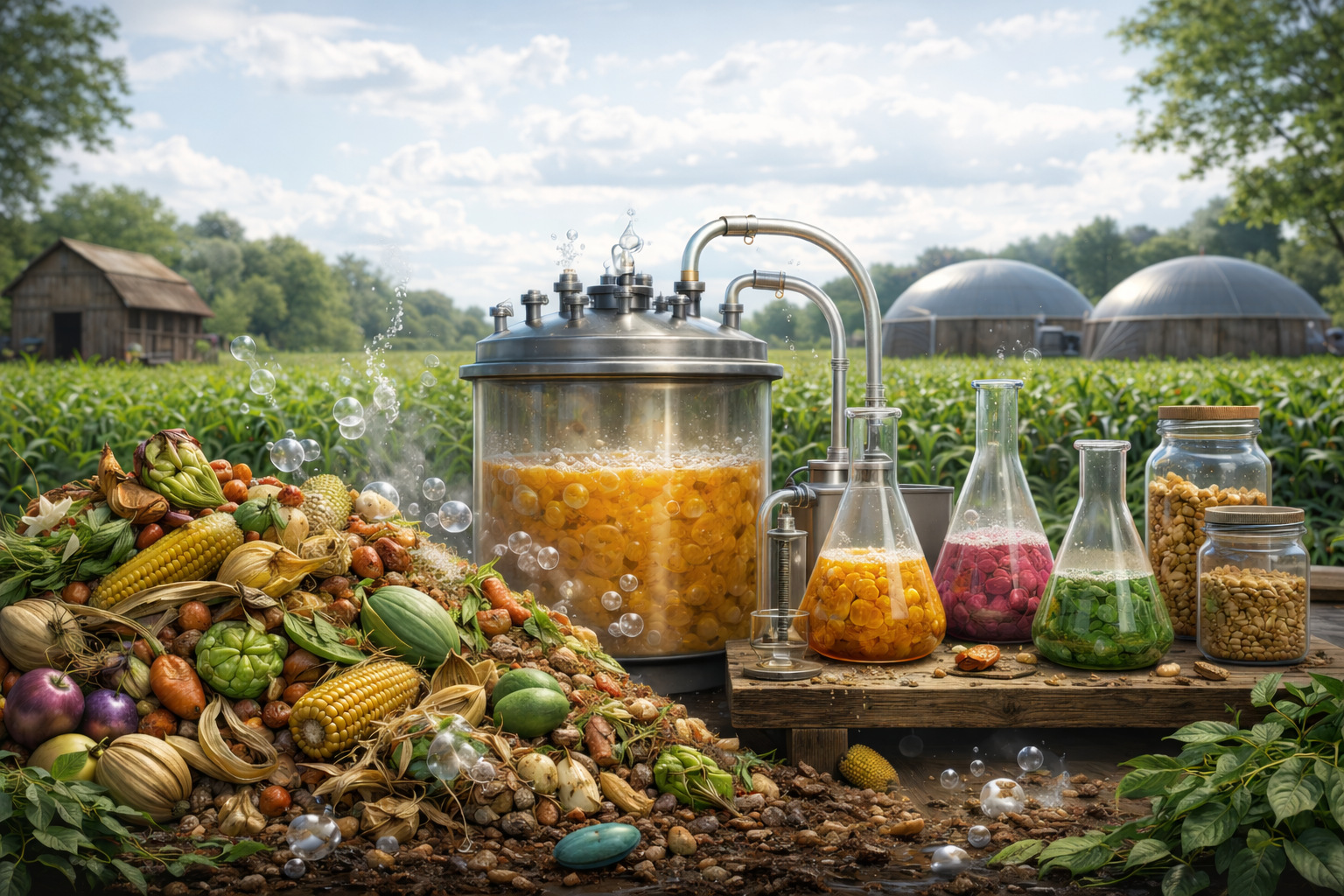
Fermentation exemplifies how controlled microbial ecosystems can unlock circular value — transforming diverse organic residues into clean energy, bio-based chemicals, and climate-smart materials with industrial impact, high economic and social value.
Fermentation technology refers to the use of microorganisms under controlled conditions to transform organic residues—such as food waste, agricultural by-products, sludges, or even waste gases—into valuable products like biogas, platform chemicals, biofertilizers, or bio-based materials.
Unlike aerobic composting, which mainly stabilizes organic matter through oxidation, fermentation takes place under anaerobic or low-oxygen conditions, allowing microbes to break down complex organic compounds into simpler molecules through metabolic pathways such as acidogenesis, acetogenesis, and methanogenesis.
In typical processes, organic residues are collected and sometimes pretreated (e.g., screened, shredded, or buffered) to improve uniformity. Then, the material is fed into bioreactors or fermentation heaps, where microbial communities convert the feedstock over days or weeks. Depending on the specific process:
- Anaerobic digestion produces biogas (mainly CH₄ and CO₂).(7)
- Acidogenic fermentation is stopped early to accumulate volatile fatty acids (VFAs), which are platform chemicals.(8)
- Chain elongation uses these VFAs to produce medium-chain carboxylic acids (MCCAs), such as caproic acid.(9)
- Solid-state fermentation produces enzymes or bioactive compounds on moist solids with minimal water use.(9)
- Gas fermentation uses specialized microbes to convert waste gases like CO or syngas into fuels or chemicals.(10)
As introduced earlier, fermentation leverages microbial ecosystems under controlled conditions to unlock value from organic residues—enabling a broad set of applications that range from energy and nutrient recovery to bio-based material production. Unlike traditional disposal or composting, fermentation enables deep resource recovery, generating both energy and carbon-rich compounds that feed into circular production systems. In recent years, innovations in membrane separation, in situ product recovery, and microbial consortia design have significantly improved process efficiency and selectivity, particularly for recovering unstable intermediates like volatile fatty acids or medium-chain carboxylic acids.
At the same time, fermentation is becoming more accessible and adaptable thanks to modular and decentralized reactor systems that allow for smaller-scale deployments near the waste source. This opens opportunities for localized transformation in places like food markets, apartment complexes, and agricultural settings—reducing transport emissions and treatment costs.

F2 “Círculos de transformación” An interpretation from illustrator Nonno on how microorganisms orchestrate a silent transformation — turning organic residues into clean energy, bio-based chemicals, and new materials. The piece reflects the circular dance of life and matter within controlled microbial ecosystems, where waste becomes the beginning of something valuable again.
Regulatory trends, such as landfill restrictions, feed-in tariffs, and carbon incentives, combined with the growing demand for bio-based alternatives in sectors like agriculture, packaging, and biomanufacturing, are creating favorable market conditions for adoption and investment.
Fermentation clusters a platform of microbial technologies capable of generating diverse outputs depending on the feedstock, operating conditions, and target application. From energy recovery to fine chemical production, it bridges biological efficiency with industrial relevance. Its flexibility allows it to be deployed across geographies and scales, offering climate impact reduction and economic opportunity. In this context, fermentation is a strategic enabler of localized, circular, and low-emission economies.
The performance of fermentation systems depends heavily on the quality and consistency of the input material. High moisture content, non-separated waste, or contamination with plastics and metals can disrupt microbial activity and reduce yields. This is especially critical in decentralized or community-scale systems, where feedstock streams are often mixed and variable. Success in fermentation requires well-designed collection, sorting, and pretreatment strategies to ensure stability and maximize value recovery.
| Technology name | Product | Process | Feedstock | Differences | TRL |
|---|---|---|---|---|---|
| Chain Elongation | Medium-chain carboxylic acids | Uses mixed cultures to convert VFAs + electron donors. | VFAs produced upstream + organic residues supplying donors. |
|
4-6 |
| Acidogenic Fermentation | Volatile fatty acids | Intentionally stop the AD process early, before methanogenesis, to accumulate VFAs | Organic residues, often food/agro waste. |
|
5-7 |
| Solid-State Fermentation | Enzymes, Acids, Bioactives | Microorganisms grow on solid moist substrates, without free water. | Agro-residues, food processing by-products. |
|
6-8 |
| Gas Fermentation | Ethanol/ Sustainable Aviation Fuel | Ferment waste gases (CO, CO₂, H₂) or syngas using specialized acetogenic microbes. | Industrial off-gases (steel mills, refineries), or syngas from biomass. |
|
8-9 |
| Anaerobic Digestion | Biogas / Biomethane | Multi-stage microbial breakdown of organics → mainly methane (CH₄) + CO₂. | Food waste, manure, sewage sludge, municipal organic fraction. |
|
9 |
From the energy-oriented logic of anaerobic digestion to the precision chemistry of chain elongation or solid-state fermentation, each pathway plays a distinct role in turning organic residues into value-added outputs.
While technological readiness levels (TRLs) and market maturity vary, their convergence signals a maturing bioeconomy where waste is a productive input rather than a liability.
The most scalable opportunities arise when these processes are integrated—linking, for instance, acidogenic fermentation with chain elongation or gas
fermentation with carbon capture—to create modular, circular systems adaptable to local contexts. Ultimately, the strength of fermentation lies on its biological efficiency and in its capacity to bridge sustainability, profitability, and decentralization—paving the way for cities and industries to transform waste streams into renewable energy, biochemicals, and climate-smart materials.
This diversity of pathways allows tailoring solutions to different waste streams, scales, and market opportunities — from on-site energy production to feedstock for green chemistry
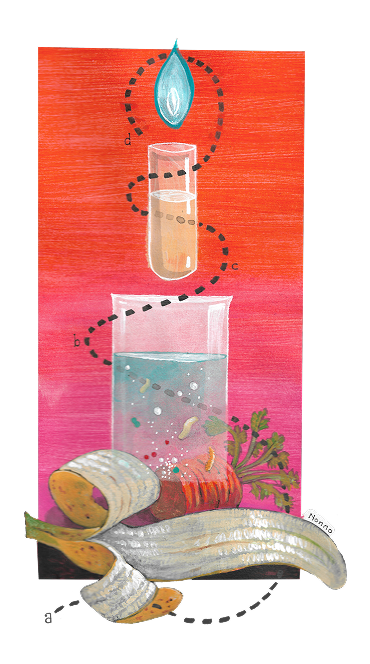
F1 “El fuego bajo la cascara”. An interpretation from illustrator Nonno that follows the invisible journey of food waste—from banana peels and vegetable scraps to microbial breakdown inside a bioreactor. Through fermentation, matter is transformed: organic residues bubble and dissolve under the surface, releasing a gas that rises—quiet, invisible, and full of potential. The flame at the top symbolizes this rebirth as usable energy.
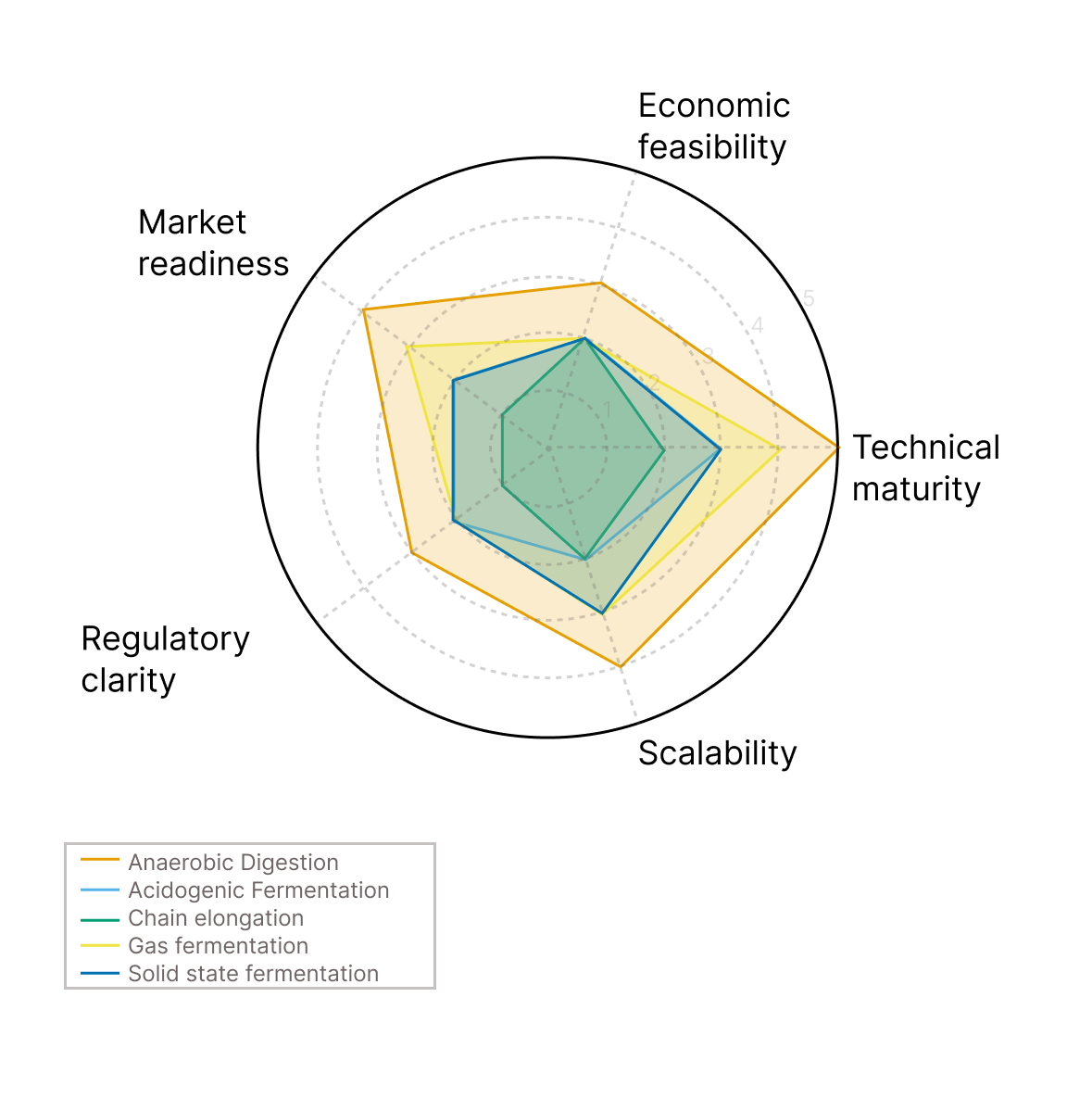
The radar chart shows that Anaerobic Digestion (AD) is the most mature and balanced technology, with high technical readiness and scalability, though it still faces moderate economic and regulatory barriers.
Gas fermentation demonstrates strong technical maturity but is limited by high capital costs and regulatory dependency, making it more suited for large industrial integrations.
By contrast, VFAs and MCCAs are at earlier stages of development, with significant technical, economic, and market readiness gaps, particularly around process control, downstream processing, and immature markets.
SSF occupies a middle ground, offering niche opportunities but facing scaling and standardization challenges.
Overall, the chart highlights a clear maturity gap between energy-focused routes (AD, gas fermentation) and emerging chemical valorization routes (VFAs, MCCAs), indicating where R&D, market development, and policy support should be prioritized.
While fermentation is technically proven, its full deployment requires overcoming a combination of feedstock, economic and regulatory barriers that differ significantly between energy-focused and chemical-focused pathways

F3 “Masas en equilibrio” An interpretation from illustrator Nonno on how organic matter can be transformed from waste into energy, and how this in a way represents an underseen opportunity seating under our ground, just as oil did before it was industrialized. At the end, it is all about a mass and energy balance.
In urban and peri-urban areas, food service establishments and residential buildings generate large amounts of wet organic waste that are costly to collect and difficult to compost due to moisture content and odor generation. In 2023, a pilot initiative in Seoul, South Korea, tested small-scale anaerobic fermentation units designed for apartment complexes, each processing 200–300 kg of food waste per day. The system aimed to cut municipal transport costs while producing biogas and nutrient-rich digestate for local reuse.
Process and Technology
The units operated under mesophilic conditions (35–38 °C) and used a two-stage fermentation process:
- Hydrolytic–acidogenic stage: breaking down food waste into volatile fatty acids (VFAs).
- Methanogenic stage: converting VFAs into biogas (≈ 60% CH₄).
Feedstock was a mixture of household food scraps pre-treated with mechanical shredding and dilution (~10–12% solids). The biogas was captured and used on-site to heat water for the building, while the digestate was dewatered and co-composted with yard residues.
Results
- Biogas yield: 80–100 m³ per ton of food waste, covering ~25% of the building’s hot water energy needs.
- GHG reduction: estimated 0.5 t CO₂-eq saved per ton of waste diverted from landfill.
- Economic performance: payback estimated at 4–5 years compared to centralized collection fees.
- Social acceptance: odor-free operation and visible reuse of heat improved resident engagement.
Impact
The case demonstrates that fermentation can operate efficiently at community scale, turning local waste into tangible energy and soil benefits. Decentralization reduces transport emissions and strengthens local energy autonomy — especially valuable in dense urban environments.
Key Takeaways
- Efficiency: well-managed fermentation systems can achieve high yields, even at small scale, when feedstock quality and operating conditions—such as pH, temperature, and retention time—are optimized.
- Adaptability: modular units allow replication in housing complexes, markets, or canteens.
- Scalability: integration with district energy systems or local composting loops amplifies impact.
- Relevance for startups: strong fit for business models focused on decentralized infrastructure or circular energy services.
Adapted from: Park et al. (2024). Performance evaluation of small-scale anaerobic food waste digesters in urban residential complexes. Waste Management, 169, 234–247. Sharma et al. (2024). Sustainable Organic Waste Management and Techno-Economic Perspectives. Current Pollution Reports. Kaza et al. (2018). What a Waste 2.0: A Global Snapshot of Solid Waste Management to 2050. World Bank.

Waste Culture (2024). On-site Zero Food Waste in High-rise Building Complex of 1,451 Households in Seoul, Korea. Waste Culture — Best Practice Series.
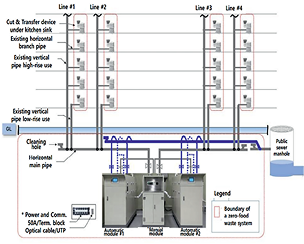
Layout of zero-food waste system for high-rise residential building
Waste Culture (2024). On-site Zero Food Waste in High-rise Building Complex of 1,451 Households in Seoul, Korea. Waste Culture — Best Practice Series.
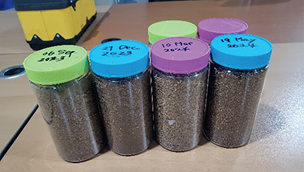
Photos of recovered biomass stored at room temperature for 280 days, 140 days, 70 days, and 1 day since September 6, 2023
Waste Culture (2024). On-site Zero Food Waste in High-rise Building Complex of 1,451 Households in Seoul, Korea. Waste Culture — Best Practice Series.
Below are three startups applying fermentation technologies to convert organic waste into valuable products. Each represents a distinct pathway within the biological valorization landscape — from anaerobic fermentation and gas fermentation to microbial bioconversion — showcasing how circular innovation can operate across regions and scales.
| Name | Region/ Country | Method | Waste feedstock | Product/value | Stage |
|---|---|---|---|---|---|
| Xilinat | Mexico | Aerobic fermentation for sugar alcohols. Xilinat developed a biotechnological fermentation process that converts corn cobs (olote) — a low-value agricultural residue — into xylitol, a natural low-calorie sweetener. The process uses aerobic microbial fermentation to convert xylose into xylitol, replacing energy-intensive chemical synthesis from wood. | Corn cobs, one of Mexico’s most abundant yet underutilized residues, often burned after harvest. | Avoids emissions from open burning — an estimated 6 tons of CO₂ avoided per ton of xylitol produced. Strengthens rural circular economies by creating income streams for smallholder farmers who supply residues. |
Pilot to early commercial. (2017) |
| Mango Materials | USA | Gas fermentation using methanotrophic bacteria Employs methane fermentation to produce polyhydroxyalkanoate (PHA) — a biodegradable polymer similar to polypropylene. Methane from landfills and wastewater biogas is fed to methanotrophic microbes that convert it into PHA granules under controlled aerobic fermentation. | Biogas methane captured from waste treatment plants and landfills — a greenhouse gas 25× more potent than CO₂. | Reduces methane emissions from waste infrastructure while displacing fossil-based plastics. PHA produced is used in consumer goods (e.g., eyewear, soap cases, and footwear components). Represents a carbon-negative fermentation process integrating waste management and sustainable materials. |
Demonstration / industrial scale-up. |
| NoMy (Norwegian Mycelium) | Norway / Japan | Applies solid-state and submerged fermentation using select filamentous fungi to convert local organic side-streams—such as brewers’ grains, coffee residues, and agricultural by-products—into mycoprotein and bio-based materials. | Converts agricultural byproducts / food waste via proprietary mycelium fermentation into sustainable protein ingredients. | “MycoPrime” protein ingredients for human / animal food supply chains. | Growing operations. |
Together, they illustrate the technical breadth and market versatility of fermentation — from decentralized bio-refineries to industrial bioprocesses — and the kind of innovation opportunities Activae tracks within the Food to Value research series.
Deep tech investors are driving capital toward biotechnologies that link materials, sustainability, and climate impact — positioning fermentation within the broader circular innovation landscape.
| Name | Website | Region/ Country | Size of current fundsSector | Sector | Additional info |
|---|---|---|---|---|---|
| Circular innovation fund | https://circulari nnovation fund.com/ | Canada | EUR 150 M | Food & agriculture | Circular economy, recycling, waste solutions, logistics, distributions |
| Circulate capital | https://www.ci rculatecap ital.com/ | Singapore | EUR 25 M | Food & agriculture | Preventing oceans plastic, waste management and recycling |
| Indico capital partners | https://www.ind icocapita l.com/ | Portugal | EUR 76 M | Food & agriculture | Ocean Tech: Sustainable Aquaculture and Fisheries, Blue BioTech, Digital Ocean, Waste and Circular Economy, Green shipping, Ocean Renewable Energy |
| Structure capital | https://structu re.vc/ | USA | – | Food & agriculture | All related to zero waste |
| AgriTech hubs | http://agritech hub.com/ | Poland | – | Food & agriculture | – |
| Flora ventures | https://www.flor avc.com/ | Israel | EUR 80 M | Food & agriculture | Sustainable agrifood startups |
| Ventures platform | https://www.ven turespla tform.com/portfolio | Nigeria | EUR 40 M | Food & agriculture | Fintech, Edtech, Agritech, Food Science, Healthtech, Bioscience, Enterprise SaaS and digital infrastructure |
For early-stage startups, grants remain critical to bridge research and market readiness, enabling the validation and scaling of fermentation-based solutions.
| Program | Region/ Country | Stage | Website | Amount | Description |
|---|---|---|---|---|---|
| Big Small Business Project | Serbia | Grant | https://velikamal aprivreda.rs/en/grants/ | – | The USAID Big Small Businesses Project, led by ACDI/VOCA and partners, supports Serbian MSMEs in Agriculture & Food and Equipment & Machinery, promoting integration into higher-value markets and sustainable, inclusive growth. Through the TPI APS 2023-01 grant program, the project seeks private-sector partners to co-create market-driven solutions that advance digitalization, green innovation, and opportunities for women and youth. EOIs are open from June 21, 2023, to April 30, 2024. |
| Op Zuid | Netherlands | Grant | https://innovenci o.nl/op-zuid-efro/ | 1M EUR | Regional grant funded by the European Regional Development Fund (ERDF) and distributed through OP Zuid, aiming to leverage the local innovation ecosystem in southern Netherlands to create economic and social impact in energy, climate, raw materials, agriculture, food, and health. |
| Young Agririan | Czech republic | Government, Grant | https://www.szif.c z/cs/prv2014-611 | 45k EUR | The Czech Republic has a tradition of supporting young agricultural entrepreneurs. In 2015-2020 support for young agrarian entrepreneurs is being provided via EU funding for persons interested in starting their entrepreneur activity in agriculture up to 40 years of age. The maximum subsidy is up to 45 000 EUR. |
Investing in fermentation technologies for organic waste offers a unique combination of environmental impact, market diversification, and technological scalability. Unlike many conventional waste management or energy solutions, fermentation sits at the intersection of waste valorization, decarbonization, and bio-based production, enabling investors to tap into multiple revenue streams — energy, chemicals, biofertilizers, and carbon credits — from a single feedstock source.
There are many examples of startups, we showcase that a growing ecosystem isn’t a sign of saturation, but rather a sign of a rapidly maturing ecosystem. Established players validate the technical feasibility and market potential, while emerging startups open niche innovation opportunities in pre-treatment, microbial engineering, downstream recovery, and modular deployments.
Moreover, global trends such as decarbonization targets, waste diversion policies, and the shift toward circular economies are creating strong regulatory tailwinds.
Key insights
- Fermentation is a suite of biotechnologies that convert organic waste into energy, chemicals, and fertilizers—creating value from waste across multiple industries.
- New fermentation routes target premium markets, producing VFAs and MCCAs for bioplastics, feed, and green chemistry—beyond traditional biogas.
- Modular fermentation systems reduce logistics costs, enabling on-site deployment in buildings, farms, or campuses—ideal for decentralized waste management.
- Different pathways serve different goals—from low-CAPEX energy recovery to high-value chemicals—offering diverse entry points for investment.
- Fermentation supports climate and circular goals, turning waste into low-carbon materials, closing nutrient loops, and enabling local, profitable circular economies.
If you’re a startup refining your strategy to scale, structuring your data room, or tackling manufacturing challenges—or an investor seeking technical diligence to de-risk a thesis or explore new spaces in the circular bioeconomy—we can help. Let’s connect to turn organic waste into local value.
References
[1] Kaza et al. (2018) What a Waste 2.0, World Bank.
[2] Eurostat (2024). Waste Generation in Europe.
[3] Christian et al. (2017). Reviews on Environmental Science and Bio/Technology.
[4] Bakan et al. (2021). Waste and Biomass Valorization.
[5] Hitman et al. (2013). Feed Innovation Services BV.
[6] Yamada et al. (2012). Waste Management.
[7] Sharma et al. (2024). Sustainable Organic Waste Management and Techno-Economic Perspectives. Current Pollution Reports.
[8] Wang et al. (2023). Advances in MCCA Production via Chain Elongation. Chemosphere.
[9] Pallín et al. (2024). Scale-Up of Fungal Pretreatment of Wheat Straw (Irpex lacteus) under SSF. Waste and Biomass Valorization.
[10] Resch et al. (2025). Upstream Considerations for Gas Fermentation Processes. Current Opinion in Biotechnology.
[11]Hitman et al. (2013). Fermentation versus composting.
[12] Resch et al. (2025). Upstream considerations for gas fermentation processes. Current Opinion in Biotechnology.
Table 1. MAIN TECHNOLOGICAL SUB BRANCHES
Kaza, Silpa et al. What a Waste 2.0: A Global Snapshot of Solid Waste Management to 2050. World Bank, 2018. Christian, Riuji Lohri et al. Treatment Technologies for Urban Solid Biowaste to Create Value Products: A Review with Focus on Low- and Middle-Income Settings. Reviews on Environmental Science and Bio/Technology, 2017. Bénédicte, Bakan et al. Circular Economy Applied to Organic Residues and Wastewater: Research Challenges. Waste and Biomass Valorization, 2021. Yang, J. et al. Ammonia Inhibition in Anaerobic Digestion of Organic Waste: A Review. International Journal of Environmental Science & Technology, 2025. Wang, Y. et al. Advances in MCCA Production via Chain Elongation. Chemosphere, 2023. Resch, M. et al. Upstream Considerations for Gas Fermentation Processes. Current Opinion in Biotechnology, 2025.
Figure 1.
Hitman et al. (2013). Fermentation versus composting.
Related Posts
Venture Building as a Regional Strategy for DeepTech Impact
In emerging regions, a significant portion of scientific and technological…

Beyond Climate: Understanding Systemic Risk Across Planetary Boundaries
Anthropogenic activity has a direct and measurable impact on the…

Beyond the Dashboard: How AI Is Outpacing the System’s Ability to Execute
The energy transition is often discussed in terms of better…