Water stress in agriculture
Water constraints affect agricultural decisions well before a crop shows visible signs of stress. Planting area, crop selection, irrigation infrastructure, and expected harvests depend on assumptions about the water available throughout the growing season. When rainfall, allocations, or delivery conditions change, growers may have to reconsider those decisions after committing capital, labour, and inputs.
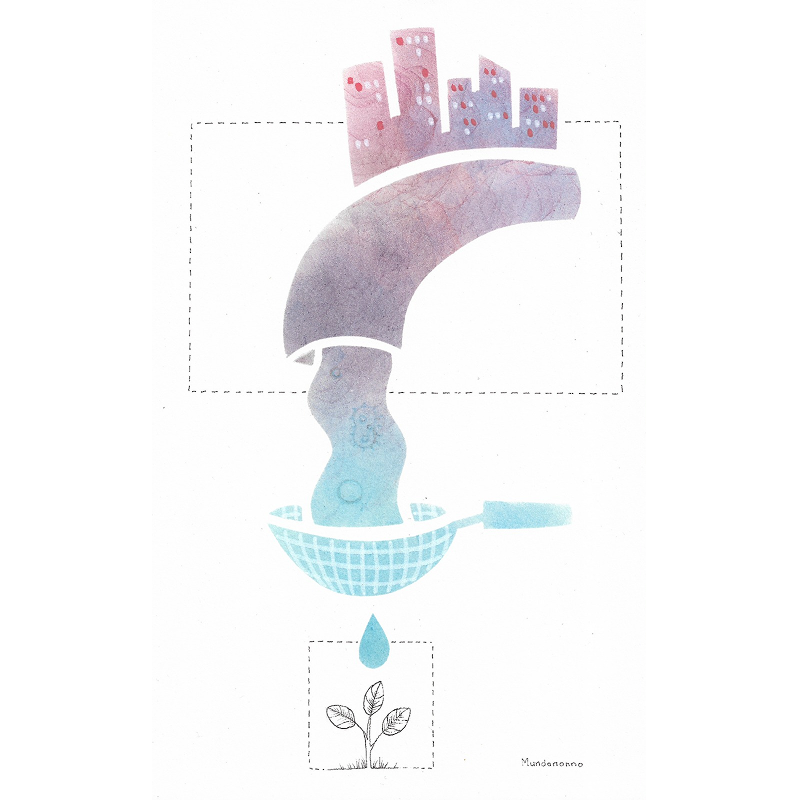
The point at which the constraint occurs determines the scope for intervention. In rainfed agriculture, the challenge may involve retaining rainfall in the soil or bridging a dry period during crop development. An irrigated farm may face restrictions at its source, unreliable delivery, or limited control over when water reaches the field. Each situation creates a different requirement for technology, infrastructure, and
management.
AgriTech can help measure these conditions, inform decisions, and improve control over water. Its value depends on whether those capabilities address the constraint that limits production. Evaluating that contribution requires connecting crop performance with the availability of shared water resources and the practical conditions under which farmers operate. This article examines that connection, following water from its source to the crop and assessing the technologies, evidence, and commercial conditions that can support more resilient agricultural production.
Water stress takes different forms
Agriculture accounted for 72% of global freshwater withdrawals in 2023, according to the FAO (Food and Agriculture Organization). This measures the water extracted from sources such as rivers, reservoirs, and aquifers. Understanding the resulting pressure requires examining how much water is available locally, when it is withdrawn, and how it moves through the agricultural system after use. The global share establishes agriculture’s importance in water management; local conditions determine the intervention required. [1]
The geographic exposure is substantial. In The State of Food and Agriculture 2020, the FAO estimated that 3.2 billion people lived in agricultural areas experiencing high or very high water shortages or scarcity, including 1.2 billion in areas facing very high constraints. These estimates encompass both water stress affecting irrigated agriculture and recurring drought affecting rainfed production. They describe populations living in exposed agricultural areas, with different constraints across farming systems and locations. [2]
Irrigation also concentrates significant economic value. The FAO reports that 23% of global cropland is equipped for irrigation and that irrigated land produces 48% of global crop value. This makes reliable water delivery an important condition for protecting agricultural investment. It also raises a strategic question: where can additional irrigation support production within sustainable resource limits, and where must existing demand be adjusted to preserve future access? [3]
The distinction becomes clearer when water availability and access are considered separately. Water may exist within a region but remain inaccessible to farmers because delivery infrastructure, services, or allocation arrangements are inadequate. Elsewhere, established irrigation infrastructure may depend on a resource already under substantial pressure. The FAO identifies physical availability, access arrangements, and infrastructure as distinct dimensions of water scarcity. A diagnosis therefore needs to establish which of these limits the agricultural operation. [4]
The World Bank’s 2026 report Nourish and Flourish illustrates the different investment priorities this creates. In much of Sub-Saharan Africa, expanding agricultural water use within sustainable limits could support food production and employment. In many parts of South Asia, the priority is improving management to reduce water consumption while maintaining economic returns. These regional patterns provide a starting point for analysis; individual projects still require assessment of local water resources, agricultural conditions, and competing demands. [5]
For technology developers and investors, these differences shape the opportunity. Expanding access requires identifying a sustainable source and establishing an affordable delivery service. Improving an existing irrigation operation requires understanding what prevents available water from being used productively. Addressing pressure on a shared resource requires examining the effects of an intervention beyond the participating farm.
The first task is therefore to locate the constraint and define the intended outcome. That diagnosis provides the basis for selecting a technology and evaluating its performance. The next step is understanding the water balance: what enters the agricultural system, what the crop consumes, what remains stored, and what becomes available elsewhere.
The water balance behind the technology
Evaluating an agricultural water technology begins with defining the system being measured. At field level, the water balance accounts for rainfall, irrigation, and, where relevant, groundwater moving upwards into the root zone through capillary rise. These inputs must be reconciled with changes in soil-water storage, evaporation, plant transpiration, surface runoff, and drainage below the roots. Tracking these components over time helps establish when irrigation is needed and what happens to the water applied. [6]
The interpretation changes when the assessment expands from a field to an irrigation scheme or river basin. Water draining below the roots may recharge an aquifer, while runoff may become available downstream. Its recoverability depends on where it goes and whether it remains accessible and suitable for subsequent use. Consequently, a flow leaving one farm can still contribute to another user’s supply. FAO’s water-accounting approach explicitly considers these connections when assessing irrigation interventions. [7]
This distinction is central to evaluating claims of water savings. The FAO describes apparent savings as reductions in withdrawals that do not account for changes in consumption. Real savings account for reductions in water consumption and non-recoverable flows, making water available for alternative uses. Establishing that result requires following the affected flows across an appropriate boundary and period. Measuring the volume delivered to a field provides one component of that assessment. [8]
An FAO comparison of surface and drip irrigation in the Shiraz region illustrates the importance of this accounting. In the example, introducing drip irrigation increased water consumption and substantially reduced return flows that had largely been recoverable. The example demonstrates how improved application efficiency can alter the distribution of water within a wider system. Its implications depend on the balance between crop consumption, return flows, and the water available to other users. [9]
Water productivity introduces a related measure of performance. Physical crop water productivity expresses agricultural output per unit of water consumed, commonly in kilograms per cubic metre. FAO’s WaPOR approach uses actual evapotranspiration to represent agricultural water consumption. Productivity can therefore improve through higher output, lower consumption, or changes in both. A higher ratio needs to be interpreted alongside the absolute volumes involved and the area cultivated. [10]
The following framework separates the outcomes a technology might claim:
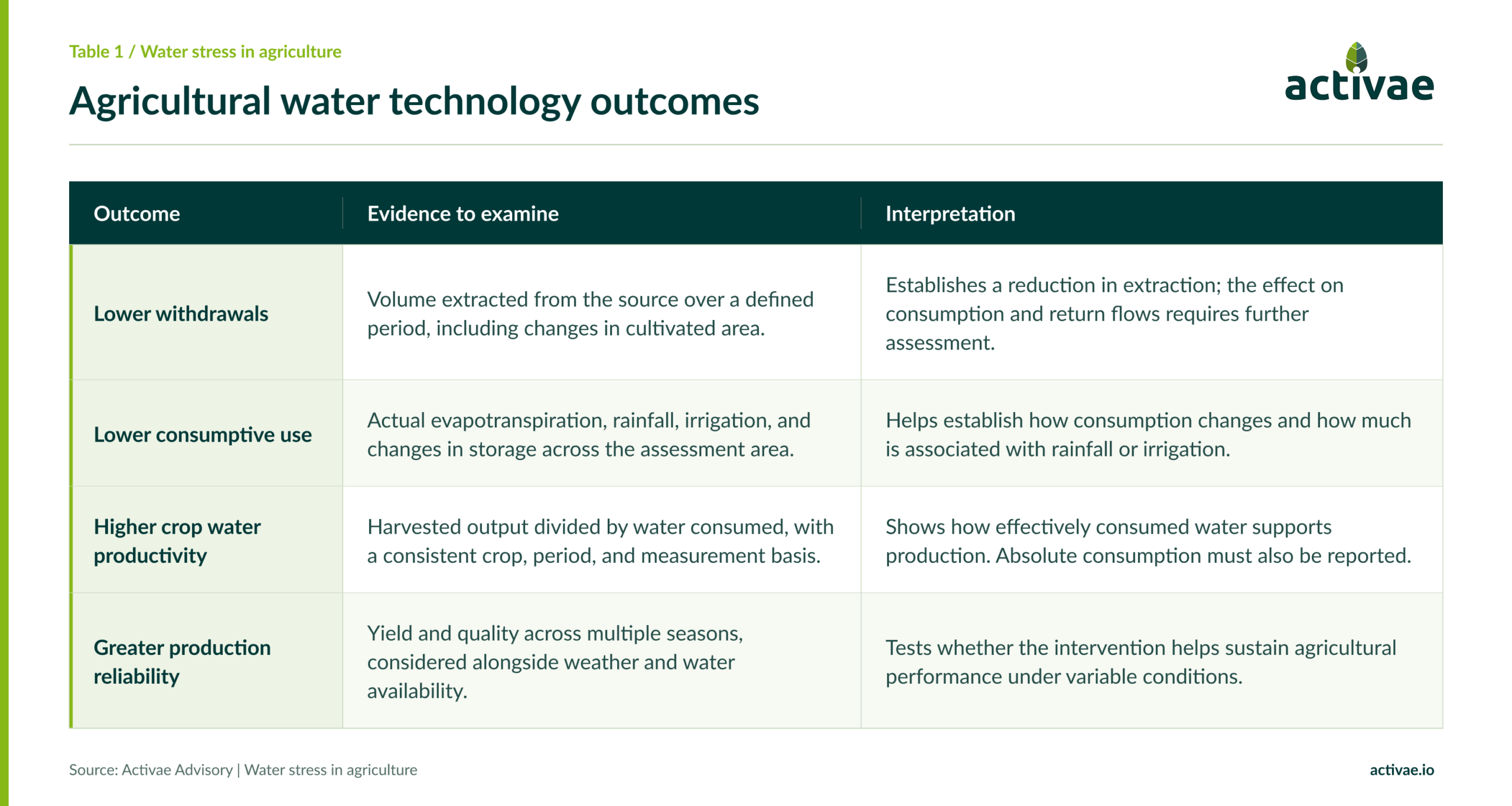
Applying these measures requires a clearly stated baseline. An assessment should identify the crop, cultivated area, accounting boundary, and observation period, while documenting rainfall, soil-water storage, and measurement uncertainty. Otherwise, a change attributed to technology may partly reflect a wetter season, a different crop, or water drawn from storage. Expansion of the irrigated area must also be included: improved control can enable additional production and increase total consumption. [11]
For AgriTech, this framework establishes a practical basis for product evaluation. A solution can improve irrigation control, agricultural output, or production reliability, with different consequences for the wider resource. Identifying those consequences allows developers, users, and investors to specify the outcome being pursued and the evidence required to demonstrate it.
Where technology can improve agricultural water management
Agricultural water technologies intervene at different points in the water balance. Some increase the water available to a crop; others improve measurement, guide irrigation decisions, control delivery, or make an additional source usable. These functions often depend on one another. Their contribution becomes clearer when each is assessed against the physical constraint it addresses and the conditions required for it to operate.
Capturing rainfall and retaining moisture
In rainfed systems, water harvesting changes where rainfall runoff goes and when it becomes available for production. Structures that slow and spread runoff encourage infiltration into cultivated soil. Ponds, tanks, and small reservoirs provide storage from which water can later be delivered. The FAO distinguishes storage as soil moisture, groundwater recharge, and surface water, each serving a different role in buffering rainfall variability.
The distinction matters for design. Increasing infiltration can replenish moisture within the root zone, while stored surface water can support supplementary irrigation during a subsequent dry period.
Soil-moisture conservation and agronomic practices must complement the intervention so that captured water remains useful to the crop. FAO identifies this combination of harvesting, conservation, supplementary irrigation, and improved distribution as an important pathway for improving rainfed production.
Evaluating a storage project therefore requires matching its expected inflows and usable capacity to crop demand. The assessment should account for storage losses, maintenance, and the means of delivering water when required. A storage structure’s nominal capacity provides only part of the information needed to establish how reliably it can support production.
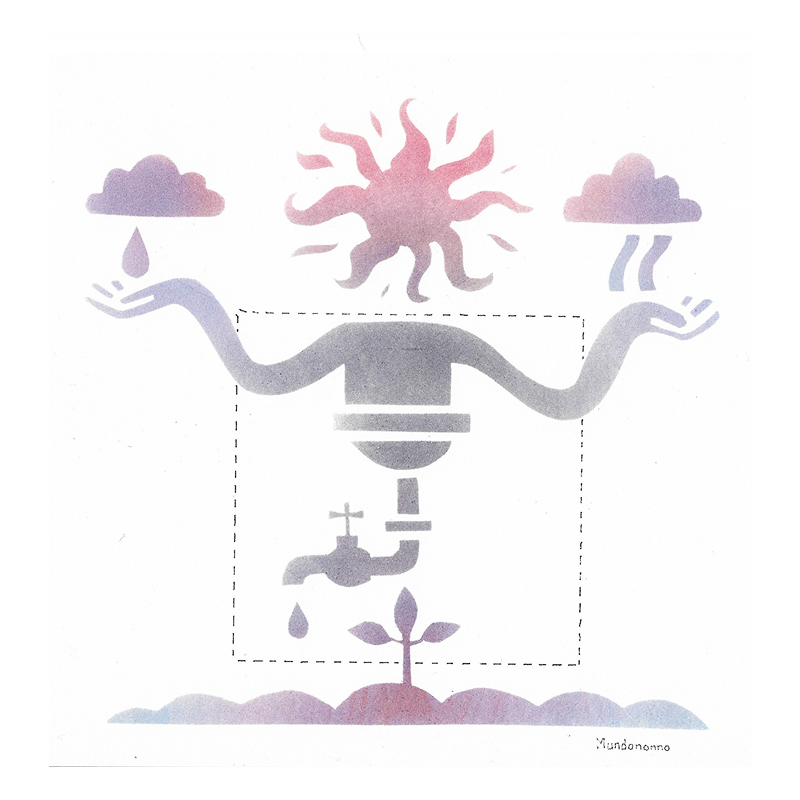
Measuring the root zone and the wider landscape
Soil sensors measure different properties. Tensiometers measure soil-water tension, indicating the suction associated with extracting water from the soil. Dielectric sensors, including capacitance and time-domain reflectometry devices, estimate volumetric water content from the soil’s electrical response. Interpreting these readings requires attention to soil characteristics, installation depth, contact with the soil, and the calibration requirements of the instrument. A measurement represents conditions around the sensor; its relevance to the wider field depends on placement and spatial variability.
Satellite-based systems offer a broader view. FAO’s WaPOR provides estimates of actual evapotranspiration, biomass production, and water productivity at several spatial resolutions, including 20-metre data for selected irrigation schemes and sub-basins. These layers can reveal differences within and between agricultural areas. Their operational use depends on the observation period and processing delay: some products are aggregated over ten-day periods, with near-real-time versions released after those periods end.
Combining these sources can connect landscape patterns with local conditions. Satellite estimates can help identify areas requiring investigation, while field sensors and weather observations can support interpretation at the crop level. The integration task includes aligning location, depth, timing, and measurement uncertainty before using the information to guide irrigation.
Turning observations into irrigation decisions
Decision-support systems translate observations into estimates of when and how much to irrigate. A daily soil-water balance tracks additions from rainfall and irrigation against evapotranspiration, drainage, and changes in storage. Crop characteristics and growth stage help determine how depletion should influence the irrigation schedule. FAO’s CROPWAT uses soil, climate, and crop data to calculate water requirements and evaluate schedules under different management conditions.
Crop-growth models extend the analysis to production outcomes. AquaCrop simulates the yield response of herbaceous crops to water availability and supports comparisons of irrigation strategies, planting dates, and management practices. Its assumptions also define its limits: standard field simulations assume uniform conditions within the assessed field, requiring care when applying results to spatially variable farms.
For a digital irrigation service, the practical task is to keep recommendations consistent with observed conditions and the delivery system. A schedule must fit the water available, the equipment’s capacity, and the periods during which irrigation can occur. This creates a clear distinction between generating a recommendation and enabling its execution.
Controlling water delivery
Delivery technologies determine how a schedule is implemented. Drip systems convey water through pipes and emitters positioned near the crop. Controllers, pumps, and valves regulate irrigation events, while pressure management and filtration help maintain consistent discharge. Suspended particles, biological growth, and mineral deposits can obstruct emitters, making water quality, line flushing, and maintenance integral to performance.
Variable-rate irrigation adds spatial control. On centre-pivot systems, application can be adjusted through changes in travel speed or independently controlled sprinkler zones. This allows irrigation prescriptions to reflect differences in soil, topography, or crop conditions across a field. The potential benefit depends on identifying meaningful variation and translating it into an appropriate application pattern.
Energy supply is another component of delivery. Solar-powered pumping can support irrigation where electricity or fuel access is constrained. Lower pumping costs can also make additional groundwater extraction more attractive, so system design must consider abstraction limits and groundwater monitoring alongside energy performance.
These technologies provide control over application. Their evaluation should establish whether the intended timing, flow, and distribution are achieved under actual operating conditions, using the accounting framework established in the previous section.
Expanding usable supply through treatment and reuse
Where existing freshwater supply is insufficient, treated wastewater, agricultural drainage, or saline sources may provide additional options. Their suitability depends on water composition, crop requirements, irrigation method, and local conditions. FAO’s approach matches treatment and management to the intended use, addressing risks from salinity, pathogens, chemical contaminants, and nutrient accumulation.
Treatment processes perform different functions. Biological treatment reduces biodegradable organic material; conventional filtration removes suspended particles; and disinfection targets pathogens. A treatment system may combine several stages, selected according to the source water and the required quality. Dissolved salts introduce a separate treatment requirement that conventional solids removal and disinfection do not resolve.
Reverse osmosis addresses this through membrane separation. Applied pressure drives water through a membrane, producing a lower-salinity permeate and a concentrated reject stream. The system consequently requires management of both product water and concentrate, together with energy inputs and membrane operation.
Agricultural viability depends on the full delivered-water cost and its compatibility with the production system. FAO identifies opportunities for desalination in high-value crops while highlighting cost, water chemistry, energy intensity, and brine management as important constraints. Treatment selection therefore needs to connect source quality with agronomy, operating capacity, and the value of the crop being supplied.
Technology groups and deployment requirements:
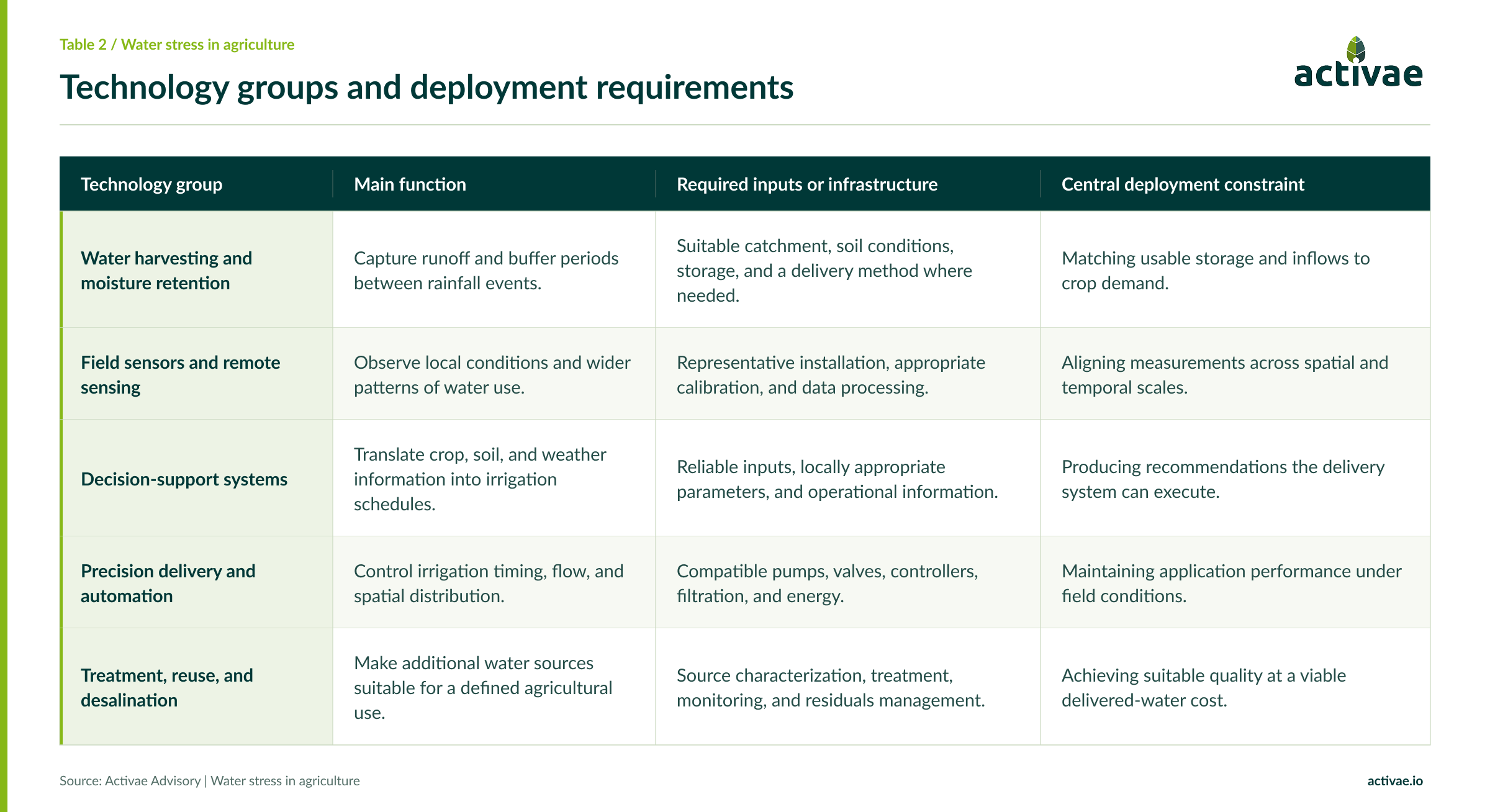
These groups form an operating chain in which performance depends on the interfaces between components. A sensor must inform a decision; that decision must reach controllable equipment; and the equipment must have a suitable water supply. Assessing how a venture manages those dependencies provides a useful basis for examining the startups developing agricultural water solutions.
From technical performance to adoption and investment
A successful field demonstration establishes performance under particular conditions. Building a commercial business requires showing how that performance creates value for a customer, how the solution will be operated, and whether its revenue can support continued delivery. Agricultural water ventures therefore need to connect three elements: a measurable outcome, an identifiable payer, and a repeatable operating model.
Identifying the paying customer
The farmer operating a technology, the organisation purchasing it, and the beneficiaries of improved water management may be different actors. A grower may pay for lower pumping costs, reduced supervision, or more reliable production. An irrigation operator may purchase monitoring and control equipment to improve delivery across multiple farms. A corporate water-stewardship programme may finance interventions with producers because it seeks benefits within a particular basin, as illustrated by Intel’s project with Kilimo and Nuup in Mexico. [12]
These arrangements require different commercial propositions. The venture must establish who controls the relevant budget, which outcome justifies expenditure, and who remains responsible for operation and maintenance. The World Bank’s irrigation guidance similarly distinguishes service contracts, infrastructure concessions, and farm-service arrangements, each allocating costs, responsibilities, and revenue differently. [13]
Demonstrating value over the operating season
The customer’s business case should compare changes in saleable production and avoided operating costs with the full cost of adopting the solution. Relevant expenditure can include installation, financing, subscriptions, energy, training, maintenance, and replacement. The IFC-IFAD Handbook for Scaling Irrigation Systems treats asset management, operating arrangements, and financing as connected components of irrigation development. [14]
The value calculation also needs to reflect how the farm actually incurs costs. Where water charges are low, reducing application volumes may generate limited direct financial savings. Avoided pumping, labour, or crop losses may provide a more relevant purchasing rationale. These benefits should be calculated separately to prevent double counting, with assumptions tested against crop prices, seasonal conditions, and equipment downtime. Payment timing matters as well: an investment can offer a positive return while remaining difficult to afford before harvest.
The supplier faces a corresponding calculation. Revenue must cover the equipment and software supplied, installation, field visits, customer support, and ongoing validation. A deployment that depends on intensive specialist attention needs a pricing and delivery model capable of funding that attention as the customer base grows.
Making deployment repeatable
Agricultural conditions vary, so expansion requires defining where the product can be delivered consistently. Relevant customer segments may share crops, soils, irrigation equipment, farm scale, or access to support. Establishing these boundaries helps a venture identify which elements can be standardised and which require local adaptation.
Evidence of commercial repeatability should therefore include installation time, support requirements, equipment availability, continued use, and customer renewal or repeat purchase. Where distributors, irrigation companies, or advisers deliver the service, their responsibilities and compensation also form part of the operating model. The World Bank’s Nourish and Flourish report emphasises accountable operators, cost recovery, and sustained service delivery as foundations for scaling agricultural water management. [5]
Matching financing to the business model
Financing should follow the expenditure being funded and the revenue available to repay it. Research grants can support experimental validation. Equipment finance or leasing may help distribute an upfront purchase over time. Subscriptions and service contracts can spread payments across the operating period, provided their fees cover the supplier’s continuing obligations. The IFC-IFAD handbook examines irrigation financing alongside the needs of farmers, equipment providers, financial institutions, and agricultural businesses. [14]
Larger storage, treatment, or desalination installations introduce longer-lived assets and additional operating responsibilities. Their assessment requires clear arrangements for supplying water, maintaining infrastructure, collecting revenue, and managing changes in demand. Public or corporate co-financing can support deployment, but the business case must identify which costs remain after the initial funding ends and who will meet them.
Investment readiness emerges from these connections. Technical results establish what a solution can do; customer behaviour indicates whether its value supports payment; operating records show what continued delivery costs. Bringing those forms of evidence together helps founders and investors judge where a venture is ready to expand and what must still be resolved.
Building agricultural resilience within water limits
Agricultural water innovation should strengthen the capacity to keep producing under changing conditions while preserving the resources on which future production depends. Achieving that requires decisions grounded in local realities: the source of water, the crop being grown, the infrastructure available, and the people responsible for operating it. These conditions determine which technological capabilities can become useful agricultural services.
Scaling a solution therefore involves establishing where its performance can be reproduced and what must be adapted between locations. Evidence from a particular soil, crop, or irrigation regime should inform the boundaries of deployment.
Commercial expansion can then build on that knowledge through suitable distribution partners, trained operators, and financing that supports continued maintenance. The resulting pathway gives innovation a stronger foundation for serving agricultural needs over successive seasons.
We see a practical role for connecting scientific evidence with these industrial and commercial decisions. Evaluating a technology’s claims, identifying applications where its benefits justify adoption, and helping ventures address the requirements of deployment can give founders a clearer route to market and investors a more grounded basis for allocating capital. Collaboration with growers, industry partners, and regional institutions can provide the test environments, operational knowledge, and infrastructure needed to advance that work.
The ambition is to make productive capacity more dependable within the water resources available. Progress should be visible in agricultural operations that can sustain performance, services that remain viable after initial deployment, and water outcomes that hold when assessed beyond the participating field. Those are the foundations on which agricultural resilience can be built.
References
-
FAO. SDG indicator 6 4 2 Level of water stress
-
FAO. The State of Food and Agriculture 2020 Overcoming water challenges in agriculture
-
FAO. Irrigation management
-
FAO. Water scarcity
-
World Bank. Nourish and Flourish Water Solutions to Feed 10 Billion People on a Livable Planet Key messages 2026
-
FAO. Crop evapotranspiration Chapter 8 Soil water balance
-
FAO. REWAS Real Water Savings tool
-
FAO. Guidance on realizing real water savings with crop water productivity interventions 2021
-
FAO. Real Water Savings in Agriculture Shiraz comparison
-
FAO. WaPOR data
-
FAO and FutureWater. REWAS Real Water Savings tool Technical document
-
Intel. Water restoration in Mexico Kilimo and Nuup project
-
IFC and IFAD. Handbook for Scaling Irrigation Systems 2022
-
FAO. Agricultural digitalization and automation in low and middle income countries Evidence from ten case studies 2022
-
FAO. Water harvesting and storage
-
FAO. Rainfed agriculture
- Virginia Cooperative Extension. Soil Moisture Sensors for Agricultural Irrigation An Overview on Sensor Types
- FAO. CROPWAT
- FAO. About AquaCrop
- New Mexico State University. Drip Irrigation for Row Crops
- Utah State University Extension. Precision Irrigation for Center Pivots Quickguide
- FAO. Non conventional water resources in agriculture
- US EPA. Guidelines for Water Reuse 2004
- US EPA. Overview of Drinking Water Treatment Technologies Reverse osmosis and nanofiltration
- FAO. Desalination for agricultural development Addressing opportunities and challenges
Authors

Maria Lozoya
Associate emerging technologies
Related Posts
The interaction between microorganisms, soil, and crops
How microbial technologies support crop nutrition and what determines their…
The resources behind a resilient city
Consider a city preparing for hotter, drier summers. Its water…
The invisible gap in Future Moblity
How devices, payments, data, identity systems, and algorithms are reshaping…