The resources behind a resilient city
Consider a city preparing for hotter, drier summers. Its water utility proposes additional treatment capacity, public buildings expand cooling, and food distributors invest in refrigerated storage. Each project addresses a credible vulnerability. Each may also assume that sufficient electricity, water, and supporting infrastructure will remain available when demand is highest. Evaluated separately, the investments can appear robust. Their combined requirements raise a harder question: can the resources supporting them sustain all three responses under the same stressed conditions?
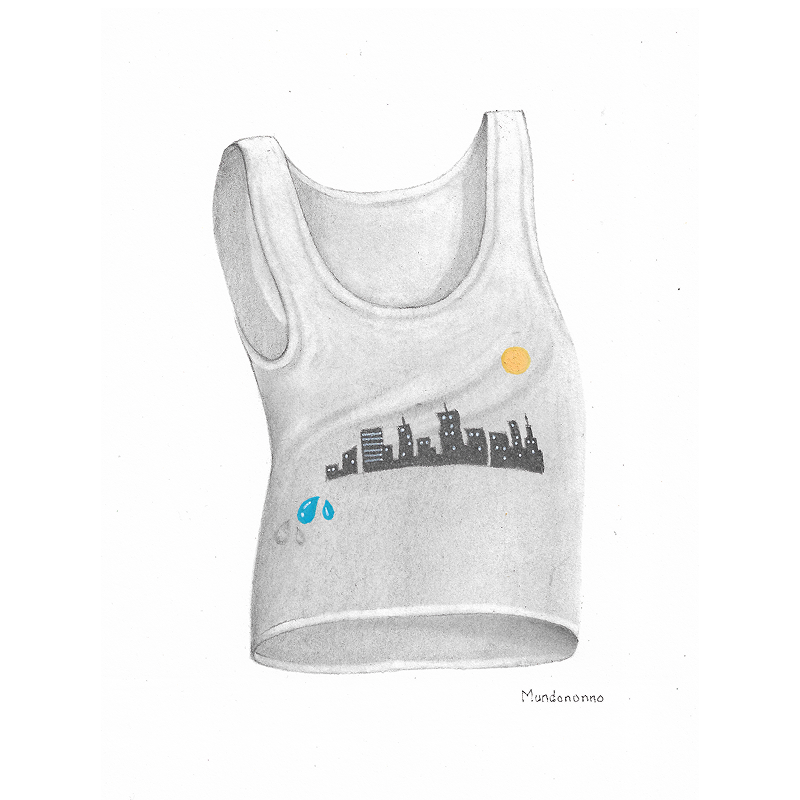
Camiseta.
A tank top immediately evokes heat, summer, and the need to stay cool or let the body breathe. Drawing a city skyline across the chest makes the visual metaphor clear: the entire city is sweating and struggling with the heat.
The consequences of shared constraints are already visible. In 2022, low hydropower availability in southern Europe increased pressure on electricity markets, while some French nuclear plants reduced output because of cooling-water limitations. During the same year, low water levels on the Rhine restricted the transport of coal, chemicals, and other materials. Water scarcity affected electricity generation and the movement of inputs needed by industry, transmitting pressure across several parts of the economy.
For urban resilience planning, these events expose a consequential investment problem. Several measures intended to reduce different vulnerabilities can concentrate dependence on the same resource or infrastructure. Additional capacity creates protection only to the extent that its operating requirements remain achievable during disruption. A project’s contribution therefore depends on how its demand interacts with other essential uses, including those beyond the city’s boundaries.
The Food and Agriculture Organization of the United Nations (FAO) work on the water–energy–food nexus identifies this tension: decisions within one sector can create competing demands, conflicting objectives, and consequences for investment elsewhere. Applying that perspective to urban resilience means examining how individual projects change the conditions under which other services must operate.
This has direct implications for DeepTech development and deployment. Performance under normal operating conditions provides an incomplete basis for evaluating a technology intended to protect essential services. Its value also depends on the resources it requires during scarcity, the flexibility of those requirements, and its ability to reduce pressure on shared constraints. These factors influence operating costs, deployment choices, and the credibility of the market it can serve.
This article examines urban resilience through that lens: how efforts to secure essential services interact, where they can transfer vulnerability, and where technological innovation can improve their ability to function together. The analysis extends into the territories supplying cities, where urban demand meets the resources and productive capacity sustaining everyday life.
When resource constraints become operating limits
Resource competition becomes an operational problem when essential activities can no longer obtain the inputs required to maintain service. The consequences take different forms: electricity must be rationed, water allocations are reduced, or reliable supply becomes more expensive.
The underlying exposure is substantial. WRI’s 2023 Aqueduct assessment identified 25 countries, containing one-quarter of the global population, facing extremely high annual water stress. This category indicates that demand reaches at least 80% of available renewable water supply. Such conditions leave limited room to accommodate additional demand or a decline in availability. For urban resilience planning, the relevant concern is how that limited margin translates into operating conditions for households, utilities, and businesses.
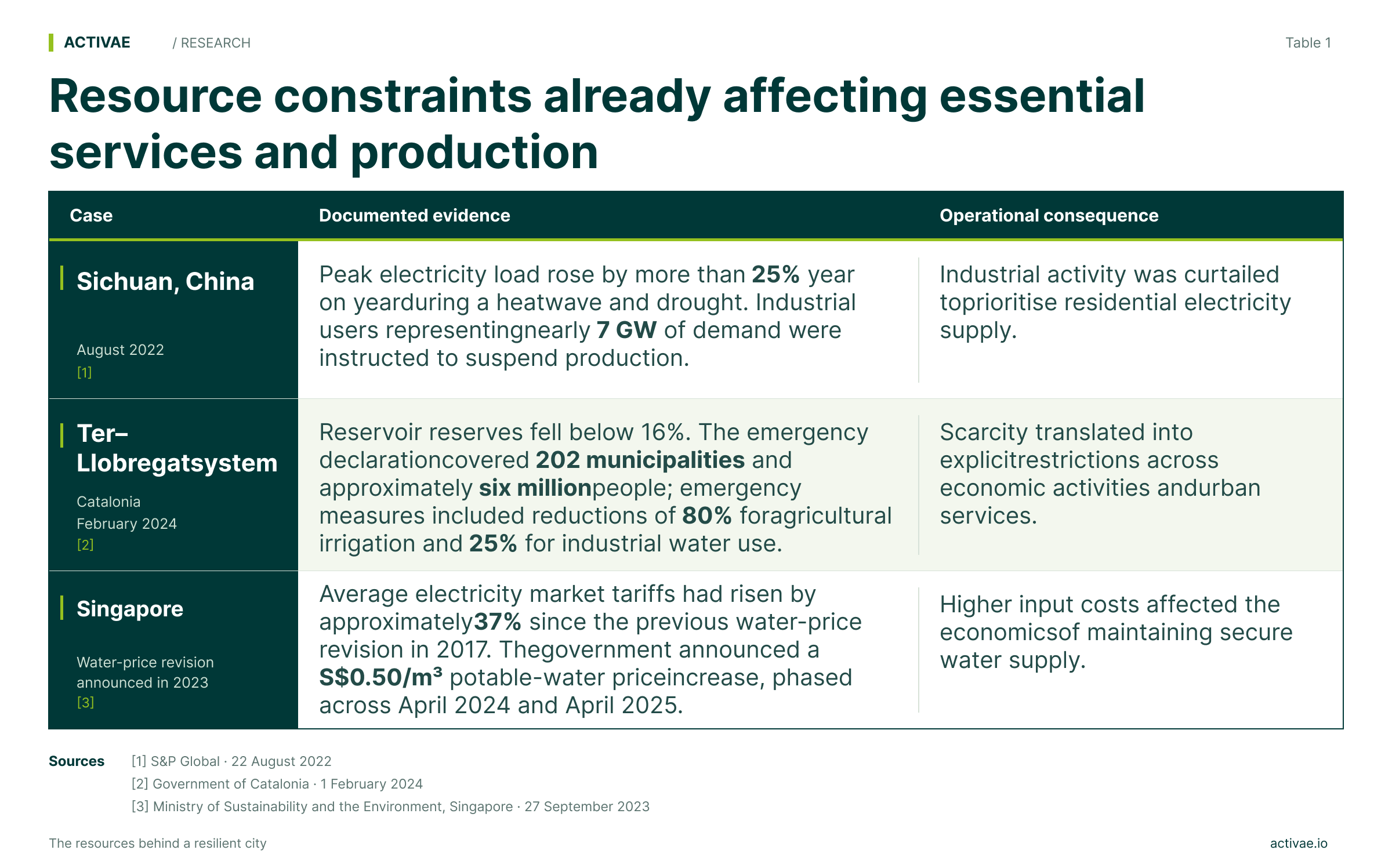
Sichuan: demand rose as supply came under pressure
Sichuan’s 2022 electricity shortage illustrates the importance of assessing supply and demand under the same weather conditions. Heat increased electricity requirements for cooling while drought constrained the province’s hydropower-dependent electricity system.
S&P Global’s contemporaneous analysis estimated that cooling accounted for 40–50% of power consumption during peak hours, compared with a usual share of 20–25%. Industrial production suspensions became part of the response to preserve residential supply.
The investment implication concerns correlated exposure. Cooling equipment and electricity generation can each meet their individual design specifications while the wider system faces a shortage. An assessment based on average electricity availability would miss the conditions under which protection is most needed: demand increasing precisely when a major source of supply becomes constrained.
Catalonia: scarcity changed the terms of resource access
Catalonia’s drought emergency demonstrates how resource availability becomes an allocation decision. The February 2024 measures imposed different reductions across irrigation, livestock, industry, and other uses. These were required reductions in water use; their percentages should not be interpreted as equivalent losses in production.
The agricultural consequences extended into decisions about preserving productive assets. An April 2024 emergency decree described risks to the survival of perennial crops and the potential need to remove immature fruit so that limited irrigation could sustain trees and protect future production.
This creates a distinction between a resource being physically present within a region and being available to a particular operation. A facility or producer may face tighter operating limits because allocation rules change during scarcity. For technology developers and investors, historical consumption and existing infrastructure therefore provide only part of the evidence needed to assess dependable access.
Singapore: securing water introduced a different cost exposure
Singapore illustrates how a successful strategy for reducing weather dependence also requires managing the cost of its supporting inputs. Its government identifies recycled NEWater and desalination as important sources of weather-resilient supply, while acknowledging that these sources are more energy-intensive and costlier to produce.
In announcing the 2024–2025 water-price revision, the government cited higher electricity costs alongside increases in construction, treatment chemicals, and maintenance expenses. Energy was one contributor within a broader increase in supply costs.
The analytical lesson is that diversification changes the composition of risk. Reducing dependence on rainfall can increase the importance of electricity procurement, process efficiency, and maintenance. A credible resilience assessment must examine whether the operating model remains affordable as those inputs change.
For cities, founders, and investors, these cases establish three dimensions to examine together: physical capacity under stress, dependable access under allocation rules, and the cost of maintaining service. A technology can improve one dimension while leaving another exposed. Its contribution to resilience depends on how these conditions interact across the services and productive territories it supports.

The illustration depicts two city skylines as human figures in motion. One cools itself with a handheld fan, while the other carries an umbrella for shade. Their building-shaped bodies and warm pink tones bring urban heat to life, portraying the city as a living system seeking relief and protection.
Where technology can ease resource constraints
The cases above point to four practical objectives: reduce unnecessary resource demand, recover useful inputs, make consumption more flexible, and diversify supply. Selecting the appropriate intervention starts with identifying the constraint limiting an essential service and establishing how the technology changes it.
Reduce the resources required to maintain service
In water networks, flow and pressure monitoring can identify abnormal consumption within defined areas, while acoustic sensors help locate escaping water. Connecting these capabilities to repair teams allows utilities to address physical losses and recover capacity within existing infrastructure. The operational value depends on completing that sequence: measurement, diagnosis, intervention, and verification.
Lisbon provides a documented example. Its water utility reports that district monitoring and active leakage control helped reduce non-revenue water from 23.5% in 2005 to 8% in 2015. This indicator includes more than physical leakage, so project evaluation should also track the volume of water recovered and the resulting change in abstraction and pumping requirements.
For technology developers, the opportunity lies in improving detection accuracy, locating failures faster, and helping operators prioritise repairs according to recoverable volume and service impact.
Recover useful resources from existing flows
Wastewater and organic residues contain recoverable energy. Anaerobic digestion uses microorganisms to break down biodegradable material and produce biogas, which can fuel electricity generation. Integrating this process with treatment infrastructure can reduce purchased electricity while providing a destination for suitable organic waste.
California’s East Bay Municipal Utility District combines sewage-derived material with food scraps, grease, and other organic waste streams. Its wastewater treatment plant became a net producer of renewable energy onsite in 2012. The utility reports approximately US$3 million in annual savings from reduced electricity purchases.
Replication requires assessing feedstock availability and composition, collection and transport costs, treatment capacity, and management of the remaining material. The investment case should establish how much usable energy the complete process delivers after its own operating requirements are met.
Make essential demand more flexible
Thermal energy storage allows cooling production and cooling consumption to occur at different times. Chillers cool water or produce ice when electricity conditions are favourable; stored cooling then serves buildings or processes during periods of higher demand. This reduces the coincidence between cooling requirements and electricity-system peaks.
The University of Texas at Austin combines chilled-water storage with forecasting and coordinated plant operation. The university reports a 5 MW reduction in peak electrical load from its optimisation efforts, which include dispatching cooling production and storage according to expected campus demand.
For a heat-exposed city, this approach can create operating room during critical hours. Evaluation should establish the achievable peak reduction, discharge duration, charging requirements, and electricity needed by pumps and controls. Storage must also be assessed against the length and timing of the disruption it is intended to address.
Diversify supply around the quality actually required
Water reuse creates an additional supply pathway by treating used water for subsequent applications. The required treatment depends on the receiving process: industrial production, cooling, and potable supply can demand different specifications and distribution arrangements.
Singapore’s NEWater system combines membrane filtration, reverse osmosis, and ultraviolet disinfection to produce high-grade reclaimed water. It supplies industrial and cooling applications through a dedicated network, including wafer fabrication plants with stringent water-quality requirements. This demonstrates how treatment technology and distribution infrastructure can connect an existing wastewater stream to dependable industrial demand.
The relevant comparison includes treatment energy, source-water availability, delivery infrastructure, and the freshwater withdrawals displaced. A diversified supply becomes more valuable when its supporting requirements remain manageable during the same conditions affecting the original source.
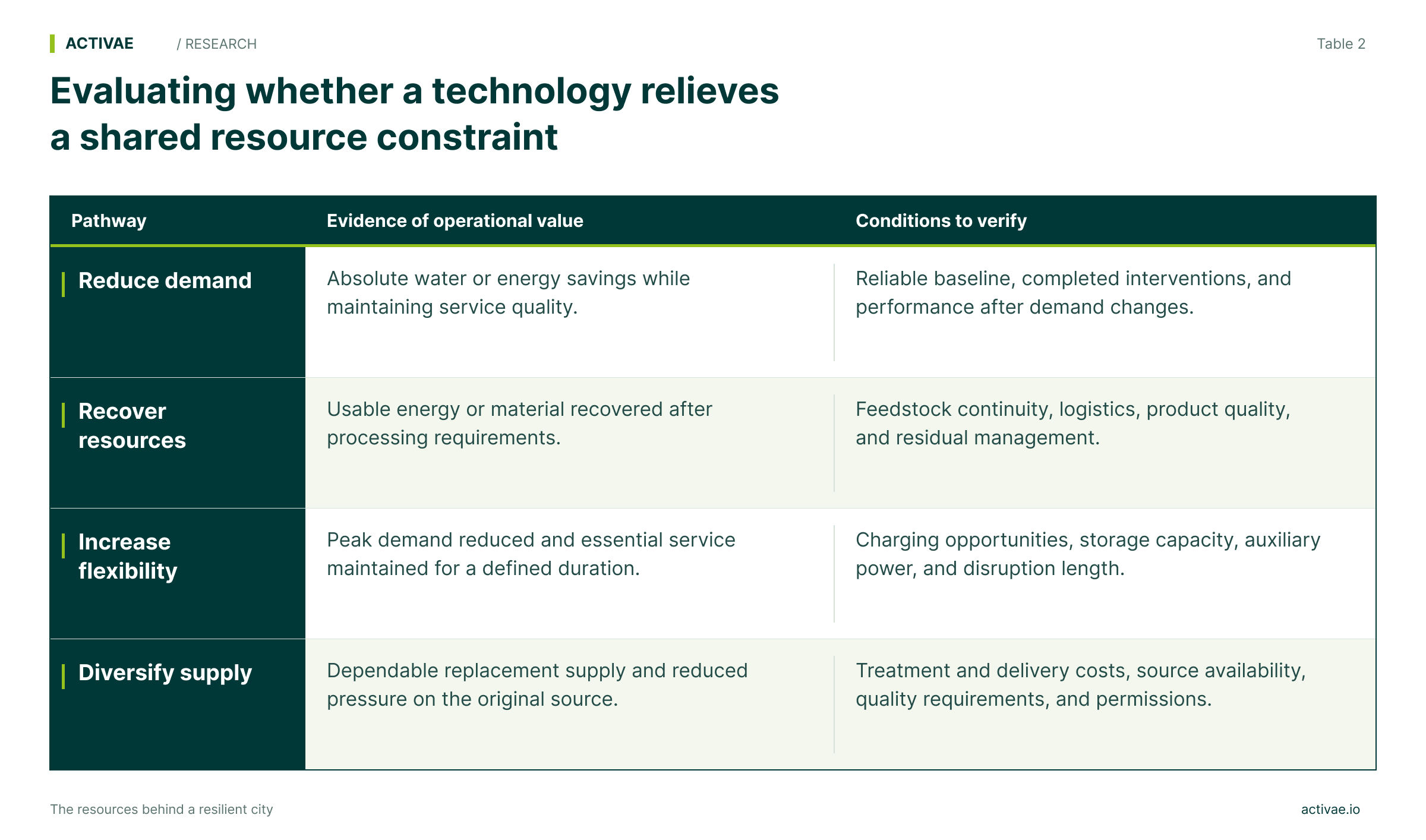
For DeepTech ventures, these pathways define opportunities for better sensing, separation materials, conversion processes, storage, and operational control. Their commercial relevance depends on demonstrating a measurable improvement at the point where a customer faces a resource constraint, supported by credible costs and performance under stressed conditions.
Resilience beyond the city boundary
The boundary used to evaluate an infrastructure project can conceal important dependencies. A city may improve the reliability of its own services while remaining exposed to declining resource availability in the territories supplying it. FAO’s City Region Food Systems programme addresses this wider geography by examining relationships between urban demand, rural production, infrastructure, and livelihoods.
These relationships have economic consequences beyond the immediate resource user. Catalonia’s April 2024 emergency decree described how reduced fruit production would affect agricultural employment, cooperatives, and associated processing and packing facilities. A restriction experienced at the farm level could therefore reduce activity across the organisations connecting production to markets.
For project appraisal, this suggests extending the assessment beyond savings within a single installation. Water reuse should be evaluated through its effect on withdrawals and the wider water balance. An alternative supply source should be assessed alongside other users’ requirements and its availability during scarcity. Resource recovery should account for the continuity of the waste streams on which it depends. These questions help establish whether an intervention reduces a shared constraint or changes where that constraint is experienced.
Agriculture becomes particularly relevant within this analysis. The continuity of urban food supply depends on producers’ ability to maintain output under changing resource conditions. Protecting that capacity requires examining the water, energy, land, and economic conditions supporting production, alongside the infrastructure connecting producers to consumers.
This creates a practical connection between urban resilience and agricultural innovation: technologies can create value wherever they help maintain productive capacity while reducing pressure on shared resources. Startups are developing capabilities across several of these points, from identifying water losses to recovering energy and enabling reuse.
Investing in resilience that holds under pressure
A credible urban resilience strategy must establish whether essential services can continue operating together when resources become constrained. That requires examining the combined demands of individual investments, their exposure to shared dependencies, and their effects on the territories sustaining supply.
For DeepTech developers and investors, the strongest evidence connects technical performance with dependable resource access, viable operating costs, and continuity of service. The relevant measure is the improvement a technology delivers under the conditions that challenge its customer most.
Food production brings these decisions into particular focus. Sustaining the territories that supply cities requires innovation capable of maintaining production as water availability, energy requirements, and environmental conditions change. Examining those productive conditions provides the next step in understanding where agricultural technologies can create lasting value.
Investing in resilience that holds under pressure
The next stage of urban resilience will depend on how effectively promising technologies become dependable parts of essential systems. Progress requires scientific capabilities, industrial needs, and capital to develop around a shared understanding of the resource constraints being addressed.
Our vision is for this evolution to connect technological ambition with a credible route to deployment. That begins with translating operational challenges into technical requirements, identifying relevant innovations, and defining the evidence needed to move them forward. Our contribution is to help founders strengthen their development and investment pathways, support investors in assessing technical and commercial assumptions, and work with industrial and research partners to build ventures around unmet needs.
The opportunity is to direct these efforts toward solutions that combine economic viability with measurable improvements in resource use and service continuity. Connecting urban demand with the capacity of supplying territories gives that work a wider purpose: preserving the conditions that allow communities and productive activities to remain viable as pressures change. Agriculture brings this relationship into focus, opening the next stage of inquiry into technologies that can sustain production while protecting the resources on which it depends.
References
-
Food and Agriculture Organization of the United Nations (FAO). (n.d.). Water–energy–food nexus. FAO
-
International Energy Agency (IEA). (2023). Clean energy can help to ease the water crisis. IEA
-
Kuzma, S., Saccoccia, L., & Chertock, M. (2023). 25 countries, housing one-quarter of the population, face extremely high water stress. World Resources Institute. World Resources Institute
-
Han, B., & Chia, C. K. W. (2022). Dual extremes led to severe power shortage in Sichuan, China. S&P Global Commodity Insights. The original URL currently redirects to S&P Global’s main Sustainable1 page. S&P Global
-
Generalitat de Catalunya. (2024, February 1). Emergency declaration for the Ter–Llobregat water system. Official announcement, also reproduced by the municipality of Sant Llorenç d’Hortons. Ajuntament de Sant Llorenç d’Hortons
-
Generalitat de Catalunya. (2024). Decree-law 5/2024, 24 April: Emergency support for the agricultural sector affected by drought. Boletín Oficial del Estado. boe.es
-
Ministry of Sustainability and the Environment, Singapore. (2023, September 27). Water price to rise from April 2024; Government to provide support for lower- and middle-income households. Ministry of Sustainability and the Environment
8. EPAL—Empresa Portuguesa das Águas Livres. (n.d.). WONE: Water optimization for network efficiency. Empresa Portuguesa das Águas Livres, SA
9. East Bay Municipal Utility District (EBMUD). (n.d.). Recycling water and energy. ebmud.com
10. U.S. Department of Energy. (2020). Combined heat and power technology fact sheet series: Thermal energy storage. energy.gov
11. University of Texas at Austin. (n.d.). Utility management progress report. Texas State Energy Conservation Office. comptroller.texas.gov
12. PUB, Singapore’s National Water Agency. (2024). NEWater. PUB, Singapore’s National Water Agency
13. Food and Agriculture Organization of the United Nations (FAO). (2023). Building sustainable and resilient city region food systems: Assessment and planning handbook. Rome. DOI: 10.4060/cc5184en. ruaf.org
Authors

Maria Lozoya
Associate emerging technologies
Related Posts

The interaction between microorganisms, soil, and crops
How microbial technologies support crop nutrition and what determines their…
Water stress in agriculture
Water constraints affect agricultural decisions well before a crop shows…
The invisible gap in Future Moblity
How devices, payments, data, identity systems, and algorithms are reshaping…