Deep Diving Into Water Resilience & Resource Security
Water is embedded in nearly every industrial system. It transfers heat, carries materials, enables chemical reactions, cleans equipment, controls dust, irrigates crops, supports mineral processing, and forms part of products ranging from food and pharmaceuticals to semiconductors. Its availability, quality, pressure, temperature, and chemical composition can directly influence production capacity.
Quality can be as limiting as quantity, semiconductor manufacturing requires ultrapure water with extremely low concentrations of ions, particles, organic compounds, and microorganisms. Food and pharmaceutical production depend on strict hygiene and quality standards, mining and metal finishing generate streams containing dissolved metals, salts, and process chemicals. Textile and chemical facilities may produce wastewater with colorants, persistent organics, or high chemical oxygen demand.
This makes water a strategic industrial input. A facility may have access to sufficient volumes while still facing operational constraints caused by salinity, contamination, seasonal variability, aging distribution infrastructure, or incompatible water quality. Water security depends on physical access, sufficient volume, suitable quality, and consistent delivery. It requires the capacity to deliver water with the characteristics required by each process, at the required location location, time, and cost, while managing what happens after it has been used.

Water is embedded in nearly every industrial system. It transfers heat, carries materials, enables chemical reactions, cleans equipment, controls dust, irrigates crops, supports mineral processing, and forms part of products ranging from food and pharmaceuticals to semiconductors. Its availability, quality, pressure, temperature, and chemical composition can directly influence production capacity.
Quality can be as limiting as quantity, semiconductor manufacturing requires ultrapure water with extremely low concentrations of ions, particles, organic compounds, and microorganisms. Food and pharmaceutical production depend on strict hygiene and quality standards, mining and metal finishing generate streams containing dissolved metals, salts, and process chemicals. Textile and chemical facilities may produce wastewater with colorants, persistent organics, or high chemical oxygen demand.
This makes water a strategic industrial input. A facility may have access to sufficient volumes while still facing operational constraints caused by salinity, contamination, seasonal variability, aging distribution infrastructure, or incompatible water quality. Water security depends on physical access, sufficient volume, suitable quality, and consistent delivery. It requires the capacity to deliver water with the characteristics required by each process, at the required location location, time, and cost, while managing what happens after it has been used.
Water systems resilience is strategic and their capacity to anticipate disruptions, absorb changing conditions, adapt operation, and recover functionality is fundamental. These include watersheds, reservoirs, aquifers, treatment plants, industrial facilities, distribution networks, monitoring platforms, and the regulatory structures that govern allocation and discharge.
The technology cluster emerging around water resilience addresses this complete system. It combines separation science, biotechnology, electrochemistry, advanced materials, sensing, hydrology, infrastructure engineering, and artificial intelligence to expand usable water supplies, protect water quality, reduce losses, and keep water circulating through the economy.
Water availability influences where industries can operate, how much they can produce, and which technologies they can deploy. The industrial sector accounts for just under 20% of global freshwater withdrawals, while agriculture remains the largest user. Industrial demand is concentrated in sectors that underpin wider economic systems, including power generation, manufacturing, mining, chemicals, food processing, textiles, and technology infrastructure. The International Energy Agency describes cost-effective water access and treatment as a factor in industrial competitiveness because water is used in fabrication, cooling, washing, dilution, and material transport. (IEA, U.S. Department of Energy)
The expansion of artificial intelligence is adding a new source of concentrated water demand. Data centers consume water directly through cooling systems and indirectly through electricity generation. In the United States, data centers consumed approximately 66 billion liters of water directly in 2023, while their indirect water footprint reached nearly 800 billion liters. Hyperscale facilities alone could consume between 60 and 124 billion liters directly by 2028. Because this demand is concentrated around specific facilities, its impact can be significant for urban water networks and water-stressed watersheds. Water availability, cooling technology, energy sources, and access to reclaimed water are therefore becoming central considerations in the expansion of AI infrastructure. Lawrence Berkeley National Laboratory, Forbes
The connection between water and production is especially visible when supply becomes unreliable. Reduced river flows can constrain thermal power generation, variations in water chemistry can affect manufacturing yields, insufficient process water can interrupt mineral refining, food production, hydrogen generation, and semiconductor fabrication. Flooding can damage treatment assets and contaminate sources, while drought can intensify competition among industrial, agricultural, municipal, and ecological users.
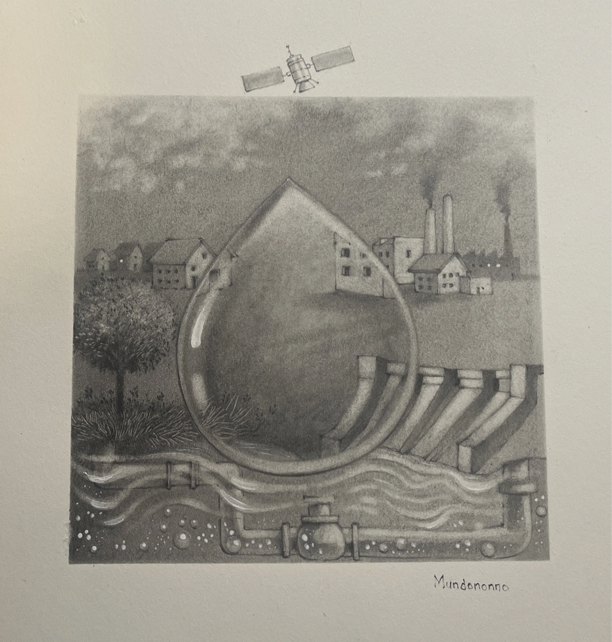
Each application therefore operates with a different definition of usable water.
This variability requires treatment systems designed around the characteristics of each water source and application. Each treatment train must account for source conditions, process requirements, local infrastructure, discharge regulations, energy availability, and opportunities for reuse. The objective is to manage water as a portfolio of qualities and flows, recognizing that each stream may support different uses, treatment pathways, and recovery opportunities.
What is Water Resilience & Resource Security?
Water Resilience & Resource Security is a technology cluster focused on maintaining reliable access to fit-for-purpose water while protecting the natural and engineered systems that provide it.
“Fit-for-purpose” means that water is treated to the quality required by a particular use. Cooling towers, irrigation systems, industrial boilers, cleaning processes, and drinking-water networks have different quality requirements. Matching treatment intensity to the intended use can avoid unnecessary energy consumption and make reuse more economically viable.
The cluster extends across the complete water supply chain.
Water must first be identified and accessed through surface water, groundwater, rainfall, seawater, brackish water, wastewater, or atmospheric moisture. It may then require treatment to remove particles, dissolved salts, microorganisms, nutrients, metals, or organic contaminants. Distribution infrastructure must move it while maintaining pressure and quality. After use, monitoring and treatment systems determine whether the resulting stream can be discharged, reused, or processed to recover energy and materials.
Natural infrastructure is part of this system: wetlands, soils, floodplains, forests, and aquifers regulate water storage, infiltration, filtration, and flood behavior. Engineered infrastructure—including reservoirs, pipes, pumps, membranes, reactors, sensors, and treatment facilities—modifies these flows to meet human and industrial requirements.
The technological ecosystem can therefore be understood through several interconnected functions: expanding supply, controlling quality, reducing demand, preventing losses, circulating water between uses, recovering resources, and improving visibility across the system.
Scientific and technological approaches
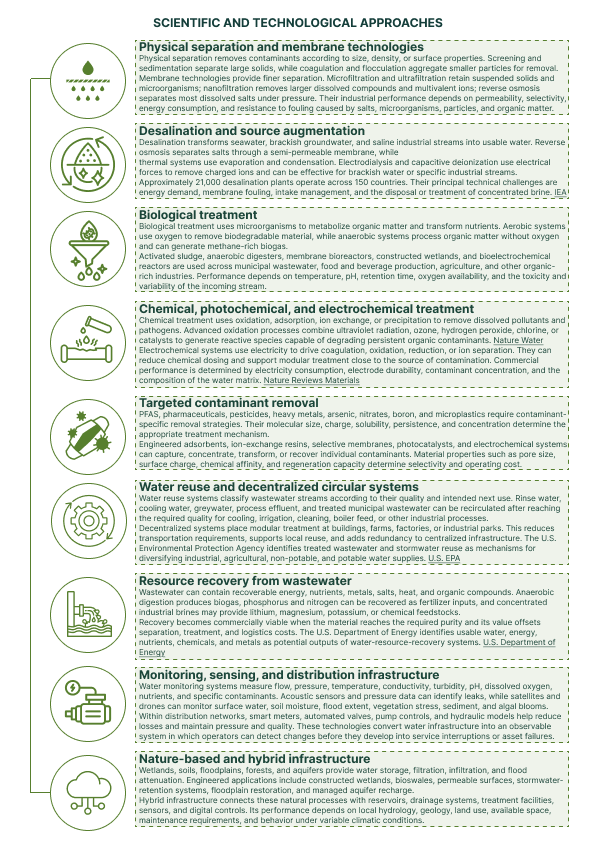
For educational and analytical purposes, we have segmented the Water Resilience & Resource Security cluster into subcategories representing distinct technological approaches across the water value chain. These categories cover water sourcing, treatment, reuse, resource recovery, monitoring, and distribution, although their boundaries remain permeable and many technologies operate across several parts of the system.
| SUBCLUSTER | DOCUMENTED USE CASE | TYPICAL BARRIERS TO SCALE |
|---|---|---|
| Physical separation and membrane technologies |
Orange County’s Groundwater Replenishment System uses microfiltration and reverse osmosis to help produce 130 million gallons of purified water per day. [1] | Membrane fouling and scaling; energy and cleaning demand; concentrate management; variable feedwater; long-duration validation. |
| Desalination and source augmentation | Singapore operates five desalination plants. Its reverse-osmosis systems use approximately 3.5 kWh per cubic meter of drinking water produced. [2] | High energy demand; brine disposal; membrane durability; marine impacts; capital intensity; permitting and long-term water-purchase agreements. |
| Chemical, photochemical and electrochemical treatment | Orange County uses ultraviolet light with hydrogen peroxide to treat trace organic compounds before groundwater recharge. [1] | Electricity and reagent demand; electrode or catalyst degradation; transformation products; sludge generation; performance in complex matrices. |
| Targeted contaminant removal | Yorba Linda operates a 25-million-gallon-per-day ion-exchange facility to remove PFAS from local groundwater. [4] | Very low contaminant concentrations; media breakthrough; competing compounds; analytical costs; spent-media management; evolving regulations. |
| Water reuse and decentralized systems | Singapore’s NEWater system treats wastewater through microfiltration, reverse osmosis and ultraviolet disinfection for industrial and indirect potable use. [5] | Fit-for-purpose standards; permitting; public acceptance; distribution infrastructure; variable inflows; customer contracts; asset integration. |
| Resource recovery from wastewater | DC Water converts sewage solids into biogas and soil products. Three 5 MW turbines provide about one-third of the electricity required at Blue Plains. [6] | Low resource concentrations; purification costs; product-quality requirements; uncertain offtake; commodity exposure; residual-waste management. |
| Monitoring, sensing and distribution infrastructure | Scottsdale Water deployed 293 acoustic sensors across 15 miles of pipeline, supporting repairs that saved an estimated 25,920 gallons per day. [7] | Sensor calibration and fouling; connectivity; false positives; legacy integration; cybersecurity; data ownership; limited repair capacity. |
| Nature-based and hybrid infrastructure | New York City’s Bluebelt program integrates wetlands and natural drainage corridors with conventional storm sewers across 16 watersheds. [8] | Land availability and ownership; permitting; variable performance; long-term maintenance; fragmented funding; limited benefit-measurement standards. |
Startups Shaping Water Resilience
The technologies described throughout this article are no longer confined to research laboratories or pilot projects. Around the world, a growing number of startups are translating advances in engineering, chemistry, biology, artificial intelligence, and digital infrastructure into commercial solutions that address some of the most pressing water challenges.
Rather than competing within a single market, these companies operate across different segments of the water value chain—from monitoring and treatment to reuse, resilient infrastructure, precision irrigation, and decentralized water systems. Together, they illustrate how Water Resilience & Resource Security is evolving into a diverse technology ecosystem where multiple scientific approaches converge to improve the availability, quality, efficiency, and reliability of water resources.
The following examples highlight just a small selection of the companies contributing to this rapidly expanding ecosystem:
Physical separation and membrane technologies
ZwitterCo develops membranes based on zwitterionic chemistry for streams with high organic content. The membrane surface attracts a tightly bound layer of water that helps resist organic fouling. Its applications include industrial wastewater, food processing, bioprocessing, and the recovery of water or products from complex process streams.
Desalination, brine management, and resource recovery
Membrion develops electro-ceramic desalination systems that use ceramic ion-exchange membranes to separate dissolved salts and metals from industrial wastewater. Its approach is designed for concentrated or variable streams found in semiconductor manufacturing, metal finishing, food production, and other industrial processes.
Desalination, brine management, and resource recovery
Gradiant develops integrated industrial-water systems spanning desalination, high-recovery reverse osmosis, brine concentration, resource recovery, ultrapure water, and digital optimization. Its counterflow reverse-osmosis platform recovers water from concentrated streams and reduces the treatment demand placed on thermal zero-liquid-discharge systems.
Biological and bioelectrochemical treatment
Aquacycl applies bioelectrochemical technology to high-strength industrial wastewater. Its systems use electrogenic microorganisms to break down organic matter while generating an electrical signal that supports the monitoring of biological performance. This creates a modular treatment pathway for food, beverage, agricultural, and other organic-rich streams.
Electrochemical treatment
Indra Water uses modular electrochemical reactors to treat industrial wastewater close to its point of generation. Its systems target surfactants, dyes, metals, pathogens, nutrients, hydrocarbons, and organic matter. The treated water can be directed toward cooling, irrigation, boilers, and other industrial processes.
Targeted contaminant removal
Puraffinity engineers adsorbent media specifically for PFAS removal. Its technology applies materials designed around the chemical properties of this contaminant family. Applications include municipal water, industrial wastewater, landfill leachate, and groundwater remediation.
Water reuse and decentralized systems
Epic Cleantec develops onsite water-reuse systems for buildings. These systems collect and treat wastewater within a property so it can be reused for non-potable applications, including irrigation, toilet flushing, and cooling. Its approach connects water circularity with building design and distributed urban infrastructure.
Digital water infrastructure and network management
FIDO Tech applies artificial intelligence to acoustic and operational data from water-distribution networks. Its models help utilities identify, locate, and estimate the scale of leaks, allowing repair activity to be prioritized according to potential water savings.
Precision irrigation and watershed management
Kilimo combines satellite data, weather information, crop models, and artificial intelligence to support irrigation decisions. Its model connects agricultural water efficiency with corporate water-stewardship projects and coordinates action among farmers, companies, and watershed stakeholders.
Water technologies frequently emerge from specialized research in materials science, electrochemistry, microbiology, data science, environmental engineering, or hydrology. Translating that research into an industrial solution requires alignment across several dimensions. Activae helps ventures assess their maturity through different lenses. We work on understanding the technology readiness level, and go far beyond this dimension by assessing customer and market readiness (mention the rest) that help investors to assess the risk and real status of solutions.
A technology may perform effectively in controlled experiments while still requiring validation in variable industrial streams, long-duration operation, integration with existing assets, regulatory acceptance, reliable component supply, and a commercial model that fits infrastructure procurement cycles.
We also work with investors, corporates, and public institutions to understand where technologies sit within the larger water system. This includes mapping emerging approaches, identifying industrial applications, evaluating scale-up constraints, analyzing adoption pathways, and connecting technical capabilities with specific operational needs.
The objective is to establish how a technology creates value within a real water system: what stream it treats, which performance threshold it must reach, what infrastructure surrounds it, who makes the purchasing decision, and how its deployment changes the economics and resilience of the wider operation.
Water Resilience & Resource Security brings together technologies that increase the visibility, flexibility, and circularity of water systems. Its scope reaches from membranes, microorganisms, electrodes, and adsorbent materials to industrial facilities, digital networks, watersheds, and regulatory systems.
Understanding this ecosystem also reveals a broader principle for ClimateTech: technological performance depends on the systems that supply inputs, absorb outputs, coordinate infrastructure, and enable adoption. The next Deep Dive will continue exploring these connections through another technology cluster shaping the industrial foundations of climate resilience.
References
[1] Orange County Water District, Groundwater Replenishment System
[2] PUB Singapore, Desalinated Water
[3] Aquacycl, PepsiCo wastewater treatment case study
[4] Orange County Water District, Yorba Linda PFAS treatment facility
[5] PUB Singapore, NEWater
[6] DC Water, Thermal Hydrolysis and Anaerobic Digester Project
[7] FIDO Tech, Scottsdale Water leak detection case study
[8] New York City DEP, Bluebelt Program
Authors

Maria Lozoya
Associate emerging technologies

Diego Santamaria Razo
Managing Director
Related Posts

The interaction between microorganisms, soil, and crops
How microbial technologies support crop nutrition and what determines their…
Water stress in agriculture
Water constraints affect agricultural decisions well before a crop shows…
The resources behind a resilient city
Consider a city preparing for hotter, drier summers. Its water…