
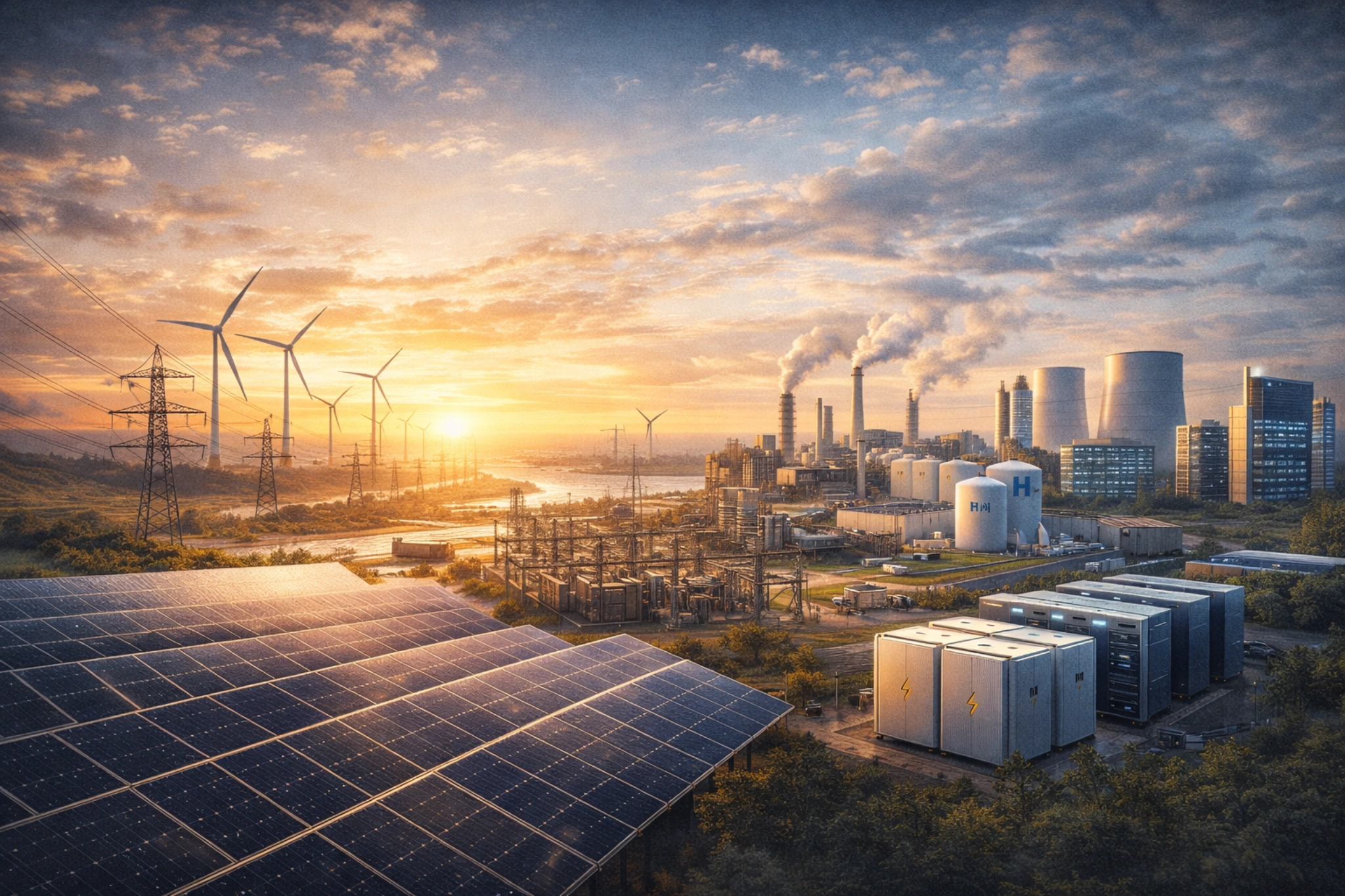
From Technology Race to System Coordination: How Energy Innovation Organizes Around Clusters
For years, the energy transition was framed as a technological race: more efficient solar panels, larger wind turbines, better batteries, smarter grids. Innovation was assumed to be the primary bottleneck. Today, that assumption no longer holds.
Core technologies across regions have matured, capital to develop is available, and policy makers are realizing of the need of new frameworks. What is certain is that demand for electrification continues to rise, driven by digital infrastructure, industry, and mobility — However deployment continues to stall in critical areas. Projects wait years for grid connection, storage struggles with bankability, industrial decarbonization depends on infrastructure that does not yet exist, and generation capacity is built faster than it can be integrated.
Systems are becoming more electrified, more capital-intensive, and more interdependent. Electricity, hydrogen, heat, carbon transport, digital control systems, and industrial processes must operate in synchrony. When they do not, value is lost through congestion, curtailment, volatility, and stranded assets.
If bottlenecks emerge at the interfaces of the system, technologies cannot be assessed in isolation, they must be grouped according to the systemic function they collectively enable.
Rather than listing technologies by discipline or maturity, we organize them into functional clusters. Each cluster concentrates innovation around a specific system constraint — whether in materials security, generation reliability, storage economics, industrial heat, circularity, or digital control. Together, they reveal where technologies must evolve in coordination to unlock deployment at scale.
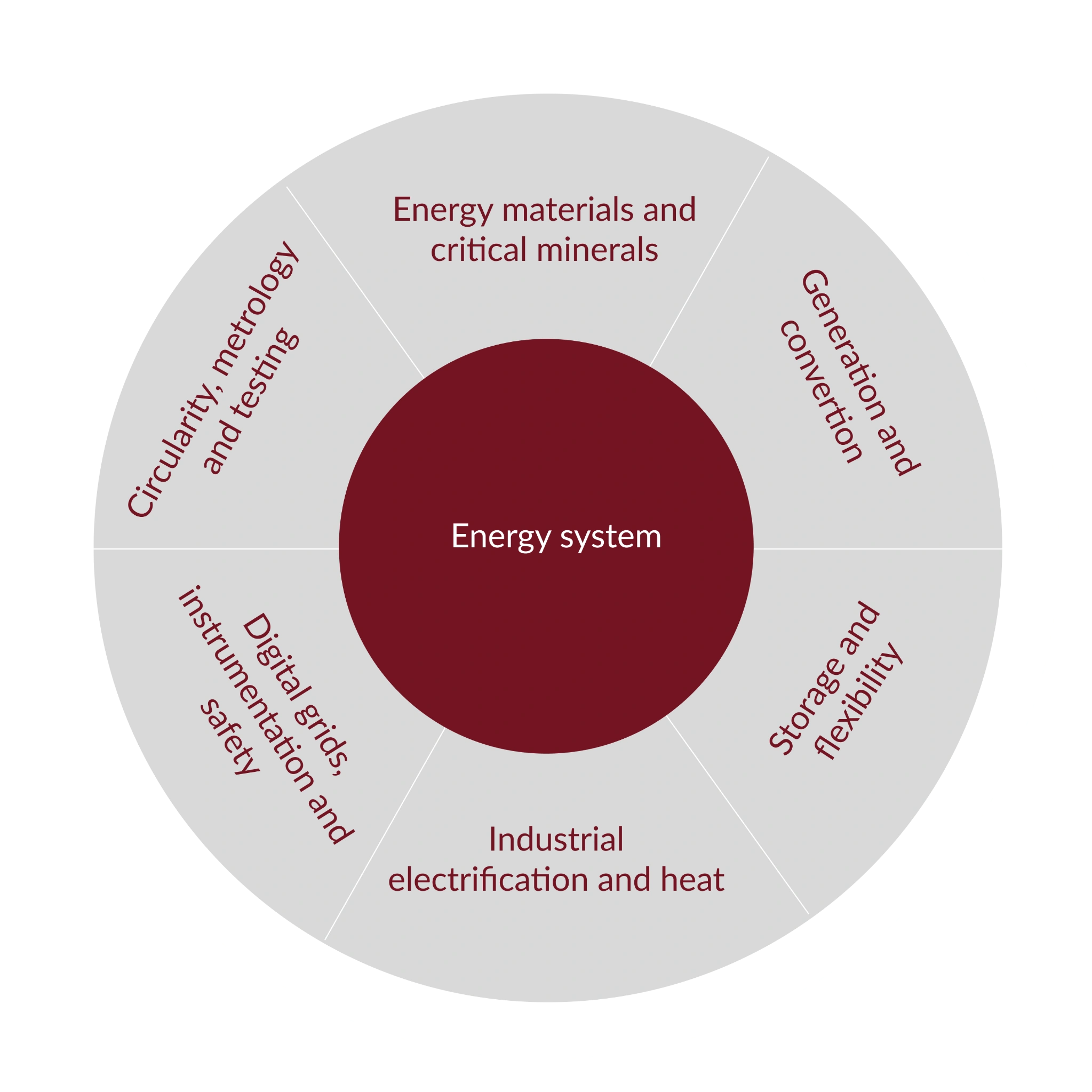
1. Energy Materials & Critical Minerals
This cluster secures the physical foundations of the transition. Every battery, turbine, electrolyser, cable, and semiconductor depends on critical minerals and advanced materials. Innovation here focuses on substitution chemistries, advanced extraction and refining processes, magnet and battery recycling, traceability, and material efficiency.
Without resilient materials supply chains, no downstream technology can scale.
2. Generation & Conversion
This cluster transforms inputs into usable energy carriers: electricity, oil, gas, hydrogen, heat, among other fuels and energy sources.
Technologies span advanced photovoltaics, offshore wind systems, electrolysers, high-temperature heat solutions, and emerging nuclear platforms. The challenge is technical feasibility, permitting speed, capital intensity, supply-chain depth, and integration with grid infrastructure.
Generation must scale in coordination with the system around it.
3. Storage & Flexibility
Variable renewables require balancing mechanisms. Storage and demand-side flexibility replace fossil backup and stabilize increasingly electrified systems. This cluster includes batteries, long-duration storage, thermal storage, hydrogen storage, virtual power plants, and digital flexibility orchestration. Also in this space innovation is finding new ways of storing energy.
Its bottleneck is often not chemistry, but market design and bankability.
Without flexibility, clean megawatts become curtailed megawatts.
4. Industrial Electrification & Heat
Competitiveness materializes at the point of use. Industry, buildings, transport, and digital infrastructure must convert energy into productive output.
High-temperature heat pumps, electrified furnaces, green steel processes, hydrogen applications, district heating, and charging infrastructure define this cluster. The challenge lies in cost gaps, retrofit complexity, and infrastructure readiness. Decarbonization is only meaningful if it preserves industrial viability.

Abismo, the Monster of Disconnection — a creature that prevents energies from coming together
5. Digital Grids, Instrumentation & Safety
As systems become more interconnected and capital-intensive, digital control and real-time coordination become critical. This cluster covers grid-forming inverters, state estimation software, digital twins, advanced metering, cybersecurity, congestion management, and hydrogen/CO₂ network monitoring.
The constraint has shifted from building capacity to managing complexity, now digitalization transforms infrastructure from static assets into dynamic and integrated systems.
6. Circularity, Metrology & Testing
Scaling deep-tech energy systems requires validation, certification, and safety assurance.
Testing facilities, hardware-in-the-loop grid systems, hydrogen safety labs, battery certification platforms, and measurement standards are foundational yet often overlooked enablers.
Without trusted validation environments, technologies struggle to become bankable.
This cluster anchors credibility and long-term system resilience.

“Energies in the Making.” Each of the players represents a different form of energy. The ball symbolizes the possibility of playing as a team, yet each one seems to run in a different direction.
Generation capacity can expand rapidly, but without grid reinforcement and flexibility markets, curtailment increases. Storage technologies can mature technically, yet without regulatory reform, they remain financially constrained. Industrial electrification can be engineered, but without predictable power prices and infrastructure headroom, final investment decisions stall.
Materials innovation without circularity deepens dependency. Digital grids without physical reinforcement amplify congestion visibility without solving it. Hydrogen production without midstream infrastructure creates stranded assets.
For founders, this means that technical excellence alone is insufficient, positioning within the system determines capital access, regulatory exposure, and time-to-scale. For investors, risk no longer sits only in technology maturity, but in infrastructure readiness and policy alignment.
Energy systems are entering a phase where scale is determined less by invention and more by coordination.
Electrons, molecules, materials, and digital control must operate as an integrated architecture because when one layer advances faster than another, friction accumulates: congestion, stranded assets, price volatility, and lost competitiveness. The six clusters outlined here describe the structural capabilities required to prevent that friction.
In the New Joule Order, competitiveness will belong to those who can orchestrate these functions coherently — aligning infrastructure, capital, regulation, and technology into a synchronized whole.
This is precisely where Activae operates.
By analyzing regional constraints, mapping supply chain dependencies, and aligning technological potential with industrial and financial execution, we help founders, investors, and institutions move from isolated innovation to system-level impact. Our role is not to add complexity to the ecosystem, but to clarify positioning — identifying where a venture sits within the system, what bottlenecks shape its path to scale, and which strategic alliances are required to unlock deployment.
In the following articles, we will explore each cluster in depth — examining the most relevant technological pathways, structural barriers, and strategic opportunities within the global context.
In a transition defined by system constraints, clarity of position becomes a decisive advantage.
Authors

Maria Lozoya
Associate emerging technologies

Diego Santamaria Razo
Managing Director
Related Posts

Advanced Materials and Critical Minerals: The Supply Chains Powering the Energy Transition
Following the narrative developed throughout this energy series, we established…

From a global challenge to local bottlenecks
As global energy demand continues to rise, energy infrastructure is…
Energy in a Changing Global System: Infrastructure, Materials, AI, and Innovation
The global energy system is undergoing a structural redesign, driven…