

From a global challenge to local bottlenecks
As global energy demand continues to rise, energy infrastructure is being pushed to expand at faster than it can grow. At first glance, the challenge appears universal. Decarbonising supply and finding new energy sources, electrifying demand, and replacing fossil fuels with cleaner alternatives are shared objectives across regions. In practice, however, the energy transition does not fail or succeed at a global level. It does so locally, where physical systems, markets, and institutions interact under very different constraints.
The global energy system remains deeply shaped by legacy infrastructure. According to the International Energy Agency, close to two thirds of global electricity generation still relies on thermal power plants fuelled primarily by coal, gas, and oil.(1) These figures, however, conceal a more decisive reality. What matters is not the global mix itself, but how each energy source is embedded within regional systems, and how those systems respond under stress.
Natural gas illustrates this divergence clearly. In some regions it functions as a transitional fuel that supports system flexibility. In others it represents a long term structural dependency that exposes economies to price volatility and geopolitical risk.(3) Hydropower provides stable and low carbon electricity where geography allows, yet remains inaccessible in many regions regardless of policy ambition.(1) Wind and solar capacity have expanded rapidly across markets, but their contribution to reliable supply depends far less on installed capacity than on land availability, grid headroom, storage, and the ability of the system to manage variability.(2)
These distinctions matter because energy systems are constrained by context rather than technology alone.(4) What appears as an energy shortage in one region may in fact be a grid constraint in another. In some cases, generation capacity exists but cannot be connected within meaningful timeframes. In others, infrastructure is technically available but relies on fragile supply chains for critical materials, components, or equipment.(2) Elsewhere, technology and assets are in place, yet scaling remains limited by permitting delays, access to long term capital, specialised operational talent, or the absence of market structures that make projects bankable.(6)
Recent developments highlight these dynamics with particular clarity. In the United Kingdom, large volumes of renewable projects remain stuck in grid connection queues, with delays extending over many years and in some cases more than a decade.(5) In the Pacific Northwest of the United States, electricity demand has risen sharply as data centres expanded rapidly, while generation and grid infrastructure failed to keep pace.(7) Despite policy support and the availability of low carbon technologies, the region has been forced to rely on costly electricity imports during periods of peak demand. Prices have increased significantly and the risk of supply disruptions has grown.(8) These situations did not emerge because the transition was technically unfeasible. They emerged because system constraints were not anticipated or addressed early enough.

A central driver of these bottlenecks is the mismatch between how energy systems are built and how demand evolves. Infrastructure such as grids, pipelines, substations, and storage assets is planned, financed, and deployed over decades.(9) Demand, by contrast, can change within a few years or even months, driven by electrification, industrial relocation, or the rapid growth of digital infrastructure such as data centres and AI workloads. Policy cycles, investment horizons, and permitting processes operate on different timelines again. When these rhythms fall out of sync, congestion, delays, and price volatility arise even when sufficient capacity appears to exist on paper.(5)
I explore the idea of a cluster as a composition of incomplete elements that only gain meaning when brought together. Each figure holds a different component of light — one carries the flame, another the candle, another the lantern. None of them alone can provide sustained illumination. It is only through their coexistence and interaction that light becomes service, that energy becomes usable. The painting reflects the notion that systems are built through complementary roles, where collaboration, rather than isolation, transforms potential into function.

I chose a simpler composition and a style slightly different from my usual work, as I felt the idea did not require excessive visual elaboration. The juggler represents the world, or contemporary societies, already holding multiple sources of energy in their hands. However, much like the not yet fully controlled movement of the juggling pins, these energy sources are not yet managed in a coordinated or harmonised way. The image reflects a system in transition — one where the elements are present, but balance, rhythm, and integration are still being learned.
Incentive structures add another layer of friction. Energy markets have historically rewarded electricity production rather than system integration, flexibility, or resilience. Grid operators are regulated to prioritise reliability and cost efficiency, not to anticipate sudden demand shocks or proactively overbuild capacity.(10) Utilities, developers, and technology providers optimise within their own mandates, while responsibility for system wide coordination often remains diffuse. As a result, persistent problems at critical interfaces, such as between generation and the grid or between infrastructure and markets, remain unresolved because no single actor is structurally rewarded for solving them.
The difference between standalone performance and system performance makes this especially visible. Solar photovoltaics can perform extremely well in isolated or off grid settings where generation, storage, and consumption are tightly aligned. When deployed at scale in grid connected systems, the same technology can contribute to instability through intermittency, bidirectional power flows, and steep ramping requirements. The limitation lies in the system’s ability to absorb, balance, and operate the technology reliably rather than in the technology itself.
Taken together, these patterns point to a deeper structural reality. The energy transition is increasingly constrained by coordination rather than invention. Modern energy systems involve many specialised actors, including technology providers, asset owners, grid operators, regulators, and investors, each optimising a specific part of the system. No single entity fully owns performance from end to end. When coordination across infrastructure, markets, operations, and talent is insufficient, even mature and proven technologies struggle to scale.
This explains why the transition breaks in different ways across regions. In some places, grid capacity is the dominant constraint. In others, access to affordable firm power, critical materials, operational capability, or bankable contractual structures plays a more decisive role. Understanding these local bottlenecks is essential to identify where systems must be reorganised for the transition to move forward, and therefore which technology developments are relevant and can find a fertile reactive ecosystem. Once the unmet market or systemic need is identified, technology developers can integrate with less friction. These recurring constraints, concentrated in specific locations and at key interfaces of the energy system, ultimately determine where value is created and where opportunity will take shape next.
Beyond physical infrastructure and market design, there is a less visible but equally decisive constraint shaping the energy transition: how talent is organised and mobilised. The challenge is not a lack of capable people. Across the ecosystem, engineers, researchers, founders, and operators are developing technologies, running pilots, and advancing solutions. The bottleneck emerges at the interfaces, where technologies must be integrated into real systems and moved from isolated success to reliable operation at scale. What is scarce are the capabilities that connect disciplines, translate technical performance into system reliability, and align engineering, regulation, finance, and operations within a single execution pathway. Without environments that allow these competencies to meet and compound, infrastructure remains underutilised, markets remain theoretical, and supply chains fail to close. In this sense, talent functions as an invisible form of infrastructure. Its availability, circulation, and coordination determine whether energy systems can adapt and scale, and whether innovation can ultimately deliver system-level impact.
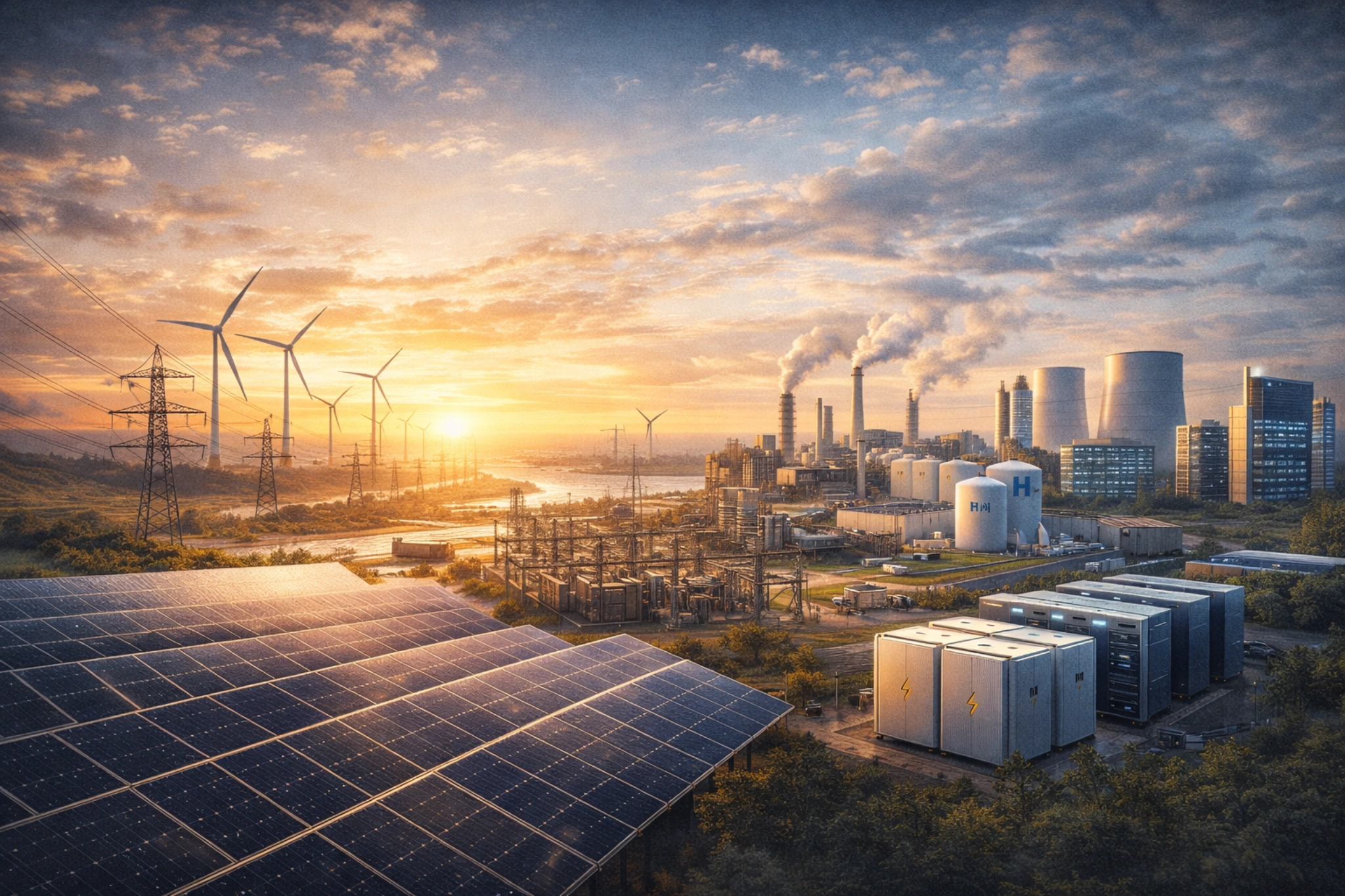
Against this backdrop, the question is how interdependent technologies are being configured to overcome structural constraints. In practice, this reconfiguration is taking place through technology clusters.
These clusters are functional groupings of technologies that interact to solve specific system bottlenecks. They bring together complementary solutions across hardware, software, infrastructure, materials, and market design around a shared constraint — whether that constraint sits in generation, grids, storage, industrial heat, flexibility, or integration.
Clusters matter because no single technology scales in isolation. Grid-scale renewables require storage and flexibility. Hydrogen depends on electrolysis, transport infrastructure, offtake markets, and regulatory alignment. Industrial electrification relies on power availability, heat technologies, and market incentives. By grouping technologies according to the system functions they collectively enable, clusters reveal where coordination is required and where value is created.
The logic of clustering becomes clearer when viewed through real-world system behaviour. Across regions, recurring bottlenecks are driving different structural responses. By examining a small number of contrasting contexts, it becomes possible to see how infrastructure gaps, material dependencies, and institutional capacity shape the trajectory of the transition.
Although the pressure of rising energy demand is global, the friction beneath deployment is highly local. The following examples show how similar demand trajectories encounter different structural constraints, making system reorganization inherently context-specific:
1. Pakistan: Solar Adoption Surging Where the Grid Struggles
In Pakistan, repeated power outages, rising tariffs, and an under-resourced national grid have pushed households and businesses to adopt solar plus battery systems rapidly. As a result, in industrial hubs such as Lahore, Faisalabad, and Sialkot, rooftop solar generation is projected to exceed grid demand during daytime hours, a phenomenon driven more by necessity than strategy. This boom reflects the fact that behind-the-meter solar is offsetting consumption from the aging and unreliable grid, creating periods of negative grid-linked demand and reshaping how electricity is produced and used. This local logic — energy generated where it’s consumed without reliance on a weak grid — illustrates how structural grid weaknesses steer investments toward ultra-localized solutions, and underscores the need for systemic coordination rather than isolated technology deployment. (11)
2. Mexico: Resource Potential Bottlenecked by Infrastructure
Mexico sits atop one of the world’s largest known lithium deposits in the state of Sonora, giving it the theoretical potential to become a strategic source of a material critical for energy storage and electric mobility. Yet despite this geological advantage, the Sonora Lithium Project has faced complex socio-environmental challenges, regulatory gaps, and delays that reflect broader weaknesses in industrial infrastructure and governance.
This gap between resource potential and industrial execution demonstrates that critical natural assets alone do not translate into competitive value without the supportive infrastructure, supply chain linkages, and institutional frameworks necessary to bring extraction and processing online. (12)
3. Europe: Advanced Systems Constrained by Material Dependencies
Europe’s energy landscape looks very different. Here, grid infrastructure and talent pools are well developed, and many countries have made substantial progress on renewables deployment and electrification. However, Europe lacks domestic supplies of critical raw materials such as lithium and rare earth elements, relying heavily on imports for these inputs essential to battery production and clean technologies. In response, the EU has adopted comprehensive strategies such as the RESourceEU Action Plan and the Critical Raw Materials Act, aimed at securing diversified supplies, strengthening domestic value chains for raw materials, and reducing strategic dependencies. (EC Press Corner) These policies highlight how a region with strong systems can still face structural barriers because material supply chains are global and fragmented, requiring strategic coordination beyond national or regional borders. (13)
Rising energy demand alone does not determine the trajectory of the transition; the defining variable is how clearly regional constraints are identified and how deliberately infrastructure, industry, and technology are reorganized in response.
Progress does not depend on deploying more solutions in isolation, but on understanding how each solution interacts within the broader system. Grid capacity, industrial demand, storage economics, regulatory design, and capital structures do not evolve independently. They shape one another. Where these interactions are acknowledged and sequenced coherently, deployment stabilizes. Where they remain fragmented, projects stall.
For founders, investors, corporates, and public institutions, the implication is structural. Success depends not only on technological strength, but on positioning within the system — on knowing where a solution reduces friction, how it interacts with adjacent layers of the value chain, and whether the surrounding infrastructure can sustain its scale.
At Activae, we operate at this intersection of technology and system readiness. By examining regional constraints, supply chain interdependencies, and infrastructure sequencing, we help align innovation with the industrial and financial conditions required for deployment. In a transition defined less by technological scarcity and more by coordination risk, clarity of system positioning becomes a decisive advantage.
References
1 International Energy Agency, World Energy Outlook 2023
2 International Energy Agency, Electricity 2024
3 International Energy Agency, Gas Market Report
4 International Energy Agency, Energy System Integration
5 National Grid ESO; Ofgem, Connection Queue Reform
6 European Commission, REPowerEU
7 Bonneville Power Administration, Load Forecasts and Resource Program
8 Oregon Public Broadcasting, Northwest energy shortages and prices
9 European Court of Auditors, Permitting delays in energy infrastructure
10 International Energy Agency, Reforming Electricity Markets for Renewables
11 Reuters (2025). Pakistan says rooftop solar output to exceed grid demand in some hubs next year. Reuters.
12 ResearchGate (2023). Lithium Nexus: Energy, Geopolitics and Socio-Environmental Impacts in Mexico’s Sonora Project. ResearchGate.
13 European Commission (2025). Commission strengthens EU action on critical raw materials. European Commission Press Corner.
Authors

Maria Lozoya
Associate emerging technologies

Diego Santamaria Razo
Managing Director
Related Posts

Advanced Materials and Critical Minerals: The Supply Chains Powering the Energy Transition
Following the narrative developed throughout this energy series, we established…
From Technology Race to System Coordination: How Energy Innovation Organizes Around Clusters
For years, the energy transition was framed as a technological…
Energy in a Changing Global System: Infrastructure, Materials, AI, and Innovation
The global energy system is undergoing a structural redesign, driven…